CI Travel's
Business Travel News You Can Use
December 15, 2010
|
|
|
|
|
|
| Greetings! | 
Hello Everyone! As 2010 comes to a close there is a lotof news coming out of the airline and hotel sectors in December.
Airlines are making a bundle on ancillary fees and now appear to be cutting back on the "free" complimentary upgrades into their premium clubs for your executive travelers. There are also several suites against the carriers for lost luggage. Your find out more aoubt these programs and their portential consequences in the Airline Section.
Secondly, see the news on hotels and their 2011 negotiating status. After the last few years of being able to ask for unlimited upgrades, etc - it's now becoming moe difficult to get these perks put into contracts. Looks like we are switching over from a buyer's market to a seller's market. Found out how you can protect yourself and your company in the reports on lodging and cars.
In 2011 we will be introducing several new programs to help improve communications from the world of travel. Seems like everything moves so fast, so since you need up to date info, we'll be prodivig you this in the form of Intelligent Reports. Thank you for your trust in us! If you aren't working with C I Travel Management yet, ask yourself - Why Not? You've got everything to gain. Chris Nicholas P.S. - if you have a question or a suggestion for an article, please email me! |
|
|
|
Let it Snow, Let it Snow, Let it Cancel Your Flight - Who Ya Gonna Call?
|  A Winter Wonderland - Land of Confusion
Editor's Note: Sever weather across the North Central and North East Sections of the country caused thousands of cancellations this weekend. Here's one story you should read..Who should you be working with? Monday Morning - Snow Storm
Monday morning I picked up the phone to call Delta Air Lines as a messy snow storm was reeking havoc in the Midwest. I was amazed to hear a recording tell me that Delta was busy, call back later and they immediately hung up on me. Can you imagine how that felt if you were a traveler with a canceled flight to receive that recording? If you did not book your reservation using a travel agent you might have to spend hours and hours on the phone. One of the great advantages of using a travel agency to make your reservations is to be able to have them assist you when these types of issues arise. On Sunday our office reviewed hundreds of itineraries of business travelers planning to depart for travel on Monday. We rescheduled many agents to start work early Monday morning in anticipation of much higher phone volume caused by the storm. We also contacted the airlines to find out the new rules they implemented to deal with the storm. This proactive approach allowed out agents in many cases to be able to re-accommodate travelers whose flights were canceled. Using a travel agency really is smart business.
Nothing beats having an experienced corporate travel consultant on your side when a flight is delayed or cancelled. It's one of the reasons we arre here - CALL US! Program us into your phone. 888-461-0022 just as soon as you get the message.
|
| Risk Management | Security | U.S. Government |

Indianapolis councilman urges switch to private screeners
A city-county councilman in Indianapolis wants to replace the Transportation Security Administration with a private security agency at the Indianapolis International Airport. Ed Coleman has proposed a resolution that would urge airport officials, who have the authority to make the decision, to switch to a private company. However, John Clark, the Airport Authority's executive director, said he did not think that replacing the TSA with a private firm would improve the screening process.
You may not realize it but there are many airports in the US who hired private companies to do the screening instead of using TSA agents. The largest airport to have done this is San Francisco.
John L. Mica (R-Fla.), ranking Republican on the House Transportation and Infrastructure Committee, is urging the 100 busiest airports to consider switching to private security companies in place of the Transportation Security Administration. TSA would continue as the regulating agency overseeing hands-on screening operations.
It "was never envisioned that [the TSA] would become a huge, unwieldy bureaucracy," he added in a common letter, soon to go to 67,000 employees. One of the authors of the public law that created the TSA, Mica has long regarded the agency's role as a regulator, rather than a hands-on screening operation, his aviation subcommittee aide said Thursday.
"It is both inappropriate and inefficient for the TSA to serve as the administrator, quality assurance regulator, operator and auditor of its own activities," Mica wrote.
San Francisco International and Kansas City International airports hire private screening companies under the Screening Partnership Program set up under the public law that allows airports to opt out of federal screening. A total of 17 airports have taken that course, and airports in Montana are seeking to exercise the opt-out provision. The board of directors of Sanford International Airport has voted to opt out. Sanford is in Mica's district.
The congressman said private screeners' performance is at least "equal to, or statistically significantly better than, all federal operations."
Airports Council International-North America (ACI-NA) supplied the same airports with background and legal information related to converting to private screening. An accompanying ACI note said the issue will generate more interest when the new Congress meets next year. ACI officials regard the decision to be a purely local one.
Mica assured airports that they would encounter no additional expenses because the TSA would remain responsible for screening costs. He said airports could adopt varying levels of involvement depending on local needs and interests. Under one model, he said, the airport authority could be actively involved in providing screening services. Legal exposure would be well protected in law, he added, and offered committee staff assistance to airport considerations.
Travel Security Intelligence, from iJET
Dominican Republic: Cholera Epidemic Update | details
France: Winter Storm | details
Europe: Severe Weather Across Central, Portions of Eastern, Southern Europe | details
India: Terrorist Threat Alert | details
United States: Flooding Warnings across Washington and Oregon | details
United States: West Nile Virus Epidemic in Arizona State | details |
| Quick Hits and Quirky News |
 Continental Debuts Option for locking in Airfares Continental Airlines has unveiled a new "FareLock" feature that allows passengers to hold a quoted fare for up to a week before deciding to purchase. Customers using FareLock can guarantee against price increases by paying an up-front fee that starts at $5 for a three-day hold. Though some European airlines offer a similar service, Continental is the first carrier to unveil it in the U.S., a spokeswoman would not say when the feature might be available on merger partner United Airlines. Currently this can only be done through Continental's Website; however, it won't be long before TMCs have the ability to do this for our corportate clients. It's not a bad alternative.
Travel managers expect airline, hotel rates to surge
Corporate-travel agencies and consultants are encountering a much different market than they have in the past couple of years as they negotiate airline and hotel rates for 2011. Many insiders expect rates to climb, with significantly higher prices at hotels in New York and other top-tier cities. "Pricing power will swing back to air and hotel suppliers for the first time in two years in 2011," said Christa Degnan Manning, director of research at American Express Business Travel.
Baggage Revenue Rises 23%, Helping Push Industry Toward Profitability
Fees for checking bags and changing tickets accounted for $1.5 billion in revenue for U.S. airlines in the third quarter, according to the DOT's Bureau of Transportation Statistics. Baggage-related charges accounted for most of that total, rising 23% to $906.4 million as more passengers opted for the convenience of checking bags rather than compete for overhead space. Such fees are one reason U.S. carriers are expected to report profits this year for the first time since 2007. Scott Kirby, the president of US Airways, has said that even with $9 billion in revenue for the first three quarters, the airline would be in the red without ancillary income.
In related stories, there are more than three class action lawsuits against the carriers for failing to refund baggage fees when the bags don't arrive on the same flight with the passenger. First, they should arrive with the passengers - you are paying for and expect that service. Second, if they aren't; why are bags allowed to be placed upon flights when the owners isn't on the flight? This flies in the face of positive bag matches.
Editorial Comments - Airlines will dump every possible charge onto flyers as they attempt to make a profit. They are just afraid to raisefares to cover their costs and make a profit. If Airline Executives were in the House of Representatives, the tax rate would be 95% and there would be no exemptions.
Orbitz vows continued AA booking for corporate clients
Orbitz says business customers will be able to call a special toll-free number for American Airlines tickets if the carrier follows through on its plan to block its flights from Orbitz-operated websites. Travelport, which owns 48% of Orbitz, has sued American for breach of contract in a dispute that centers on the way travel agencies connect to the airline's flight information. A court hearing is scheduled to begin on Friday.
Editorial Comment - This is another continuing dispute between the Mega OnLine Public Booking Sites and an airline, pick an airline. In this case, American Airlines is attempting to force travel agencies to direct connect to American Airlines flight information and content and book via their website. If agencies don't do it, American will begin adding on a FEE for booking through another channel. This fee could be as high as $7.50 per segment. AA has already instituted this outside of the United States. They are attempting to force Corporate Travel Buyers, Travel Management Companies and the public to buy through their website on a direct basis only. This will cause havoc and chaos if other carriers follow their lead. Business Travel Council, NBTA, ASTA and other industry groups are opposed to AA's action and urge corporations to tell AA that they want full content through their TMCs and global distribution systems. This is a power play by AA, one fragments the industry and makes it difficult to compare fares, fees and routes. AA is attempting to move travel distribution systems backwards by twenty-five years.
IRS Raises 2011 Mileage Reimbursement Rate
The U.S. Internal Revenue Service set the 2011 standard rate for deducting business use of a car at 51 cents per mile, up from the current rate of 50 cents.
The rate is based on an annual study, conducted by Runzheimer International, of "fixed and variable costs of operating an automobile," according to an IRS statement. "Taxpayers always have the option of calculating the actual costs of using their vehicle rather than using the standard mileage rates."
From Your Friends at BA - A Sign of Things to Come - BA To Extend Credit Card Surcharge to UK Travel Agency Distribution Channel
Effective for tickets issued on or after March 1, 2011, British Airways (BA) will collect a £4.50 payment fee with every non-premium ticket paid by credit card and processed through UK-based travel agents. BA's payment fee will apply to all BA-validated economy class tickets in which the form of payment is credit card. Exemptions include "agency check," as well as debit cards issued by MasterCard or Visa labeled "Visa Debit," including Electron or "MasterCard Debit."
The airline has indicated that "when an eligible itinerary with a chargeable card is ticketed, the GDS will automatically apply the Payment Fee to the transaction." BA currently collects a payment fee through its UK-direct distribution channels, including BA.com. According to BA, this change will offer customers in the UK a consistent policy across all distribution channels.
BA's payment fee policy does not apply to US-based distribution channels... But for how long? Before long, the airlines will be shifting the cost of using credit cards onto the end users - via the ticketing channels. |
The Survey Says.....
|

Top Five Most Used Ancillary Services for Business Travelers
Ancillary fees have been a major revenue driver for airlines in 2010 and an important topic in the corporate travel industry. In March of this year, the International Air Transport Association (IATA) projected an industry-wide loss of $2.8 billion. IATA has since revised that figure to a profit of $8.9 billion this year with ancillary fees being a significant component of that growth.
As the unbundling of airline services continues, the Business Traveler Magazine Quarterly Trend Report asked travelers to rank the ancillary fees they are most likely to incur during business travel.
The top five most used airline ancillary services (in order):
- Securing an aisle row seat
- Priority security line access and early boarding
- Airline lounge or club access
- Securing a seat near the front of the plane
- Extra leg room in coach
Baggage check - one of the most utilized services in leisure travel - ranked sixth on the list. According to those surveyed, the least-used ancillary services are priority standby for an alternative flight and internet access. While the latter may seem surprising, it suggests that business travelers use in-flight time as a 'safe haven' to stay disconnected and prepare or play catch up before plugging back in on arrival.
The Top Five Most Significant Factors When Selecting Hotel Accommodations
In contrast to their airline counterparts, hotels have long embraced unbundled fees, and many of those services will ultimately influence where business travelers choose to stay.
The Business Traveler Magazine Quarterly Trend Report also asked survey respondents to rank the most significant factors when booking a hotel accommodation.
The top five most significant factors when booking a hotel (in order):
- Loyalty or awards program points
- Proximity to business meeting or event
- On-site amenities such as Wi-Fi, on-site cleaners, exercise center, etc.
- Lower daily rate than comparable hotels
- Hotel star rating
While choosing a lower daily rate is always good news for corporate travel managers, respondents cited 'hotel is a preferred supplier' as the least important reason to book a hotel. And in contrast to leisure travel, only 17 percent of those surveyed said user reviews were extremely valuable in their selection process.
Finally, only 10 percent of respondents said they have either shared a room or had their company encouraged them to share a room during a business trip. |
Global Business Traveler Association (GBTA) News
| Great News for NexGen Air Traffic Control System
 Rep. John Mica, R-Fla., says a controversial labor provision will be dropped next year from a bill designed to upgrade the nation's aging air traffic control system. Without this language championed by outgoing Transportation Committee Chairman James Oberstar, D-Minn., Mica believes remaining issues can be ironed out quickly, allowing the NextGen system to move ahead. Rep. John Mica, R-Fla., says a controversial labor provision will be dropped next year from a bill designed to upgrade the nation's aging air traffic control system. Without this language championed by outgoing Transportation Committee Chairman James Oberstar, D-Minn., Mica believes remaining issues can be ironed out quickly, allowing the NextGen system to move ahead.
Survey: Corp. Travel Budgets To Rise As Air Discounts Wane Air travel budgets and volumes are poised to return to pre-recession peaks by the end of 2012, and airlines will maintain or even further pricing power and negotiating leverage in the meantime, according to a Morgan Stanley survey of 273 corporate travel buyers released on Friday. Though corporate travel demand is increasing, buyers continue to closely manage spend, largely maintaining premium-travel restrictions deployed during the downturn.
"Our survey suggests that airlines are competing less aggressively using corporate discounts," Morgan Stanley aviation analyst William Greene reported in a research note, which found percentage-off discounts are falling from 2008 peaks. Last year, the report noted, airlines began lowering many discounts from a range of 21 percent to 30 percent down to levels below 20 percent. "Importantly, our most recent survey suggests this trend continues," Morgan Stanley reported.
With discounts falling, buyers expect corporate negotiated airfares to grow next year by mid-single-digit percentages. The airlines' pricing power is attributed not only to growing demand, but also to the "enhanced market power" that has resulted from legacy carrier consolidation and the growing dominance of antitrust-immune joint ventures on international routes, Morgan Stanley reported.
Of the respondents, 81 percent expect corporate air bookings to grow next year. Of those, about two-thirds said growth would exceed 5 percent. "This is consistent with anecdotes we've heard suggesting that while corporate spending on non-critical business travel remained tight in 2010, it may begin to relax incrementally as economic conditions continue to improve gradually in 2011," Morgan Stanley noted. According to the survey, 60 percent of respondents expect their corporate travel budgets to surpass pre-recession peaks by the end of 2012, though 15 percent indicated "their corporate travel trends are permanently impaired." Greene reported that a stronger-than-expected economic recovery could propel budgets to peak levels even sooner than the end of 2012.
"Even if economic trends do surprise corporate travel managers to the upside, companies are unlikely to relax premium travel policies at this point in the cycle," Morgan Stanley noted, as more than 70 percent of the respondents expect to maintain their "existing, conservative" premium-travel policies, with fewer than 10 percent expecting to loosen them.
|
Ground Transportation News
| |
How Much are The Car Rental Frequent Renter Programs Costing You for "Giving You Airline Mileage Credits?
We've heard back from the car rental companies. Both National and Avis do have a surcharge when applying your airline frequent flyer number to a car reservation. The charge varies by car vendor. The charge is anywhere from .50-$1.00 per day. As of now Hertz does not charge. I'm still checking into Budget!
What can you do if you are a corporate travel manager faced with cutting costs? Arrange to have a clause inserted into your car company agreements which do not allow for these charges or offers these programs as a complimentary benefit.
|
Lodging News
|
 Intercontinental Group Offering Sliding Discounts Intercontinental Group Offering Sliding Discounts IHG Claims Growing Use Of Dynamic PricingInterContinental Hotels Group expects almost a quarter of its corporate clients to use "some form of dynamic pricing" after completing 2011 rate negotiations, according to director of business travel and worldwide sales Lara Hernandez, speaking here this week during Business Travel Media Group's Travel Management 2011 conference. While many buyers still have reservations about dynamically priced models--in which corporate rates are discounted from the floating, best-available rates available in the market, instead of flat rates used throughout the year--IHG has been urging large-volume buyers globally to accept the model and training its sales team on the concept. About two years ago, IHG began an aggressive push for dynamic pricing in the Asia/Pacific region. Since then, more than 1,000 accounts agreed to contracts based on dynamic pricing for at least some of their hotel program, Hernandez said. "We're seeing global adoption of dynamic pricing," she said. "This is really a simplifying process, and it's the only way in our business that we can guarantee a buyer 100 percent of the time that they will receive a discount." Dynamic pricing for large-volume buyers is by no means the norm. Among the companies listed in the most recent Business Travel News Corporate Travel 100 report, only 22 percent indicated they used such a model. Buyers' attitudes, however, have softened during the past few years. At the peak of the last seller's market about four years ago, when several major hotel companies strongly pushed dynamic pricing models, most buyers were vehemently opposed. Part of that came from an all-or-nothing approach by some hoteliers, said Maria Chevalier, global director of travel and meeting services for Hewlett-Packard. "Those [hoteliers] that approached it as an option got better traction than those who tried to force it initially," she said. Editorial Comment - We are seeing more hotels adopting this "floating rate" concept for corporate clients. Rather than get an annual flat rate, the hotels are offering a percentage off their rates. The percentage off is determined by the number of nights stayed and the pattern of the stays. Are they Sunday - Thursday nights, two night stays, 5 night or longer stays etc. These negotiates can become rather drawn out. As we've mentioned here before, your C I Travel Account Executive is in the best position to help you achieve the maximum discount possible. Work with us and we'll get you a better agreement! |
| Airline News |
Airlines Trying To Cut Back On Status Giveaways In Corp. Negotiations

Airlines as part of corporate negotiations are tightening up on granting loyalty program elite status, a benefit that gained new value in recent years as such status exempted many frequent flyers from some of the carriers' new add-on charges.
Rearden Commerce senior vice president for travel services Tony D'Astolfo last week suggested the new stinginess while moderating a panel discussion here at the Business Travel Media Group's Travel Management 2011 conference. He noted that in the past, airlines would "give away" premium status to some number of a corporation's top travelers as a perk of a preferred relationship. Travel buyers with Citi and Lockheed Martin corroborated that this now is apparently harder to come by.
"When we made nominations for frequent flyer status, they were significantly limited" in recent negotiations, said Lockheed Martin Corp. Global Supply Chain Operations travel and meeting services director Richard Wooten. "Of course, that correlates with the money airlines are realizing off the fees."
"All the airlines started with the answer of no, none," said Citi global travel department managing director Mick Lee. "We sort of [laughed], and then at the end, before contract award, we got everything we wanted."
Concur executive vice president for supplier management and advertising Mike Koetting, also a speaker at the conference, said airlines likely "realize there's greater financial impact" of restricting the benefit, but he also suggested consolidation plays a role. "Someday there will be two airlines, and half the traveling public will be a frequent flyer on one of them," he said. "That could be one reason there's been some push-back as the airlines consolidate to try to maintain" the value of elite status.
Loyalty programs for many years were enemies of managed travel programs, since they could lead travelers to seek benefits on carriers that were not preferred by their companies. But travel managers lately have been taking advantage of negotiated status matching to support preferreds.
Citi's Lee paid particular attention to this element of her latest airline talks. "When we were closing our request for proposals globally, before we would provide any contract award, we included the requirement of elite status memberships" for a certain portion of the company's 60,000 frequent travelers, she said. The goal was to mitigate the costs of checked-bag fees and other ancillary charges.
"Close to the time we were awarding the contract, we made it clear: 'Until you say yes to this, we will not award you with the business,' " said Lee. "We purposely did that towards the end when everything else had been agreed upon."
Lee's team then informed travelers of this benefit to using preferred suppliers at the same time they communicated revised policies that took effect Oct. 1, including a ban on first-class tickets, restrictions on business class, tightened eligibility for reimbursable purchases and a new rule that fares for flights on non-preferred carriers would only be reimbursed at 80 percent.
The grants of status "helped us balance out the reception from the travelers to let them know we were keeping not only safety and security and productivity in mind, but also traveler comfort," Lee said.
Ancillary Policies
Finding that ancillary purchases, mostly for bag fees, represented about 1.6 percent of Lockheed's annual U.S. domestic air spend, or about $4.5 million, "was an eye-opener," Wooten told attendees. "I look at it as eating into our discount agreements with airlines." Citi determined that ancillary purchases ranged between 2 percent and 4 percent of its $500 million annual air tally.
As a result of its internal review, Lockheed implemented policies calling for reimbursement of inflight Wi-Fi, onboard meals and checked carry-on--within certain parameters--while entertainment, blankets and alcohol are on the employee's dime. Travelers also are allowed to pay for improved seat comfort but cannot be reimbursed.
Four in 10 travel managers told PhoCusWright in an August survey that their companies had adopted or were adopting policies to guide travelers on what is reimbursable among the airlines' ancillary, fee-based offerings. Three-quarters of the 76 respondents also said it was important to track spending on ancillary services; 56 percent said they had implemented a tracking procedure.
A majority of travel managers surveyed agreed that the value of tracking such spending includes monitoring policy compliance, detecting waste and fraud, and helping with budgeting and supplier negotiations. One in five respondents said their companies reimburse travelers for all ancillary services, while 71 percent said they do so for some.
ANA Increases Fuel Surcharge
ANA announced plans to increase fuel surcharges, effective 1 February 2011. Flights from Japan to Europe, North America and the Middle East would incur a fuel surcharge of 14,000 yen (US$167), up from the current charge of 10,500 yen (US$125).
BA Ups Fuel Surcharges
British Airways on Tuesday announced it will raise its fuel surcharge on long-haul flights by £10 (US$16) per sector, effective Dec. 16. Revised long-haul surcharges will range from £63 for economy-class flights of less than nine hours to £108 (US$171) for first-class and business-class flights of more than nine hours. Surcharges for short-haul flights were not affected.
Delta may get a second chance for tie-up with Virgin Blue
The Transportation Department appears to be reconsidering its earlier rejection of a proposed joint venture between Delta Airlines and Australia's Virgin Blue Group. Regulators have asked both carriers for additional information in order to "fully and fairly evaluate their proposed changes to the alliance." The review comes after the Australian government strongly condemned the DOT's initial finding that the proposed tie-up would not offer sufficient consumer benefits and protections.
Airlines plan for higher fares, modest capacity growth
Airlines will expand capacity only in key markets as part of an effort to boost fares in 2011, executives said. They also noted that they will focus on attracting more business travelers, who typically pay higher fares. Meanwhile, analysts predict that carriers will boost capacity up to 3% next year in hub markets and on international routes.
AA Policy change regarding waivers due to illness on International itineraries
Effective for tickets issued on/after December 8, 2010, the policy regarding penalty waivers on non-refundable International tickets with regard to illness has changed.
With this new policy, waiving change charges and additional collections that result from voluntary changes due to illness will no longer be permitted for tickets with International itineraries. This is consistent with our current Domestic US50/Canada policy. In the event of illness of a customer, immediate family member, or traveling companion, airport agents and reservation representatives are instructed to collect all applicable change charges and any additional amount resulting from a higher fare. We will no longer advise a doctor's note to waive penalties is acceptable. This will alleviate any questions regarding validity of a doctor's note.
Fare rules have been updated with an effective date of December 8th, 2010. Tickets issued prior to December 8th will follow the policy in effect at the time of ticketing.
Penalties and refunds in the event of the death of passenger or family member/ traveling companion have not changed.
Translation - Get Sick - AA says too bad - Pay Up for Changing the Ticket. They are so compassionate, aren't they? Just leaves me with a warm fuzzy feeling all over.
Southwest hopes to close AirTran deal in first half of 2011
Southwest Airlines believes its acquisition of AirTran Airways will "close in the first half of 2011," according to Laura Wright, Southwest's chief financial officer. She said the company is "working on fulfilling" a second information request from the Justice Department and registrations have been filed with the Securities and Exchange Commission. Wright said Southwest expects "solid revenue improvement" in the current quarter and capacity growth "in the 8% range in the first quarter of 2011 and in the 5% range in the second quarter." |
| Airport News |
 Report: Scanners can't detect some hidden items
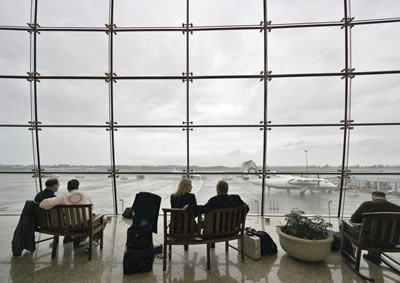
A new analysis by researchers at the University of California suggests that full-body scanners used to screen travelers at the nation's airports may not detect some hidden items. The report found that the scanners could not detect items placed outside the side of the body. JFK, Houston, Detroit among the most beautiful airport terminals
Airlines often invest billions in terminals at their hub airports, betting that a more pleasant and efficient facility will translate into a competitive advantage with frequent fliers. So who's getting the most bang for the buck? TheStreet.com names its four most beautiful terminals in the U.S., including American Airlines' Terminal 8 and JetBlue's T5, both at JFK; United/Continental's Terminal E at Houston Bush Intercontinental; and Delta's 122-gate terminal at Detroit Metro.
Some airports allow travelers to buy alcohol 24 hours a day
Bars at some U.S. airports are now permitted to sell alcohol to travelers at all hours. At Chicago's two airports, for example, a new city ordinance permits bars to serve travelers 24 hours a day. Airports in Seattle, New York and Philadelphia have also expanded the hours when alcohol may be sold. Some airlines are getting in on the trend, as well. American Airlines, for example, will launch an in-flight "happy hour" next month on flights that take off between 5 p.m. and 6 p.m. |
|
|
C I Travel Management's employee/owners are extremely grateful for your trust in us to assist your organization in achieving a higher return on your travel investment. Our philosophy is that when you grow - we grow. It is our responsibility to help you meet and surpass the goals you've established for your travel programs and to assist your travelers whenever necessary. We thank you again for the opportunity to serve.
Sincerely,
|
|
|
 Recieve a $50 per stateroom shipboard credit on any 5 night or longer sailing! Sailing must be completed by March 30, 2011 and cruise reservation must be booked by December 25, 2010. Call you C I Travel Leisure Consultant today at 757-627-8000 or 757-217-0500. Recieve a $50 per stateroom shipboard credit on any 5 night or longer sailing! Sailing must be completed by March 30, 2011 and cruise reservation must be booked by December 25, 2010. Call you C I Travel Leisure Consultant today at 757-627-8000 or 757-217-0500. | | Offer Expires: December 15, 2010 |
|
|