
American Health News and
Wellness Report Newsletter
Prevention is a Cure (c)  
JANUARY 2011 - Vol 12 Issue 2

AHA Masthead HeartLumosity logo 

In This Issue
BUILDING A HEALTHY HEART
WALK FAST, LIVE LONGER
GET YOUR HEART FIT AND RUN MARATHONS
Join Our Mailing List!
Quick Links
Greetings!
 
 
Calendar of events
  
Monday, January 10th 2011   7:30pm
All About YOU: A Discussion Group For All Ages
Boca Raton Community Center
150 Crawford Blvd, Boca Raton
Sponsored by American Single's Society
561 361 9091   Free

Wednesday, January 12th 2011  7:00pm
American Health Lecture
Dr. John Conde:
Low Back Pain: An American Epidemic
Spanish River Library
1501 NW Spanish River Blvd, Boca Raton
561 361 9091  $3 donation

Saturday, January 15th 2011  9:00am
Lets Talk About It. A discussion Group
Heritage Park West Library
5859 Via Flora, Delray Beach
561 361 9091  $1 Donation
 
Call the American Health Association for any special offering.
President American Health Association
J. Robert Gordon
How exercise builds a healthy heart 

(American Health Newswire) -- It's common knowledge that exercise offers metabolic and cardiovascular benefits; however, scientists surprisingly know little about how physical activity actually influences the heart itself. Thanks a new study, scientists now know a little more.


Mice in the study that exercised turned on a genetic program that leads the heart to grow as heart muscle cells divide. In due course, the shift in activity is driven, in part, by a solitary transcription factor (a gene that controls other genes). That gene, commonly referred to as C/EBPb, was known to play imperative roles in various other parts of the body, although this is the foremost evidence for its influence in the heart.


"We've identified a pathway involved in beneficial cardiac hypertrophy -- the good kind of heart growth," Bruce Spiegelman of Harvard Medical School, was quoted as saying.

These discoveries might offer clinical implications, predominantly for those with heart failure or other conditions that make exercise demanding to impossible.


"This is yet another reason to keep on exercising," Anthony Rosenzweig of Harvard Medical School, was quoted as saying. "In the longer-term, by understanding the pathways that benefit the heart with exercise, we may be able to exploit those for patients who aren't able to exercise. If there were a way to modulate the same pathway in a beneficial way, it would open up new avenues for treatment."


There may be additional ways to optimize training regimens so that they tap into this natural mechanism more proficiently, Spiegelman added. The heart muscle adapts to increased pressure and volume by increasing in size, according to the researchers. This is true in the case of exercise as it is in pathological conditions including high blood pressure. In disease states as opposed to exercise, those changes to the heart can eventually lead to heart failure and arrhythmias.


Researchers discovered changes in 175 transcription factors in exercised mice and 96 in mice whose aortas were constricted. Notably, the changes illustrated slight overlap between the two animal models. For instance, the researchers said, 13 percent of the genes with differential expression subsequent to exercise have known or suggested roles in cell production in comparison to less than 1 percent of those that changed with the surgery.


The researchers then zeroed in on one transcription factor, C/EBPb, which goes down roughly two-fold with exercise and a second that rises in turn. Studies in animals and cell culture additionally illustrated that the decline in C/EBPb leads to transformations that appear to be constant with those that follow endurance exercise, including an increase in both heart muscle size and proliferation.


Those mice with lower C/EBPb levels as well were resilient to heart failure.


Researchers add that these findings are principal for the fact that there is exceptionally little prior evidence demonstrating that the increase in heart size with exercise has direct benefits. The innovative evidence also gives essential biological insights into the heart's capability for regeneration of muscle.


It will be key in future studies to investigate all of the players in the pathway and to offer even more authoritative evidence that exercise leads to an increased rate of cell proliferation in heart muscle, according to Rosenzweig.


SOURCE: Cell, December 2010

 
Walk fast, live longer

(American Health Newswire) -- Walking fast may do more than just help you get somewhere quickly. A new study reveals those who have faster walking speeds live longer lives.
 

Researchers from the University of Pittsburgh analyzed data on more than 34,000 adults who were 65 years of age or older. They measured gait speed for each participant using distance in meters and time in seconds.


Results showed walking speed was associated with differences in survival, especially among those who were older than 75 years of age. Gait speeds of 1.0 meter (3.3 feet)/second or higher were consistently associated with longer survival. Gait speeds of about 0.8 meters (2.6 feet)/second were mostly associated with a median life expectancy.


"Walking requires energy, movement control and support and places demands on multiple organ systems including the heart, lungs, circulatory, nervous, and musculoskeletal systems," the authors write. "Slowing gait may reflect both damaged systems and a high energy cost of walking."


The authors say their findings suggest that walking speed may be used to identify older adults with an increased risk of early death. Practitioners may target those with speeds slower than 0.6 meter (2 feet)/second.


"Gait speed may be a simple and accessible indicator of the health of the older person," the authors conclude.

.

SOURCE: JAMA, 2011; 305:50-58

Marathons can damage the hearts of less-fit runners 

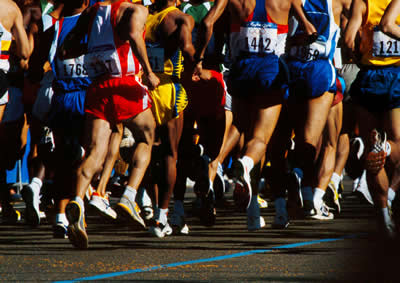
(American Health Newswire) -- We run to the store. We run to the bank. We run everywhere daily, but how about a marathon? Is running a marathon good for you or can it damage your heart?

A team of researchers and runners from the Heart and Stroke Foundation are trying to answer the question of whether or not fitness level matters. They used a traditional test that uses data from an MRI to find out what is really going on in the marathoner's heart as the kilometers go up. They found that that the magnitude of abnormal heart segments was more widespread and significant in a group of less fit runners. During the marathon, they had signs the heart might be at greater risk of damage than that of runners who had better training or at least had better exercise capacity.


"Without proper training, marathon running can damage your heart. Fortunately the exercise-induced injury is reversible over time," Dr. Eric Larose, professor of medicine at Laval University and a cardiologist and clinical researcher at Institut universitaire de cardiologie et de pneumologie de Québec (IUCPQ) in Québec City was quoted saying.. "But it could take up to three months to completely recover."


The left ventricle of the heart is divided into 17 segments that make up the heart as a whole. When a segment is injured or stressed out during the marathon, its neighbors on either side can take over to perform the function of the damaged area. This makes the heart as a whole appear stronger and fitter than is really the case when considering each individual segment. That makes it impossible for physicians to arrive at an accurate assessment of the heart health when considering the whole heart.


Researchers turned to the VO2 max test. This ultimate measure of aerobic endurance directly measures body oxygen consumption and it is the best test to provide an accurate measure of a safe maximum heart rate (number of beats per minute) for runners. In V02 testing, treadmills or stationary bicycles may be used to establish cardiac fitness.


In this test, researchers took healthy amateur runners and performed a full evaluation six to eight weeks before, and then immediately after, they ran a marathon. They underwent exercise tests, blood analysis, and magnetic resonance imaging.


"What we did notice in this study is a runner with less preparation before the marathon had lower V02 max, so they had lower exercise capacity. "   Dr. Larose was quoted saying. "Compared to those runners with better training, they became more dehydrated and their hearts showed greater signs of injury. The less well trained runners also experienced greater loss of function associated with lower blood flow and greater irritation of heart segments."


They advise new runners to train properly; stay hydrated and most importantly, speak to their doctors about what is right for them.


SOURCE: Canadian Cardiovascular Congress, October 2010


100% of every dollar goes to service the charities programs and services here in Palm Beach County and around the globe Not one cent in 8 years has ever gone to salaries, of any kind, to anyone. We are, from top to bottom all volunteers in service to the community.
MISSION STATEMENT
The American Health Society is a distinguished 11 year old multi-award winning preventative public health & wellness 501(c)(3) charity whose mission is in preventative healthcare, mental wellness, health education, literacy and advocacy aimed at preventing lifestyle based illnesses, diseases and the frailties of aging. 
 
We have a strong "Social Green Philosophy" of Humanitarian  Service through our American Volunteer Corps which has a global outreach in 46 countries with members in 37 US States.

J. Robert Gordon - CEO and Founder
American Health Association
561-361-9091
Newsletter Editor and Communications Manager:
Suzanne Parent - suzanne@americanhealthfoundation.com