Upcoming Events
School Based Flu Clinics
Some of the North Country Public Health Region Schools will be holding school based influenza vaccination clinics at the schools for the students. These clinics are still in the planning stages, however we are looking for volunteers.
|
Thank you! Your decision to volunteer for MRC is appreciated! Please spread the word about our Northern NH Unit to your friends, family and Co-Workers. We would welcome the opportunity to come and speak about MRC at your workplace or other meetings or functions.
Please remember to keep us updated if your email address changes! Email is our most immediate and efficient way of communicating with our volunteers.
|
|
Greetings!
September is National Preparedness MonthAugust saw two natural occurring events happening within 10 days of each other. Communities in NH including Gorham and Bethlehem felt the effects of the earthquake that was centered in Virginia. Earthquakes are not that unusual in NH, and we include this type of event in emergency planning. Hurricanes and/ or Tropical Storms more unusual, and Irene hit many communities pretty hard as she passed through. Thankfully northern New Hampshire did not have any fatalities due to the storm, but many experience power outages lasting hours to days, not to mention damage to the roadways and homes and businesses. Having an actual event take place so close to home has more people thinking about putting together a personal preparedness plan. Northern NH MRC Unit has information about personal preparedness available. You can also go to the Ready NH website at site also has information about road closures and what communities still do not have electrical power. http://www.nh.gov/readynh/
|
|
Stay in an Emergency
As a reminder, in order to be prepared for an emergency, it is important that you are able to stay in your house for up to three days without access to electricity, water, or other services. STAY refers to situations such as heavy storms where it is safer for people to remain in their homes than it is to go outside. Sometimes you may just have to stay in your home for several hours or perhaps a day to give public works crews the time to clear roads and highways. Sometimes you may need to stay in your home for three days, or even longer, while waiting for power to be restored. Any time power is knocked out during a storm there is the possibility that it could be out for a long time. Utilities begin restoration work immediately, but a widespread outage could take a long time to fix, especially for people who are in isolated areas. The ice storm in December 2008 knocked out power to more than half the state and some people were without power for two weeks. New Hampshire residents need to be prepared for that kind of storm as well. In winter storms, people who have secondary heat sources, such as wood or gas stoves, may be able to continue to stay in their homes. Others may need to stay at local shelters. People using electric generators for their homes should have them properly installed and vented. Never operate a generator in an enclosed area and never use an outdoor heating appliance indoors. Both will produce deadly carbon monoxide. To learn more about what you should do to prepare to stay in your home during an emergency, review the "stay" checklist in this brochure. (link to: http://www.nh.gov/readynh/documents/readynh_stay_leave_connect.pdf)(from email from DHHS) |

School Based Vaccination Clinics
Looking for MRC volunteers to help staff school based influenza vaccination clinics in October and November. If you would like to help out, contact Elaine at 603 259 3704 ext 229 or email at ebelanger@nchcnh.org. Due to being in a school setting, one of the requirements are background checks. If you wish to volunteer and have not had a background check, Elaine can give you instructions. |
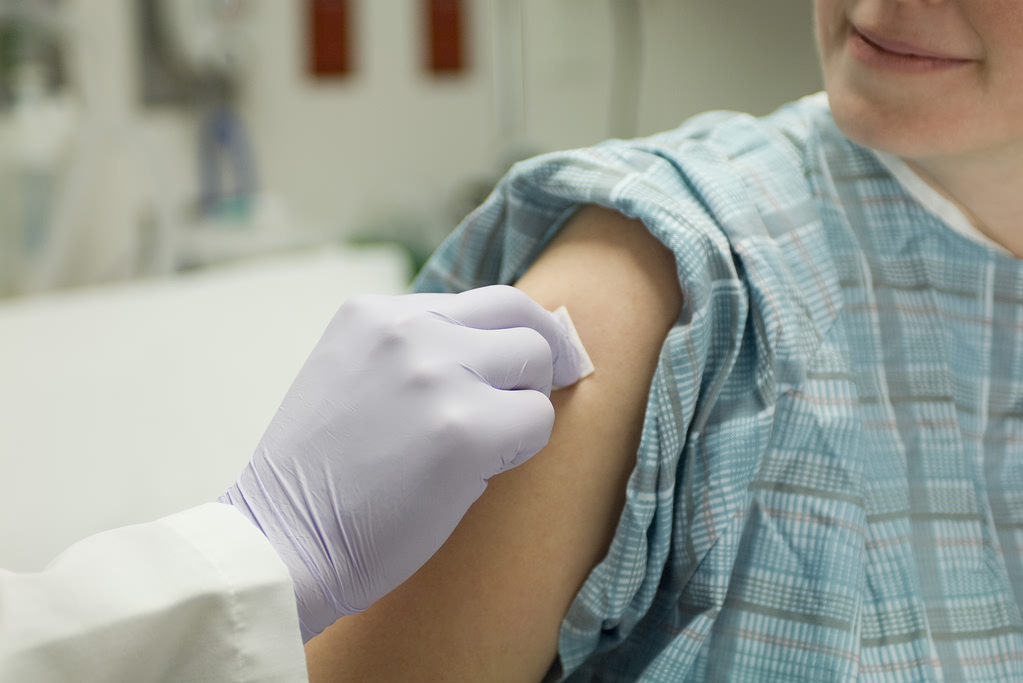
It's Flu Shot Time
Protect yourself, your family and your community by getting your yearly influenza immunization. Having the flu can keep you out of work for to 7-10days not to mention the body aches, fever and the cough that will make you miserable.
Places to find flu vaccines are your health care provider office and check your local papers for community clinics in your area. Clinics will be taking place all over the North Country Public Health Region.
|
Educational Opportunities
 MRC TRAIN is a training website for MRC volunteers and those in emergency management. TRAIN, a service of the Public Health Foundation, provides a robust on-line clearinghouse of more than 11,000 on-site training and distance learning opportunities offered by more than 2,650 providers. For distance learning they have everything from live webinars to on demand webcasts. To start, create an account by going to MRC TRAIN. MRC TRAIN is a training website for MRC volunteers and those in emergency management. TRAIN, a service of the Public Health Foundation, provides a robust on-line clearinghouse of more than 11,000 on-site training and distance learning opportunities offered by more than 2,650 providers. For distance learning they have everything from live webinars to on demand webcasts. To start, create an account by going to MRC TRAIN.
Other websites that have Public Health webinars are
University of Albany School of Public Health. http://www.ualbanycphp.org/default.cfm
|
From NACCHO, National Association of County and Cities Health Officials website
Hurricane Irene Severe Weather Alert: Tools and Resource In the Spotlight "Our goal is to provide local public health leaders with useful information to help them ensure the health and safety of their communities."
Jack Herrmann, Senior Advisor & Chief
NACCHO Public Health Preparedness Programs
Access tools and resources that LHDs and communities can use to manage the aftermath of Hurricane Irene. More »
|
|

ESAR-VHP
If you are a MRC volunteer, please register with ESAR-VHP (NH Emergency System for Advance Registration of Healthcare Professionals). This is no longer restricted to just health-care professionals. All MRC Volunteers can register. It is an electronic database of health-care personnel and others who have indicated their interest in volunteering to provide aid in an emergency. ESAR-VHP works on a volunteer basis, so you decide when and where you wish to volunteer. This system:- Registers health volunteers (as well as others)
- Applies emergency credentialing standards to registered health volunteers, and
- Allows for the verification of the identity, credentials and qualifications of registered volunteers in an emergency.
All MRC volunteers are urged to register. Click
here
for more information. If you are having difficulty when trying to register, please let Elaine know at ebelanger@nchcnh.org.
|
Ongoing Training Requirements
Learn Who's in Charge with ICS
- "Incident Command System (ICS) 100, An Introduction"
- : This course explains the communication procedures used to best support on-scene responders and coordinated various agencies during all-hazard incidents. Go online to FEMA's Emergency Management Institute today. It takes about 3 hours to complete. Please remember to send confirmation of your successful completion of ICS 100 to Becky at rbowers@nchcnh.org.
- "IS-700, National Incident Management System (NIMS), An Introduction": This course helps you understand the way in which disasters are managed and how volunteers fit into the plan/response. Go online to FEMA's Emergency Management Institute today. It takes about 3 hours to complete. Again, please send confirmation of your successful completion to Becky at rbowers@nchcnh.org.
- "Terrorism and Public Health": This is a replacement course for our old public health online training, "Public Health 101". The State University of New York at Albany has developed an excellent course on terrorism that focuses specifically on public health. The course covers the basics of epidemiology and biological, chemical and radiological threats, incorporating the elements of public health planning. This course is offered online and takes about 6 hours to complete. Participants can earn 6 hours CME/CHES or 7.2 hours CNE.
- "Personal/Family Preparedness": Assemble a disaster supply kit, learn hazard-specific preparedness, develop a family communications plan, plan for the care of vulnerable family members and practice and maintain your plan. Creating a personal/family preparedness plan is a Core Competency for MRC. Go online to FEMA's Emergency Management Institute to learn about IS-22: "Are you ready? An In-depth Guide to Citizen Preparedness."
|
Hmmm, Something to Ponder
Irene: Rediscovering Radio
 Thank you Irene for helping people rediscover radio. Thank you Irene for helping people rediscover radio.
As part of my emergency kit for when the lights went out - and they did for three days - was my old transistor radio (not to mention a wind-up model I keep as a backup, backup). My friends know that I've been through lots of power outages over the years and when they ask me what precautions I take, I tell them that besides the extra water, dry goods and candles, I always pack my "transistor." Smile.
So when Irene came barreling through, downing trees and wiping out power cables it was my reliable radio that kept me locked into the news, which unfortunately was not all that good. But at least I was not totally in the dark.
And when it was all over, folks who had taken my advice and who had not really listened to the radio in quite awhile were delighted to have that personal companion. They felt informed and not isolated. Because that's what radio does better than any other media: it makes you feel connected.
I packed up my radio this morning - it's a Grundig emergency model, with batteries, wind-up and a little flashlight - and put it away for the next event. Because I'm sure one is not far away and when it comes, I'll be ready - and in touch.
From Science Friday Website, September 8, 2011
|
| Letter From the CDC
Dear Colleague,
On September 9, Warner Brothers will be releasing the movie Contagion, a
fictional drama that portrays CDC and other U.S. and international partners
responding to an emerging infectious disease outbreak. We are reaching
out to you and other members of the public health community in an effort to
take advantage of this opportunity to provide accurate and potentially
life-saving information to the public about how to prepare for a public
health emergency.
When asked to respond to the inevitable question about the plot of the
movie, "Could this really happen?" CDC is compelled to say, "Not only
could it happen, CDC scientists are working 24/7 to find out if it's
happening right now." We hope you will consider highlighting the following
websites for your own audiences, particularly during September (National
Preparedness Month).
Thank you for your help in spreading the word about the critically
important role emergency preparedness plays in protecting the health of
people in this country and around the world.
Sincerely,
Judith A. Monroe, MD, FAAFP
Deputy Director, Centers for Disease Control and Prevention
Director, Office for State, Tribal, Local and Territorial Support
http://contagionmovie.warnerbros.com/index.html#/home
http://www.cdc.gov/24-7/contagion/
|
|
|
|
|





 Thank you Irene for helping people rediscover radio.
