Staying Safe with Fall Arrest: Using a Dual Dorsal Ring Harness
by Bill Sapsis
It's
great to see how far safety awareness has come in the rigging industry. In the
old days (you can decide if they were the good or the bad old days) if you
showed up at a job with fall arrest equipment you got laughed out of the
building. Now it's quite the opposite, show up without it and you won't be
allowed to climb. This is a very good thing. However, in some circumstances there
is some confusion over how to properly use the equipment.
A common situation is when a technician climbs a wire rope ladder or a ground
support tower to get to a truss to focus lights or run their follow spot. More
often than not, the technician uses a self-retracting lifeline (SRL) as the
safety device on the vertical climb and a horizontal lifeline while on the
truss. It's important at this point to remember that:
A) Manufacturer specifications require the hook on the SRL be connected directly into the dorsal
ring on the harness.
B) OSHA regulations
require that only one hook engage the dorsal ring on the harness at a time.
If you are climbing the ladder or tower and are using an SRL, and you need a
lanyard for the horizontal lifeline, where do you clip your lanyard? Do you
hold onto it until you get up onto the truss? Is it left on the horizontal
lifeline for you to grab when you finish the vertical climb? Either one of
these scenarios, and others like them are awkward, dangerous and illegal.
They are awkward because they require
you to first reach around to your dorsal ring and disconnect the SRL hook and
then clip your lanyard hook into that dorsal ring. Sounds easy but anyone who
has ever tried knows how difficult it is to reach that dorsal ring. Let's not
forget that while this is going on you are 49 feet in the air, standing on a
20.5' wide lighting truss swinging in the breeze. Switching hooks on a dorsal
ring is hard enough to do on the ground, let alone at height.
It's dangerous because when you disconnect the SRL from the dorsal ring you are
no longer connected to the fall arrest system. Flailing around trying to make a
connection while standing on a truss is just plain unsafe.
The illegal part comes in because OSHA says you are not allowed to disconnect
from the fall arrest system while you are at risk. I don't know about you but
standing on top of a truss 49 feet in the air trying to reach a ring on my back
with my stubby little arms sounds an awful lot like being at risk.
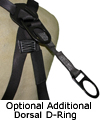
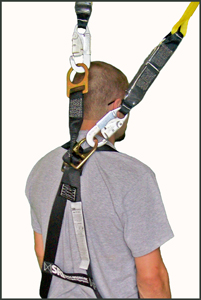 Fortunately, there is a solution that comes right from the manufacturer and
doesn't require additional effort from you. You can buy a harness with an
additional dorsal ring sewn onto the harness. The second ring comes with about
8" of webbing on it making it very easy to reach when you need to disconnect or
reconnect the SRL. Your shock absorbing lanyard clips into your primary dorsal
ring (connect the end with the shock pack to your dorsal ring) and the other
end you tuck somewhere...on your belt, in your pocket... wherever it's
comfortable for you so that it's easy to reach when you get to the truss.
The whole process goes like this: Fortunately, there is a solution that comes right from the manufacturer and
doesn't require additional effort from you. You can buy a harness with an
additional dorsal ring sewn onto the harness. The second ring comes with about
8" of webbing on it making it very easy to reach when you need to disconnect or
reconnect the SRL. Your shock absorbing lanyard clips into your primary dorsal
ring (connect the end with the shock pack to your dorsal ring) and the other
end you tuck somewhere...on your belt, in your pocket... wherever it's
comfortable for you so that it's easy to reach when you get to the truss.
The whole process goes like this:
Before you start the climb:
- Hook the lanyard into the primary dorsal ring on your harness and
stick the loose end into your pocket.
- Clip the SRL hook into your dorsal ring that has the webbing
extension.
- Climb the ladder.
When you get to the top of the climb:
- Clip the loose end of the lanyard to the horizontal lifeline.
- Disconnect the SRL hook and go about your business on the truss.
When you are finished and ready to come down you simply reverse the process.
Finally, if you don't want to buy a new harness because yours doesn't already
have the addition dorsal ring, you can buy a lanyard that has the secondary
D-ring sewn onto it. The function is exactly the same as if it's on the
harness.
So you can see there is no reason to ever be at risk while working at height.
We have the gear to protect you properly while you do your job.
~~~~~~~~~~~~~~~~~~~~~~~~~~~~~~~~~~~~~~~~~~~~~~~~
|
SRI Achieves CM Level 2 Hoist Certification
 Billy Williams, lead hoist technician for Sapsis Rigging, has achieved Level 2 Certification status for CM Entertainment Lodestar and Prostar hoist maintenance, repair and inspection procedures. Level 2 certification is the highest certification offered by CM and assures our clients that all warranty work done on Lodestar and Prostar hoists at Sapsis Rigging, Inc. is authorized and backed by CM. Billy Williams, lead hoist technician for Sapsis Rigging, has achieved Level 2 Certification status for CM Entertainment Lodestar and Prostar hoist maintenance, repair and inspection procedures. Level 2 certification is the highest certification offered by CM and assures our clients that all warranty work done on Lodestar and Prostar hoists at Sapsis Rigging, Inc. is authorized and backed by CM.
Billy was member of the inaugural class of hoist technicians from around the country who were invited to the CM plant in Bristol, VA to test for this certification. Billy's test score, at 98 was one of the highest in the class.
Needless to say, we're very proud of Billy. His achievement exemplifies the commitment Sapsis Rigging makes to continued education for its staff and better service for its customers.
~~~~~~~~~~~~~~~~~~~~~~~~~~~~~~~~~~~~~~~~~~~~~~~~
|
Meet our Staff and find out more about the crew that keeps SRI humming like a well-oiled chain hoist. With pictures, too! http://www.sapsis-rigging.com/staffbios.html
~~~~~~~~~~~~~~~~~~~~~~~~~~~~~~~~~~~~~~~~~~~~~~~~
|