6th Annual Charity RideJuly 31 - Aug 6 6th Annual Charity RideJuly 31 - Aug 6 |
|
 ProPlus Fall Protection ProPlus Fall Protection
from Sapsis Rigging, Inc
We're entertainment technicians, just like you, and we understand the special demands of the entertainment industry. The equipment in the SRI ProPlus Fall Protection System works where you do.
The fall protection standards were updated in 2007 to insure your continued safety at work. Not everyone can say that all of their equipment meets the new standards, but we can. Every piece of ProPlus Fall Protection equipment meets the new ANSI.Z359.1-2007 standards.
We've been working with you in this industry for close to 30 years. We know that money is tight. The ProPlus Fall Protection System is designed to meet not only your work needs, but also your budget requirements.
Visit our Online Catalog to view the entire line of ProPlus Gear.
_____________________________________________________________________
|
|
ANSI Z359.1-2007 and You
by Bill Sapsis
There has been a growing interest in the entertainment industry in safety in general, and Fall Protection in particular. This is wonderful news, considering productions are now larger and more complex than ever, requiring a greater number of riggers, follow spot operators, electricians, flypersons, etc. The increased use of motorized systems is not without potential for accidents. It should also be noted that gravity works exactly the same way it always has.
Over the years the understanding of the OSHA requirements for fall protection have grown from "OSHA? What's that?" to "Yes, I know OSHA says we have to have safety equipment and I wear a harness, but I don't have time to read all that other stuff. Besides, it probably doesn't affect me."
Well, it does affect you. And just to make things more interesting, a new set of Fall Protection standards was issued back in October of 2007. This event did not go unnoticed and it has produced a fair amount of concern and confusion.
Hopefully we can clear up some of that confusion. First, a little history.
OSHA's Fall Protection regulations are based on standards written by various groups in the private sector. Since the mid 1990's the most common reference source has been the Z359 Standards. These standards were developed by an industry group known as the American National Standards Committee on Standards for Fall Protection, Z359. The Standards, and the OSHA regulations that referenced them, were long on identifying the regulations but short on explaining how to follow them. When the Committee wrote those standards they knew that more had to be done; that the early Z359 standards were just a beginning. The Z359-2007 standards are part of the follow up. As the foreword for Z359.1-2007 says (in part)
"The need for this standards activity grew out of the continuing development of a series of fall protections related standards. The focus is to tie the elements of those standards together and provide the tools with which employers may develop the programs that incorporate those elements. This standard also brings together the administrative requirements for those fall protection standards."
In other words, The Z359-2007 Standards pick up where the earlier ones left off. The Z359-2007 Standards help describe and define just what is required to maintain a safe and practical fall protection system within a workplace.
At this point it should be noted that those who put the new standards together did not mince words. There are four sections that make up the 2007 standards and each section runs from between 23 pages to over 100 pages long. Needless to say, I am not re-printing them here. If you want to read the standards you will have to buy them. (More information on how to do that is at the end of this piece.) What follows is a brief summary of each section.
ANSI/ASSE Z359.1-2007 Safety Requirements for Personal Fall Arrest Systems, Subsystems and Components. (Part of the Fall Protection Standards)
OK. So what does that really mean? To quote from the standard itself....
"This standard establishes requirements for the performance, design, marking, qualification, instruction, use, maintenance and removal from service of connectors, full body harnesses, lanyards, energy absorbers, anchorage connectors, fall arrestors, vertical lifelines and self retracting lanyards comprising personal fall arrest systems for users within the capacity range of 130 to 310 pounds (59 to 140 kg)."
The standard then goes on for 104 pages to do just that. One of the highlights of this standard, and one of the main elements of the standard that has a direct bearing on our industry, is the section: 3.2.1.4 which says (again, in part) "...the gate of the snaphook or carabiner shall be capable of withstanding a minimum side load of 3,600 pounds (16kN) applied to a point midway between the nose and gate hinge without breaking" The previous threshold for a side load was 360 pounds.
This, my friends, is a big deal. Increasing the side load capacity by a factor of ten greatly helps reduce the failure rate of snaphooks and carabiners that have been choked around an I-beam or pipe batten. The standard doesn't say you can now do that choke thing - you still can't. But now if you are foolish enough to try it anyway, you have a much better chance of surviving (assuming, of course, you have used equipment conforming to current ANSI standards).
ANSI/ASSE Z359.2-2007 is titled: Minimum Requirements for a Comprehensive Managed Fall Protection Program. This standard identifies what an employer is required to do to design, maintain and document a Fall Protection Program. Employers be warned, you no longer have the ability to say, "I didn't know" or "I didn't understand". The information is in there in the minutest detail, all 50 pages of it, complete with charts and graphs.
ANSI/ASSE Z359.3-2007 is titled: Safety Requirements for Positioning and Travel Restraint Systems.
This one is the baby of the group, coming in at a mere 23 pages. Nevertheless, it discusses in great detail what you need to do if you are in a work-positioning situation (in a bosun's chair, for example) or when walking along a balcony or catwalk with an exposed edge.
And last but by no means least we come to ANSI/ASSE Z359.4-2007 Safety Requirements for Assisted-Rescue and Self Rescue Systems, Subsystems and Components. 54 pages of the most scintillating descriptions of what happens to you after you fall and what you have to do to get rescued. This is, in my opinion, the most important section of them all. Rescue is not something that has been widely embraced by our industry. However, given the size, complexity and sheer number of shows requiring fall protection, it is something that all of us should come to grips with sooner, rather than later. This standard is totally clear on the who, what, when, where, why and how of rescue training.
OK. So we have these standards. Now what? What does it really mean to those in the entertainment industry. First off, it means we can no longer keep our heads in the sand about fall protection. We can no longer claim ignorance. The standards exist and, like it or not, you'll need to work with them.
What's that you say? The Z359-2007 Standards aren't part of the OSHA regulations? By their very existence the ANSI/ASSE Z359-2007 standards carry with them the force of law. If there is an incident in your facility that results in an injury or death, there will be the prerequisite OSHA investigation and the predictable civil lawsuits to follow. If you've screwed up and you're at fault, then either OSHA will get you or the lawyers will. Either way it would be a lot easier/cheaper/smarter to follow the standards from the git-go.
To purchase the ANSI/ASSE Z359-2007 you can go to ANSI's website or to the ASSE website
The standards aren't cheap but given the amount of information they contain, they're worth every penny.
________________________________________________________________
|
 SRI in the News
Sapsis Rigging Provides Rigging for
Park Avenue Armory Art Installation
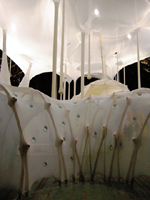
Sapsis Rigging provided rigging design, equipment and installation supervision and labor for the New York Park Avenue Armory and artist Ernesto Neto's first commissioned art installation in the 66th St and Park Avenue venue.
The piece, titled "anthropodino" is a 120 ft wide by 180 ft long canopy suspended from the armory roof structure. Columns of fabric, weighted with spices and sand, descend 60' and help define a maze of rooms and passageways.
The primary load-in took two days, noted rigging project manager Michael Sapsis. "Because the hanging points would greatly affect the shape of the fabric, we worked closely with Ernesto to make sure the points were located in the roof steel properly. Once he was satisfied with the point location we ran the fabric through the points and started shaping the fabric with the scented columns." The fine tuning took another two days with SRI's Daryll John taking the lead to make sure the piece was safe and secure.
________________________________________________________________
Sapsis Rigging Moves with the Crystal Ball.
Sapsis Rigging provided rigging services (design, equipment, labor and supervision) for the 23rd Annual Mt Sinai Crystal Ball. The ball is the New York City hospital's largest fundraiser of the year. Not wishing to expose patients and staff to the H1N1 virus, the event was moved from its traditional location, the hospital lobby at 105th St and Park Avenue, to the Central Park Conservancy tent nearby in Central Park. The decision to make the move came only a day and a half before the load in was scheduled to begin.
Mike Sapsis, the SRI project manager for the event noted that "the problems we faced in moving to a different venue were compounded by the fact that we were no longer in a building but now in a tent. Not only did we have further to go to get the gear into the tent but also the allowable loads in the tent are very different from those in the building. And the suspension methods are also very different from one structure to the other. We re-designed the system on the fly, shifted equipment around as best as possible, added a couple of ground support systems and were good to go in time for the event."
|
|
|