Join our list!
|
|
Greetings!
Welcome to netHEADS!, the electronic newsletter from Sapsis Rigging Inc. You can update your email subscription through the links provided at the end of the newsletter and we provide a handy forward link so you care share the fun with your friends.
The SRI Staff
|
|
|
NATEAC Conference Exceeds Expectations
by Eddie Raymond
It was the evening of Saturday, July 19, and my wife, Diana, and I had just arrived at Pier 16 at the South Street Seaport, for the kick off of the inaugural North American Theatre Engineering and Architects Conference (NATEAC). We had arrived an hour early as the "meet, greet, and herd the cats" team in preparation for a three hour cruise of New York harbor on the Circle Line flagship, the Zephyr.
In the months leading up to the conference there was, as might be expected, a bit of trepidation and anxiety about the conference. Would anybody show up? Would the people who compete for business behave in a civil manner toward each other? Would conference director, Bill Sapsis, have to sell his home to pay for the whole thing? No one knew for sure.
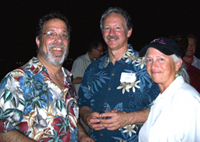 People started arriving soon after we got to the pier. It became obvious immediately that this was going to be a special event. By the time the registration team began to sign in the guests, well over 100 people had appeared and there was a buzz that could be heard above the roar of the shark boat engines on the adjacent pier. People were greeting long lost colleagues and introducing them to new acquaintances, creating a crowd in which no one was more than three degrees separated from anyone else. People started arriving soon after we got to the pier. It became obvious immediately that this was going to be a special event. By the time the registration team began to sign in the guests, well over 100 people had appeared and there was a buzz that could be heard above the roar of the shark boat engines on the adjacent pier. People were greeting long lost colleagues and introducing them to new acquaintances, creating a crowd in which no one was more than three degrees separated from anyone else.
The cruise was a complete success. We toured the harbor and enjoyed a close up view of the waterfalls (the lighting designers among us had a lot to say about how they should have been lit). We ate, drank, and visited. We danced (well at least Diana and I did) and were treated to a surprise fireworks display as we headed to the dock at the end of the cruise. Through it all, the buzz never ceased. It was the perfect kickoff event.
The conference began Sunday morning at Pace University with breakfast and registration. It was all pretty standard fare for a conference, except that there were no lone individuals perusing their programs trying to figure out if there would be any interesting panels to attend. The buzz from Saturday night picked up where it left off, a theme that continued throughout the conference. People talked to each other all the time; they talked in the panel rooms with the panelists, they talked in the rooms after the panels, they talked in the hallways, and they talked in the beautiful if not muggy courtyard. It seemed as though people were meeting old friends and making new ones with every opportunity.
The conference began at 9:30 a.m. with a keynote address by Richard Brett, founder of the Theatre Engineering and Architects Conferences in London in 2002 and 2006, and Hugh Hardy, founder of H3 Collaborative Architecture. The address was given in the main theatre at Pace, in front of the set for Inside the Actor's Studio; all that was missing was James Lipton.
Richard, who was seemingly everywhere during the conference, stressed the need for training, knowledge, understanding, and, above all, experience in the design and execution of performance spaces. His golden nugget for all attendees was, "Companies don't succeed, people do."
Hugh did a brief but amusing recap of the evolution of theatres, and how that evolution led us to the current state of the art. Pointing out the diversity of performance spaces we now enjoy, but emphasizing the common purpose of them all, to help tell a story.
There were three one hour and twenty minute panel slots each day, with three concurrent panels in each slot. It was difficult to choose between the panels offered, but the distribution of attendees seemed surprisingly even.
The first panel I attended was "Structural Issues in a Motorized World" moderated by Shawn Nolan, President of Nolan Engineering Services; with panelists William Gorlin, P.E., S.E., SECB, Vice President of the Entertainment Division at McLaren Engineering Group; Steve Rust, Director of Technical Services at Sachs Morgan Studio; and Scott Fisher, President of Fisher Technical Services. They spoke about the demands that new machinery and technical expectations place on a building's structure, particularly older and historic buildings. Emphasizing that the load factors are not only bigger, but also increasingly three dimensional, they spoke about construction difficulties and some strategies to address those ever increasing load factors. Their slides and DVD's were fascinating and demonstrative of the points they were making and the time flew by.
Immediately following the session lunch was served in the courtyard, and the buzz continued. Attendees gathered in groups large and small to talk about the sessions they had just attended. The 245 attendees and the more than 60 panelists mixed seamlessly, and it became apparent that people had come from everywhere to attend the conference. Among them were 48 attendees from 8 countries (Canada, the UK, France, New Zealand, Brazil, Singapore, and Korea) who seemed excited to mingle with their US counterparts.
After lunch I chose the panel exploring the "Architect's Role in Theatre Facility Design," moderated by Robert Shook, ASTC, of Schuler Shook Theatre Planners. The panelists included Leigh Breslau, SOM, architect; Mark Holden, FASA, JaffeHolden, acoustics consultant; Joe Mobilia, ASTC, Fisher Dachs Associates, theatre planning consultant; Joe Perryman, MRICS MAPM LEED AP, Donnell Consultants, cost consultant; and Rick Pfannenstiel, Pfocus, owner's representative. The panel spoke about the changing environment of performance spaces and the need for the architect to understand the intended use and programming of a space in order to be true to each building's intent. They addressed the artful marriage of form and function and the ways in which all performance spaces are similar, and yet unique to their end users. The panel also discussed the complicated hierarchy of a theatre project and where the architect fits into that chain of command.
The third and final slot for me was the panel I was to moderate on "Designing a Safe Work Space." My stellar panel consisted of Monona Rossol, Founder, ACTS (Arts, Crafts, Theatre and Safety); Drew Landmesser, Production Director, San Francisco Opera; and Darrell Ziegler, ASTC, Associate, Theatre Specialist, Westlake Reed Leskosky. The goal was to point out the world as we find it today, and to suggest things to consider as we move forward with an ever increasing awareness of the safety of theatre technicians. Judging from the spirited Q&A at the end and the fact that no one wanted to leave at our appointed hour, I believe we can judge the panel a success.
That evening people were free to enjoy New York, and Conference Coordinator Donna Frankel had arranged for group rate tickets to either Spamalot or Blue Man Group for attendees. It was a beautiful summer night in the Big Apple.
Monday morning again began with breakfast in the Student Union building to get out of the heat and to provide better seating-and the energy was still there. If only we could have bottled that electricity and passed it out to the attendees to use when they needed a boost back home-that would have been the best swag ever!
The first panel I attended Monday was "Inspections and Maintenance," moderated by conference director Bill Sapsis, President, Sapsis Rigging, Inc., with Tom Young, Vice President at J.R. Clancy, Inc.; and Charles Swift, Graham, Swift & Company, LLC as panelists. Their approach was to describe the theatre as a factory of ever increasing complexity and precision that, like any machine (say your automobile), needs a regular and documented prescription of maintenance. They talked about the need in both new designs and refits to account for accessibility to areas that have maintenance needs, and that all stage machinery needs maintenance. Also emphasized was the requirement of ongoing education and communication about maintenance schedules and procedures in the forms of training, documents, and signage.
The next session was "The Greener Theatre," a subject nearer and dearer to us all in these environmentally uncertain times. David Taylor of Arup was the moderator, with panelists Andy Hales, Managing Director of Charcoalblue Ltd, a leading UK theatre consultancy; Scott Geogeson, AIA, NCARB, LEED AP and award-winning architect; and Juhi Shareef, a member of Arup's Sustainable Business Management team in London who helped develop the British Standard on Sustainable Event Management (BS 8901). They spoke about sustainability and how a building as unique as a theatre can address issues such as the avoidance of energy use, the reduction of energy use that "must be," and the use of renewable energy. Examples of LEED certified theatres were illustrated as were the opportunities to explore these energy use subjects in future buildings. The UK standard for sustainable events, BS 8901, was discussed as a model for managing large events with a reduced environmental impact.
Lunch was served back in the Student Union Building. Not to sound like a broken record, but - buzz, buzz, buzz; high energy, and warm collegiality.
The final session I attended was "Single Purpose Theatres-Vegas and Beyond," moderated by Steven Ehrenberg, President of Technical Production at BASE Entertainment; with panelists Len Auerbach, Founder and President of Auerbach Pollock Friedlander and Auerbach Glasow French; David Rockwell, Founder, Rockwell Group; and Marie-Flore Gignac, Head of Architecture and Design for the Theatre Projects department at Cirque du Soleil. They discussed and demonstrated the process of designing and building a space intended to be the home of a single production. Examples of such spaces as KÀ, Cirque du Soleil's show at the MGM, Phantom of the Opera at the Venetian, both in Las Vegas were used to discuss the scope of such projects, the expectations of new audiences, the partnerships required to successfully complete such a project, and the philosophy behind such undertakings.
My only regret in all of this was that I had to choose between sessions. The twelve others were equally compelling, but there are just so many slots available in two days. While it is probably unfair to exclude any of the panels from mention, two were widely talked about. These included "Educational Facilities," presented by Robin Crews, Wrightson, Johnson, Haddon & Williams, Inc.; and Scott Butler, Wilson Butler Architects; and Tom Young, J.R. Clancy, serving as moderator, and "Value Engineering," the process of getting the most for your dollar, led by Robert Hamilton, Douglas Welch Design Associates; with presenters Dr. Joel Rubin, Joel E. Rubin & Associates; Joe Perryman, Senior Cost Consultant, Donnell Consultants Incorporated; and Josephine Márquez, J. Márquez Consultants, Inc.
The wrap up before we departed to dinner (more on that in a bit) was the plenary session led by Steven Ehrenberg and David Taylor. Standing at lecterns on either side of the main stage, they reminisced about the conference in a casual and humorous way; at times debating their points of view on the state of the theatre and how it reflects the state of our culture. At times they called on and interacted with members of the audience, panelists, and attendees alike, asking for clarification of points made and reactions to the sessions. It was a delightful summary of two intense days of panels.
The farewell dinner for the conference was held at Sardi's Restaurant in the heart of the Manhattan Theatre District. As it was a Monday, the restaurant was closed to the public, so this family of diners had the run of this 82 year old theatre business icon. Surrounded by cartoon images of famous Broadway celebrities, the guests spoke animatedly about their experiences of the last two days and enjoyed being in each other's glow.
The dinner speaker was Ron Austin, Executive Director of the Lincoln Center Development Project. He began his entertaining address by pointing out that if something happened to the collected audience, there wouldn't be a theatre project built for years, such was the pedigree of the attendees. His delivery was crisp and natural; clearly at home in front of a microphone. Ron could have been accused of being a stand-up comic, dressed up for the role and used as a ringer to guarantee a good send off for the crowd.
The dinner ended around 11:00 p.m., but no one wanted to leave, so the party carried on at various establishments around the theatre district. It continued into the wee hours of the morning, and only those with reservations for the Tuesday morning tours of the New York State Theatre, Jazz at Lincoln Center, and Radio City Music Hall left before 1:00 a.m.
What can be said about the conference is that it met its mission statement goal to "promote communication between the architects, engineers, consultants, and manufacturers responsible for designing and building new theatres and renovating existing facilities in North America" and, "to promote a higher level of interaction between these professionals and the end users of their facilities." I believe they hit the nail squarely on the head.
For more information and pictures go to www.nateac.org.
_________________________________________________________
Edward L. Raymond is Vice President of IATSE Local 16 in San Francisco. In 2006 Ed was a recipient of the Frank Stewart Volunteer of the Year Award for his work developing the ETCP Rigging Certifications, serving as a tri-chair of the Rigging Skills Working Group, leadership as a subject matter expert, and service on the ETCP Council. Ed is also a member of the ESTA Board of Directors.
This article first appeared in the Fall 2008 issue of Protocol, the journal of the Entertainment Services and Technology Association. www.esta.org. All rights reserved.
|
Featured Product: Chain Runner
Cable Management
 The award winning system for the management of power and data cables to moving trusses. Neatly
and safely paging cables along a motor chain has, until now, been
fraught with problems; carabiners spin and can "lock" into each other,
shackles can undo and fall, solid blocks mean you have to take the hook
off at each gig, and those little bits of split pipe are far from
ideal. The Chain Runner solves all those problems and more. The award winning system for the management of power and data cables to moving trusses. Neatly
and safely paging cables along a motor chain has, until now, been
fraught with problems; carabiners spin and can "lock" into each other,
shackles can undo and fall, solid blocks mean you have to take the hook
off at each gig, and those little bits of split pipe are far from
ideal. The Chain Runner solves all those problems and more.
WINNER: Product of the Year 2006
STRONG and LIGHT - alloy construction
TOOL FREE - only cable ties
EASY - no need to remove hook, no small shackles or nuts and bolts.
DURABLE - designed to be robust and long-lasting
SAFE
Available for all popular chain sizes including: CM, VERLINDE, LIFTKET, LODESTAR, STAGEMAKER, CHAINMASTER
Finished in self-color high-grade aluminium as standard
please inquire about other finishes (e.g. anodizing, painting, etc...) The
Chainrunner is fully marked and manufactured to ISO 9001:2000 quality
controls.
Chain Runner- Black Anodized $30.00
Chain Runner- Silver $30.00 |
For Your Library

HEADS! & Tales
Uncle Bill's Musings on the Theatrical Experience
by Bill Sapsis
A compilation of articles and stories Bill has written over the past 15 years. Revised, refreshed and updated, they are a treasure trove of practical advice, humor and gems of wisdom for the stage technician from one of the most respected leaders in the industry.
In this book you'll find chapters on
· Fall Arrest
· Counterweight Rigging
· Eating in Foreign Lands
· Rope
· Voting
· and Bill's favorite topic... Safety
ORDER HEADS & TALES
|
|
Sapsis Rigging Goes to the Opera
 July 16,2008
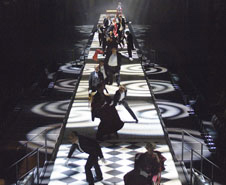
Sapsis Rigging, Inc. was part of the critically acclaimed Lincoln Center Festival production of Die Soldaten at the Park Avenue Armory in New York City. The company provided rigging consultation, design, and equipment for this landmark opera production from 20th-century German composer Bernd Alois Zimmermann. The rigging equipment for Die Soldaten, which included over 150 chain hoists and approximately 3,000' of truss, was part of an overall load in that took two weeks to complete.
Mike Sapsis, who shared onsite supervisor duties with son, Paul, noted, "Working in this venue is always interesting. The 55,000-sq.-ft. space is great to work in, but, because it was built in 1877, hanging even a normal show in here can be a challenge. Die Soldaten was anything but normal. This production, with the moving risers and everything else going on, presented it's own set of demands. Thanks to a great team and excellent communication with the Lincoln Center festival design and production teams, we put this project together quickly and safely. |
|
Visit our website sapsis-rigging.com
or give us a call 800-727-7471
|
|
|