|
In honor of Cervical Cancer Awareness Month,
this issue of YWM is devoted entirely to
cervical cancer and HPV, whose presence is
seen in 99.7% of all cervical cancer cases.
Cervical cancer is the second most common
cancer in women. Worldwide, nearly 500,000
women
around will develop cervical cancer
and 300,000 women will die from it. In the
United States, after breast cancer, cervical
cancer is the leading cause of cancer death
in women ages 20-39.
Because there are no symptoms until it is
advanced, cervical cancer is extremely
devastating disease. In this day in age, no
woman should die from cervical cancer!
Between the HPV vaccination, the Pap Test,
and the HPV test, we can eliminate
cervical cancer. But many women do not have
the knowledge or access to these resources.
Whether or not you decide to get the HPV
vaccination, every woman needs regular
screening. It is recommended that women
between the ages of 19-29 receive a yearly
Pap and women 30 and older should get an HPV
test. Check out the articles below and our
Cervical Cancer/HPV Fact Sheet to the right.
Protect yourself by learning about the facts
and available resources. Spread the word by
talking to your friends, mothers,
daughters and
grandmothers and ensure that they know how to
protect themselves.
Don't wait! Talk to your doctor today about
the vaccination, the Pap, and the HPV test to
determine what the best option is for you. If
you are 26 and under and are interested in
getting the HPV Vaccination but are unable to
pay because you are either uninsured or your
insurance does not cover the vaccination,
check
out these resources. If you are
privately insured but your insurance does not
cover the vaccination, be sure to read about
the article on the Does Replacement Program.
If there are no resources available in the
community where you live, take action and get
involved!
Sincerely,
Shannon, Alison,
and, as always, the entire YWTF Coordinating
Board
| Do You Need The HPV Test? |
 |
|
From
Better Health and Living
You've probably heard about the HPV vaccine-a
series of three shots that protect against
infection with strains of the human
papillomavirus that are responsible for 70
percent of cervical cancers. Right now, this
vaccine is FDA approved for women ages 26 and
younger. What you may not know is that for
women over age 30, another HPV-related tool,
an HPV test, can help stop cervical cancer.
When given along with a traditional Pap test,
this check can help catch more cervical
cancers in their earliest, most treatable
stages than a Pap smear alone.
Even women whose Pap tests have always been
normal may benefit from this important new
test, yet many women haven't heard about it.
"The Pap is one of best cancer screening
tests ever made, but it's not perfect. It
doesn't pick up important precancerous
changes in all cases," says HPV researcher
Daron G. Ferris, MD, director of the
Gynecologic Cancer Prevention Center at the
Medical College of Georgia in Augusta. "The
HPV test is more sensitive at detecting
moderate to severe precancerous changes, but
it's not being used as widely as it could be.
Women should discuss this extra test with
their doctors and find out if their insurance
company will pay for both."
About 11,000 women are diagnosed with
cervical cancer each year; 3,000 die. Here's
what you need to know.
|
| U.S. and European Advocacy Groups Launch United, Global Campaign to Prevent Cervical Cancer |
|
|
From PR
News Wire
WASHINGTON, Jan. 14 /PRNewswire/ -- Marking
Cervical Cancer Awareness Month in the United
States, a coalition of U.S. women's health
advocacy groups, policymakers, healthcare
providers and others is partnering with their
European counterparts in a united, global
awareness campaign to prevent cervical cancer
worldwide. The Pearl of Wisdom Campaign to
Prevent Cervical Cancer
(www.PearlofWisdom.us) will raise awareness
of cervical cancer, encourage women to take
advantage of the means that are now available
to prevent it, and work to make sure that
these methods are accessible to girls and
women around the globe - particularly to the
underserved populations that have much higher
rates of cervical cancer. The campaign will
promote the Pearl of Wisdom as the global
symbol for cervical cancer prevention and
will help all participating groups unite
behind a core set of messages.
"Cervical cancer devastates too many women's
lives around the world, with nearly 300,000
women dying from this disease each year,"
said Dr. Anne Szarewski, interim president of
the Brussels, Belgium-based European Cervical
Cancer Association (ECCA), which initiated
the campaign. "However, research has
established that cervical cancer is caused by
persistent infection with a very common virus
called the human papillomavirus (HPV), whose
presence is seen in 99.7% of all cervical
cancers. So, almost all cervical cancers are
now preventable through organized screening
with Pap tests, HPV tests and immunization
programs with HPV vaccines."
|
| Clinical trials often only hope to fight cervical cancer for India's poor |
|
|
From
Courier-Journal.com
KOLKATA, India - Snechalata Maity wipes away
tears with one end of her blue-and-green sari
as she voices her fears about the cervical
cancer threatening her life.
Yet, she draws hope from a cancer treatment
study, a cooperative effort between
Chittaranjan National Cancer Institute in
Kolkata and the University of Louisville.
"I think I will be recovered," the
58-year-old housewife and mother of four says
through an interpreter in a women's ward
crowded with cancer patients. "This is the
only thought in my mind."
The study involves testing a treatment for
advanced cervical cancer that uses interferon
shots and pills of retinoic acid, a Vitamin A
derivative, to boost the benefits of radiation.
Poverty, combined with a lack of cervical
cancer awareness, screening and access to
health care, mean the vast majority of cases
are diagnosed late.
|
| Drugmaker Seeks FDA Approval For Gardasil For Males |
|
|
From Jezebel
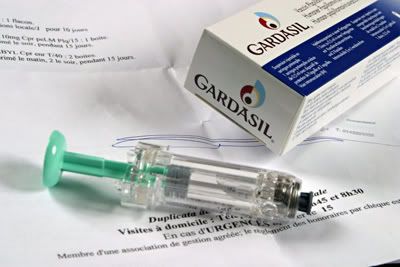
Drugmaker Merck has asked the FDA to approve
the Gardasil vaccine's use for boys ages 9 to
26. For those who don't know, Gardasil is a
vaccine that protects against HPV and
cervical cancer.
Gardasil first hit the market in 2006 and was
initially recommended for girls and young
women, ages 12-26. Due to aggressive
marketing, Gardasil quickly became one of
Merck's top-selling vaccines, with sales of
$1.5 billion in 2007 (which were perhaps
aided by the high cost- $360 for a three-dose
regimen). Despite becoming a requirement for
immigrant women, sales slowed in 2008 after a
government-funded Harvard study found that it
was not cost-effective to administer Gardasil
to women in their 20s.
Gardasil for men is not a new idea. Merck has
long planned to release a vaccine
specifically for males, which seems like a
great idea considering that men are more than
simply the carriers of HPV. Men infected with
HPV run the risk of getting cancer of the
genitals or mouth, not to mention genital
warts. In Merck's initial testing, Gardasil
prevented 90 percent of cases of penile
cancer and genital warts in the 4,000 males,
ages 16-26, who received the vaccine.
|
| Merck Launches Dose Replacement Program for HPV Vaccine |
|
|
From AAFP News Now
Delegates at the AAFP National Conference of
Special Constituencies recently took action
on a measure intended to address the high
cost of some vaccines recommended for routine
administration by the CDC's Advisory
Committee on Immunization Practices, or ACIP.
Now the manufacturer of one such vaccine,
Merck and Co. Inc., has launched its own
initiative aimed at helping physicians and
other immunization providers defray some of
these costs.
Physicians who enroll in Merck's Dose
Replacement Program can receive a limited
number of free replacement doses of the
company's quadrivalent human papillomavirus,
or HPV, vaccine, Gardasil, when they
administer the vaccine to privately insured
19- to 26-year-old women and later learn the
women's insurance plans provide no HPV
vaccine coverage.
|
| Immigration authorities add Gardasil to list of required vaccines |
|
|
From Feministing
U.S. Citizenship and Immigration Services
(USCIS) announced today a revised list of
vaccines required for applicants seeking to
adjust status to become legal permanent
residents. This revision follows guidance
from the Department of Health and Human
Services, Centers for Disease Control and
Prevention (CDC).
CDC's revised Technical Instructions to Civil
Surgeons for Vaccination Requirements require
the following age-appropriate additional
vaccinations to adjust status to legal
permanent resident:
* Rotavirus
* Hepatitis A
* Meningococcal
* Human papillomavirus
* Zoster
The requirements for these new vaccines went
into effect on July 1, 2008, however CDC
approved a 30-day grace period for any
medical exam conducted before August 1, 2008.
At that time the new vaccinations, if
appropriate, must be administered in order
for USCIS to approve the applicant for
adjustment of status.
|
|
HPV and Cervical Cancer Facts |
|
|
|
1. HPV is a virus that includes more than 100
different stands, more than 40 of which are
sexually transmitted
2. Only a few high risk types cause cancer
3. HPV causes normal cells of infected skin or
mucous membrane to turn abnormal
4. 10% of women with highest risk HPV on their
cervix will develop long lasting HPV
infections that will put them at risk for
cervical cancer
5. Approximately 20 million Americans are
infected with HPV and 6.2 Million become
newly infected each year
6. Most HPV infections will be cleared up by the
immune system within 8-24 months but if a
person's immune system does not clear the
infection with high risk, he/she is at high
risk of developing cervical cancer
7. The HPV Vaccine is highly effective in
preventing HPV infection with two "high risk"
types (16 & 18) that cause 70% of cervical
cancer, and types 6 & 11, which cause 90% of
genital warts
8. The vaccine is recommended for girls/women
9-26 and is given through a series of three
shots over a six month period
9. 74% of new infections occur among young
people 15-24
10. HPV can go undedicated for years, so it is
difficult to know when people have become
infected, how long they have been infected,
and who passes it to whom
11. Even if you are sexually active, the vaccine
can be beneficial because it is unlikely that
you have been exposed to all 4 types of HPV
the vaccination protects against
12. The Pap test is used to look for abnormal
cervical cells. It only catches about 70% of
cervical cell abnormalities - this is why it
is important to have a Pap done every year
13. The HPV test is a very accurate way to tell
if high risk HPV is present in a woman's cervix
14. Risk factors for persistent HPV infection and
or progression to cancer include: multiple
partners, lack of condom use, smoking, HPV
type, and increasing age
If you would like more information regarding
the safety of the HPV vaccination, read
the CDC's Q&A
|
Brought to you by the Younger Women at YWTF
|