 |
|
|
How I Got Published:
The Editing Company features Kathy Caprino and Penny Pearlman
First in a series on local authors
|
|
|
Dear Reader,
This newsletter is the first in a series on local writers who are getting
published.
At tEdCo, we are interested in educating writers; you need
to know the real story of what it takes to write and publish a book. Lately,
we've been writing about the steps that will generate a published book.
Obviously, there are some steps you can skip (hunting for an agent). But
writing a book is... well, like writing a book - it takes complete commitment,
vision, and hard work. Even after you have a final draft, you have to be
prepared to hear from your support system: editors, agents, and friends. And
then, you may need to make changes---your premise needs tweaking, or you need to
cut one third out, or maybe you need to interview 50 more people. It's not
easy.
However, this is the kind of commitment these two writers have,
and they each have excellent books to show for their efforts.
Penny Pearlman chose to self-publish while Kathy Caprino found a traditional publisher
for her project. They took different routes, but both still had to spend hours
researching and re-writing. They relied on professional advice at every step of
the process.
Both are first-time authors, both professional women, both
are enhancing and defining their professional standing, both committed to
helping other women and, perhaps, both looking for a little adventure (OK, in
Penny's case, a lot of adventure).
Here are their stories.
Cheers,
Tish
|
|
In this Newsletter:
How I Got Published: Kathy Caprino
How I Got Published:
Penny Pearlman
Special Promotion: Design & Editorial Consultation
|
|
Kathy Caprino
Kathy is a work-life expert and author. A national champion for professional women in crisis, she is a trained psychotherapist, specialized career and life coach, and sought-after writer and speaker on women's issues. She is founder and president of Ellia Communications, Inc. and a former corporate VP.
|
|
Penny Pearlman
Penny is an accomplished motivational speaker, business
consultant and seminar leader who helps individuals and organizations develop
strategies for success. Her personal journey has
included executive positions in the health care industry, management consulting
and nonprofit leadership. Her left and right brain work equally well as she has
a B.A. in fine art from Queens College and an MBA from the Wharton School. |
|
|
|
Breakdown, Breakthrough:
The Professional Woman's Guide to Claiming a Life of Passion, Power and Purpose
 Drawing on her own
work experience in the corporate world, Kathy Caprino was well aware of the
harsh challenges working women face in achieving success, satisfaction,
wellness, and balance in life and work. After a series of grueling professional
crises and traumas, and a brutal layoff in the days following 9/11, Kathy chose
to reinvent herself, and received training as a psychotherapist and a career
and life coach. As she began giving
talks to women about career reinvention, she became alarmed at a trend she was
seeing among her female audience and clients.
Drawing on her own
work experience in the corporate world, Kathy Caprino was well aware of the
harsh challenges working women face in achieving success, satisfaction,
wellness, and balance in life and work. After a series of grueling professional
crises and traumas, and a brutal layoff in the days following 9/11, Kathy chose
to reinvent herself, and received training as a psychotherapist and a career
and life coach. As she began giving
talks to women about career reinvention, she became alarmed at a trend she was
seeing among her female audience and clients.
"After devoting
years to building successful careers, midlife women often feel their
professional lives and identities no longer work. These women are having
full-blown professional crises - or what I call "breakdown."
Breakdown can serve as a wake-up call, informing women that major change in
life or work is required - now. I know
now that seven out of 10 working women report that they are facing a major
turning point in their professional lives, and over half don't know what to do
about it. Working women, particularly
those in their middle years, are at a critical juncture."
So Kathy set out to
learn more about this phenomenon, and conducted a yearlong national research
study with women who'd overcome professional crisis. In the process, she gathered compelling case studies for a book.
She soon discovered that the research, writing and publishing process would
take her on an unexpected journey. Caprino is very frank about her ups and
downs along the way, and her discovery that getting expert help and remaining
teachable at all times throughout the process made all the difference.The final product: she has written a powerful and
compelling non-fiction, self-help book for women. The format is highly
effective - she has three big ideas per chapter, inspiring stories from real
people (and these stories support her three big ideas), exercises to help the
reader integrate the book's messages, and an easy-to-follow format that's
well-presented with white space, boxed info and tips. The format and design embraces diversity and takes into
consideration the various learning styles of a wide
audience.
Keep reading! Kathy
describes her book development process ~ continued below.
|
Pretty Smart: Lessons From Our Miss Americas
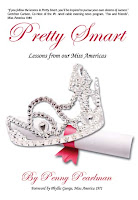
Penny Pearlman did something pretty smart. She completely turned stereotypical thinking
about Miss America around by looking beyond the lip-gloss and glam. She
discovered strong, motivated, educated women who, after the contest, went on to
become highly successful individuals. Pearlman, a change facilitator, saw an
opportunity to connect with a larger audience using the stories and strategies
for success of the individual Miss Americas. This modeling would be useful to
help others in finding their passion and attaining their goals.
As Penny
says, "There is no secret to fulfilling a passion or a dream. The
ingredients are the same, though the mix may be different for each of us.
Persistence, discipline, focus, courage and vision are the drivers in our soul
that keep us moving forward."
But first
Penny had to face her own fears: leave her family, jump on airplanes, convince
strangers to meet with her and somehow create a book out of all of this. She
had the great idea and the great title but did not know one Miss America. That
did not stop her. She jumped on that first airplane, attended her first pageant
and had her excellent adventure and her book.
"Like lots of ideas, when I came
up with the theme, I thought it was destined for the file cabinet. But after a
while it took a hold of me and wouldn't let go. So I poked at the concept for a couple of years to see whether it
had legs. After that I had to decide if I would be willing to commit the time,
energy, resources and angst I knew I would experience to bring it to life. It didn't take long for me to answer YES on
all counts. Then I got serious. I had found my passion. Having never published a full-length book,
this looked like one daunting task. I
spent two and a half years powering my way through the researching,
interviewing and writing of Pretty Smart."
Keep reading!! Here's my interview (continued below) with this resourceful, smart
woman. (Tips are in bold.)
|
About Berrett-Koehler Publishers (no agent necessary!)

"Berrett-Koehler is an independent publisher with an ambitious mission: Creating a World that Works for All. We believe that to truly create a better world, action is needed at
all levels--individual, organizational, and societal. At the individual
level, our books help people align their lives with their values and
with their aspirations for a better world. At the organizational level,
our books promote progressive leadership and management practices,
socially responsible approaches to business, and humane and effective
organizations. At the societal level, our books advance social and
economic justice, shared prosperity, sustainability, and new solutions
to national and global issues."
|
|
Caprino continued~
"After my own reinvention, I began giving talks locally to women
about life change, and also coaching them. I began to witness that
thousands of working women today are miserable and "breaking down" in
their professional lives. I was compelled to do something about it - help
women bypass what I'd experienced, and be part of the solution, and share these
solutions with women in a large way. I longed to write a book outlining
the steps women needed to take that would help drive positive life
change.
As I wasn't experienced as an author, I sought help right away. I hired a great writing and book proposal coach to advise me
on my book proposal and chapter development. Through that process, I was led to meet with a top
editorial consultant in NYC who helps authors take their ideas to the next
level. This was a costly step, but it was well
worth it, as a way to assess the critical steps necessary to get my book
published. She indicated that I was a fine writer but I hadn't found my
"big idea" yet, and the "big idea" is what would make my
book unique and relevant to a wider audience. She
gave me some very important advice. She said I needed to do three things: l.
research, research, and more research; 2. gain affiliation and widen my
platform - become affiliated with associations, organizations and individuals
in my field who would serve as my "community"; and 3. take all my skills, talents, and experiences
from my previous professional life and build on those to take me to the next
level. She told me to "marry up" who I had been in the past with
where I wanted to go. In this way, I'd be able to move forward in a more
expansive way.
That advice changed
everything. The next day, I had a thunderbolt
- as I had been a market researcher in my previous corporate life, I realized
that I could conduct a national research study, and learn about professional
crisis in a much bigger way that I had previously experienced. And my big idea did in fact emerge from my
yearlong research. I interviewed over 100 women across the country, either in
person or on the phone. With their permission, I recorded and transcribed these
interviews and soon, patterns started emerging. After hours of analysis and evaluation, I began to see that that
there are 12 "hidden" crises women are facing, on four different levels of
empowerment, and that these are vastly different experiences than those of
professional men.
I kept interviewing, to verify,
validate and inform. After six months of research, I knew where the book was
going, and I revised my book proposal. I sent the proposal to a friend of the family who is a literary agent, for his review. He liked it and thought it "had legs," and gave me the name of
several agents who work with women's authors.
It turned out it was essential that I had earned a masters degree, as
this adds to an author's credibility in the non-fiction arena. (Tip: In non-fiction, agents won't even
look at a proposal without the author having an advanced degree).
Despite over 10 agent rejections, I never lost hope during this process and I
never doubted the value and importance of this material and information; I
just kept moving forward with faith and perseverance. Finding an agent with whom I wanted to partner was very
difficult. I finally found one who liked the project but he and I had very
different style. I felt uncomfortable
with his approach and vision of my book.(Tip: It is very important to find
the kind of agent that is the right fit -- ethics, integrity, style,
approach -- everything has to be right.)
After a year of attempting to find
an agent with no success, a friend told me that his colleague had been
published by a wonderful non-fiction house which doesn't require agent representation
- Berrett-Koehler publishers . I reached out to the author - Noah
Blumenthal, author of You're Addicted to You - and he was very generous with
mentoring advice on my proposal. After
another round of tweaking, I submitted it to Berrett-Koehler, and was accepted
shortly thereafter (after yet a few more proposal tweaks!). I was thrilled. Little did I know that Berrett-Koehler's process would involve a
multi-stage rigorous editorial development process, but I trusted their great
team and my fantastic editor.
At first, a few on the management
team believed my project was too risky as I hadn't yet developed a media
platform, but the president of the company believed in me and the project. (Tip: I told the publisher up
front that I was willing to hire a publicist. - a step publishers need and
want to see, and is vitally important in gaining national media exposure as an
expert in your field.)
The book development process was
very collaborative and fascinating. For
instance, B-K conducts a survey on the
book's title - that's how involved they are. My editor, Johanna Vondeling, was instrumental in helping my book take shape. She constantly questioned me and challenged my thinking, helping me
develop a solid "model for change" that could stand the test of time. She helped me communicate in a simple and
direct way the vital information I'd learned about the root causes of the 12
"hidden" crisis professional women face and key steps to overcome
these crises. I was encouraged to
simplify and distill my coaching advice into to three main steps. The three steps are: Step Back - to gain an
empowered perspective; Let Go - of the thinking, actions, and beliefs
that hold you back and keep you stuck; Say Yes! - to yourself, and to
your compelling future visions -- and move toward them.
My editor also asked me to include
more of my subjects' tips and advice. Their narratives would personalize my
message. (See Editing Co's article on Storytelling in our archives.) And finally, my editor
continued to keep after me: "Simplify,
simplify, simplify! Be clear and
concise." (Tip: a great book for understanding why certain concepts "stick"
and certain ones don't, is "Made to Stick" by Chip and Dan Heath).
Another great service that B-K
provides is to sponsor an Author Day at the company. All authors are invited to
a day dedicated fully to their book.
Authors present their books to the entire publishing staff and
illustrious invited guests (prepare your elevator speech!) and then they give
you feedback. The publisher critiqued me after I presented the book, and
said (Tip)"When you speak about
your book to the media and to potential readers, we need you to be an "author,"
not a therapist or coach. You need to communicate about the book in a
very compelling, "sticky" way so that readers will be grabbed
immediately.
I received even more feedback
about simplifying my premise and messages down, and this proved to be a big
challenge. As part of the development
process, B-K sends out each manuscript to four hired reviewers for feedback.
Even more editing ensued! I threw out a
good deal of what I'd previously written, and refined the parts that had been
well researched and well-documented. Tip: rewriting and editing can be a full-time
job. In total, the book took a year
to write, several months of which involved eight to ten hours of writing per
day. When I was done with the editing process, a copyeditor stepped in to do a
full line-edit.
Overall, as challenging as it was,
I deeply loved the collaborative nature of B-K. I was able to participate in a
fabulous creative team approach to designing the cover and the interior of the
book, and my editor brought the book to a much higher level that I could have
achieved alone. Six months later after
submitting the final manuscript, I was published author, with a product I'm
extremely proud of.
|
|
Pearlman continued~
TF: You had a terrific idea and great material and yet you
decided to self-publish. Did you have a specific reason why?
PP: Timing was the main reason. I was offered the
opportunity to launch my book at the Miss America pageant in January of this
year. I had been working steadily all through 2008 but there was no way I would
have had the time to work with a traditional publisher, much less find an
agent. I also wanted to go with self-publishing because I was very clear about
my vision for the project and I wanted to have complete control over the
material. Getting editorial advice from an agent and from your publisher can be
extremely helpful in developing your project, however, they can also impose
their structure or vision.
TF: Did you get help in developing the book?
PP: From the very
start, I knew I had a lot to learn; I needed to study the craft, hone my writing skills and dig deep tolearn how to write in a different voice. I took
workshops right here in Westport at the Westport Writer's Workshop. I
worked for one year before I even started the book.
TF: Did you get editorial advice?
PP: Oh yes. I had a number of readers who gave me feedback.
My main reader is a published author and she worked with me
and gave me structural information at every step. If you haven't written a
book before, it is very important to get some editorial assistance with your
outline, the structure of your chapters and overall editorial advice. I then hired a professional copyeditor
who went over every word and did fact checking. I recommend that anyone
self-publishing hire a copyeditor.
TF: At tEdCo we tell our clients that writing a
book is a long process. Talk about how long it took you to do your interviews,
transcribe, edit and get a first draft.
PP: Over two years with 800 transcribed pages from more than
30 interviews.
The last year, writing was a full-time job and in the
last three months, I worked 10-12 hour days. And the revision process took
as long as the writing process. I revised every chapter 4-6 times and that
was before it went to my readers. Then I went back and revised again. Tip: I
found it helped when I had revised a chapter thoroughly on paper to read what I
had written out loud. (TF - this
is what Patrick advises all our writers to do.)Then repetitive words,
awkward sentence structure and out-of-context comments tended to stand
out. I could also feel the rhythm of
the words more clearly and it helped me create a more natural narrative.
I have advice to share to writers about organizing a lot
of research material. And organize is the key word. I had over 800 pages of
transcripts and another 100-200 pages of support material. It was overwhelming.
I first made a list of chapter titles. I started the project with 16 chapters,
later simplifying down to 12. I gave each chapter a code. Then I read through
the 800 pages and coded practically every page or paragraph according to which
chapter I thought it would best go. For
each chapter I had a folder. Then I cut up each coded section,
making sure that I marked the page they came from and who was talking with
their initials. I put the folders on a big
table. I put each coded piece in the appropriate chapter folder so that when I
was ready to write a chapter, I had all of my relevant material in one place -
my quotes, my stories, my research. And it was great that I could pick and
choose because I had so much material. This process took three weeks. Then I
printed out the transcripts and put them in a binder. If had I cut out a
paragraph or section, because it was coded, I could go back to the complete
page in the binder and see what happened before and after that particular
section.
TF: Was it difficult getting those interviews?
PP:It was difficult in the beginning and took some
creative thinking and a commitment of resources. I knew I would have to meet these women face to face to get them
to say yes, so I went to the Miss America Pageant in 2007. I have an important tip about interviewing
celebrities or high-level people of any sort. Walk through your fear. You
have to ask - the worst thing they can say is no. If they say no, you go to the
next person. They won't think less of you for asking. You'll be surprised how
many people say yes. Make a list of people larger than you need. And do your
homework! When you approach a subject, make sure you know everything you can
about that person and your project. You must be informed. I was an ordinary
woman with an idea and no press credentials and yet I got them to the yes.
Preparation is key.
TF: You chose Authorhouse. Could you tell us why?
PP: I did my research and called different publishing houses
and looked at their books. I knew I wanted Print On Demand (POD) - you don't
have to buy any inventory. I also knew
I wanted the highest quality product with a custom cover. Authorhouse seemed to
offer a quality product and had a good track record. It's important for you to
do your due diligence. Call them! Find out all
the different packages they offer. I am happy with my choice. I bought the
"rapid release process" guaranteeing a book in my hand in SIX weeks; interior,
cover, galleys - everything. TIP: stay on top of them! Things will always get lost in translation.
Use their phone support system. I was
on the phone a couple of times a day - to several times a week, every week to
make sure they understood my instructions. Anytime you are in production with
anything, you have to stay on top of it. Don't be afraid to call if you have
any questions. There are always confusing things in the electronic process,
i.e., uploading photos correctly. It's best if you send them the most complete
ideas you have. For example, I spent a lot of time looking at book covers, book
interiors, table of contents, etc., until I had a good idea of what I wanted my
book to look like. Here's a concrete example on headers: I knew that I wanted
all of my chapters to start on the right hand page and I wanted the chapter
title to appear on the right handpage of its
chapter. That was not standard. I made the request and stayed on top of it.
Another example: I had an idea for the cover and even sent them a mock-up. They
want your direction, they want you to be happy and they want to speed up the
process. Don't expect them to come up with ideas. Give them direction.
Who knows better about the heart of your book than you?
TIP from TISH: If you don't have time think about lay-out
and design, it is an excellent time-saving idea to have a consultation with our
book designer LAURA CASE. She has twenty years experience as a book designer
for major houses and is an expert on self-publishing, knowledgeable about the
software for each publisher. She can help you get the most out of each house
from the most expensive to the least expensive.
TF: Did Authorhouse get you on Amazon?
PP: Yes, on Amazon
and BarnesandNoble.com. If you want to
be in the bookstores,you have to sign up for their "bookstore return program." It is not that expensive. They charge you a
fee so that they can let the bookstores return the remainder if necessary.
Otherwise, bookstores won't touch the self-publishers. Authorhouse also has an extensive array of marketing programs including help with press
releases and national email blasts.
Tip: I recommend hiring publicists. But it is expensive
so first do as much as you can yourself by contacting local press and working
on your "elevator speech."
TF: By taking the initiative and getting a book
out there as quick as you could, you have opened up a new world of opportunity,
right?
PP: Yes. I now call it my great mid-life adventure I had so
much fun and learned so much about a world I didn't know about and I learned
about my self. I got SOUL satisfaction, stretching myself personally and
professionally, achieving a goal that I didn't know was possible. I now have
professional speaking engagements, on both coasts, many consulting assignments,
and other business opportunities that are fun and exciting. I also have also
been asked to co-author a couple of books by a couple of my interview subjects.
Believing in yourself and following your passion is the gift that enriches
your life.
|
|
Laura Case Design and The Editing Company
$150 special promotion
Take a meeting with our team and get started on your self-published project. tEdCo will provide editorial assistance (structure and manuscript analysis). Laura will tell you all about the various self-publishers and how to navigate through their process and software. Call us today! 203-454-4522 or email tish@theeditingcompany.com to set up your consultation.
|
|
|
|
|
|
|
|


