JOIN Mailing LIST
[click phone] | | | | |

| ACIM
CONFERENCE
April 26,27,28 2013
Register NOW for 23% OFF
Course in Miracles Society (CIMS), is pleased to be a co-sponsor of the CHICAGO 2013
ACIM Conference | |
*When you register please tell them that you were referred by Course In Miracles Society (CIMS).*
| |
|
| | | | |
|
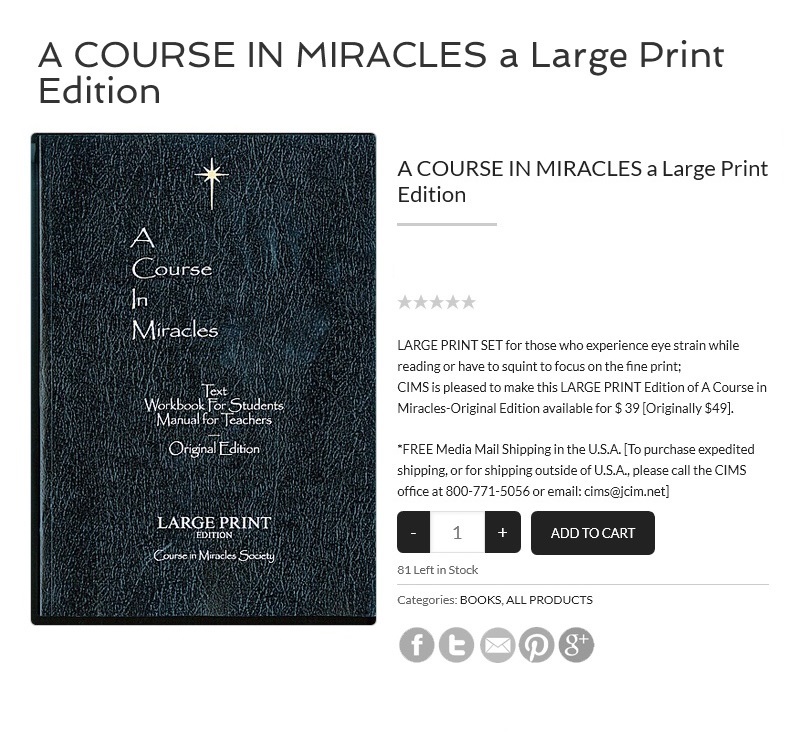
LARGE PRINT ACIM on sale now! | |
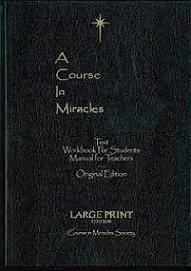
| |
|
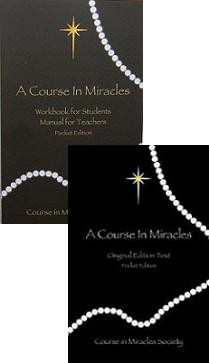
| LIMITED EDITION |
 | | Deluxe Gift Set |
Distinctive Black Cloth Hardcover,
with Gold Embossed Lettering
Pocket Sized with Slip Cover
Only 500 published | |
|
|
CIMS
NEWSLETTER |  | |
Monthly Newsletter from CIMS
|
| MUSIC from mARTin |  | |
|
|
ACIM GATHER PALTALK
STUDY GROUP |  |
" ACIM:The Original Edition,
Cover to Cover "
with REGINA DAWN AKERS
Every Friday, 2:00-3:30 PM ET on ACIM GATHER / PalTalk LISTEN to PREVIOUS SESSIONS
If you have never attended a chat room study group or need a refresher on how to access this room, please visit the following site:
|
|
Now Available |  | |
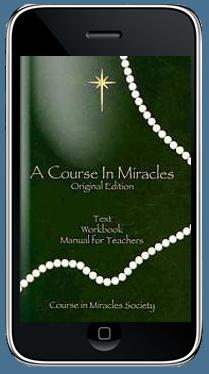
Now you can read The Course in Miracles ~ Original Edition on your KINDLE!
This Kindle Edition contains the Text, Workbook and Manual.
|
| E-Book
Text
Workbook
Manual |  | |
The electronic PDF
version of
A Course in Miracles
original edition
is now available.
BUY NOW
$9.95 |
 | |
REVIEW
A Course in Miracles is a self-study course. In the beginning it tells us, "This is a course in miracles. It is a required course. Only the time you take it is voluntary. Free will does not mean
you can establish the curric...
 | |
|
| About CIMS |  |
Course in Miracles Society (CIMS) is an international group of Course students and teachers organized to discover, authenticate and propagate the Divine Teachings of A Course in Miracles.
As students, we seek to increase our knowledge of Jesus' words and to deepen our experience of His teachings.
As teachers, we work to circulate the message of
A Course in Miracles throughout the world by our words, by our deeds, and by the example of our lives.
|
|
Namaste!
 CHAPTER THREE
"Retraining the Mind"
VIII. Judgment and the Authority Problem "When you feel tired, it is merely because you have judged yourself as capable of being tired. When you laugh at someone, it is because you have judged him as debased. When you laugh at yourself, you are singularly likely to laugh at others, if only because you cannot tolerate the idea of being more debased than they are. All of this does make you feel tired because it is essentially disheartening. You are not really capable of being tired, but you are very capable of wearying yourselves. The strain of constant judgment is virtually intolerable. It is a curious thing that any ability which is so debilitating should be so deeply cherished."
~ ACIM OrEd.Tx.3.65
|
|
L e s s o n 35
My mind is part of God's. I am very holy.
<AUDIO> <VIDEO>
Voice & Music by CIMS SonShip Radio
< GUIDANCE from ELDER BROTHER >
1 Today's idea does not describe the way you see yourself now. It does, however, describe what vision will show you. It is difficult for anyone who thinks he is in this world to believe this of himself. Yet the reason he thinks he is in this world is because he does not believe it.
2 You will believe that you are part of where you think you are. That is because you surround yourself with the environment you want. And you want it to protect the image of yourself that you have made. The image is part of it. What you see while you believe you are in it is seen through the eyes of the image. This is not vision. Images cannot see.
3 The idea for today presents a very different view of yourself. By establishing your Source, it establishes your identity, and it describes you as you must really be in truth. We will use a somewhat different kind of application for today's idea, because the emphasis for today is on the perceiver rather than on what he perceives.
4 For each of the three five-minute practice periods today, begin by repeating today's idea to yourself and then close your eyes and search your mind for the various kinds of descriptive terms in which you see yourself. Include all of the ego-based attributes which you ascribe to yourself, positive or negative, desirable or undesirable, grandiose or debased. All of them are equally unreal, because you do not look upon yourself through the eyes of holiness.
5 In the earlier part of the mind searching period, you will probably emphasize what you consider to be the more negative aspects of your perception of yourself. Toward the latter part of the exercise period, however, more self-inflating descriptive terms may well cross your mind. Try to recognize that the direction of your fantasies about yourself does not matter. Illusions have no direction in reality. They are merely not true.
6 A suitable unselected list for applying the idea for today might be as follows:
7 I see myself as imposed on.
I see myself as depressed.
I see myself as failing.
I see myself as endangered.
I see myself as helpless.
I see myself as victorious.
I see myself as losing out.
I see myself as charitable.
I see myself as virtuous.
8 You should not think of these terms in an abstract way. They will occur to you as various situations, personalities and events in which you figure cross your mind. Pick up any specific situation that occurs to you, identify the descriptive term or terms which you feel are applicable to your reactions to that situation, and use them in applying today's idea. After you have named each one, add:
9 But my mind is part of God's. I am very holy.
10 During the longer exercise periods, there will probably be intervals in which nothing specific occurs to you. Do not strain to think up specific things to fill the interval, but merely relax and repeat today's idea slowly until something occurs to you. Although nothing that does occur should be omitted from the exercises, nothing should be "dug out" with effort. Neither force nor discrimination should be used.
11 As often as possible during the day, pick up a specific attribute or attributes you are ascribing to yourself at the time and apply the idea for today to them, adding the idea to each of them in the form stated above. If nothing particular occurs to you, merely repeat the idea to yourself with closed eyes.
|
|
Workbook - Part 1  Introduction Introduction <AUDIO> <VIDEO>
Voice & Music by CIMS SonShip Radio
1 A theoretical foundation such as the text is necessary as a background to make these exercises meaningful. Yet it is the exercises which will make the goal possible. An untrained mind can accomplish nothing. It is the purpose of these exercises to train the mind to think along the lines which the course sets forth.
2 The exercises are very simple. They do not require more than a few minutes, and it does not matter where or when you do them. They need no preparation. They are numbered, running from 1 to 365. The training period is one year. Do not undertake more than one exercise a day.
3 The purpose of these exercises is to train the mind to a different perception of everything in the world. The workbook is divided into two sections, the first dealing with the undoing of what you see now and the second with the restoration of sight. It is recommended that each exercise be repeated several times a day, preferably in a different place each time and, if possible, in every situation in which you spend any long period of time. The purpose is to train the mind to generalize the lessons, so that you will understand that each of them is as applicable to one situation as it is to another.
4 Unless specified to the contrary, the exercise should be practiced with the eyes open, since the aim is to learn how to see. The only rule that should be followed throughout is to practice the exercises with great specificity. Each one applies to every situation in which you find yourself and to everything you see in it. Each day's exercises are planned around one central idea, the exercises themselves consisting of applying that idea to as many specifics as possible. Be sure that you do not decide that there are some things you see to which the idea for the day is inapplicable. The aim of the exercises will always be to increase the application of the idea to everything. This will not require effort. Only be sure that you make no exceptions in applying the idea.
5 Some of the ideas you will find hard to believe, and others will seem quite startling. It does not matter. You are merely asked to apply them to what you see. You are not asked to judge them, nor even to believe them. You are asked only to use them. It is their use which will give them meaning to you, and show you they are true. Remember only this-you need not believe them, you need not accept them, and you need not welcome them. Some of them you may actively resist. None of this will matter nor decrease their efficacy. But allow yourself to make no exceptions in applying the ideas the exercises contain. Whatever your reactions to the ideas may be, use them. Nothing more than this is required.
|
ACIM Edmonton - Sarah's Reflections 
Lesson 35
My mind is part of God's. I am very holy. Sarah's Commentary: Yesterday was the anniversary of my brother's death. I was not thinking about him, but toward the evening I was not feeling particularly happy my efforts to watch my thoughts and do my forgiveness work . The malaise just hung on like a grey cloud. Finally toward evening I settled into some quiet meditation time to prepare my mind for today's lesson. As I did so, I flipped the text open at Chapter 9 VI "The Acceptance of Your Brother" And there was the exact paragraph I had sent to my brother in his final days. It was a paragraph given to me by the Holy Spirit for him and made quite an impact on him. Now it was like my brother was reminding me of the same message on this anniversary!! It blew me away. Yet when I got over the initial amazement, I realized that this is always available to us at every turn. We are never abandoned. We are never left comfortless. The power of His Presence is always with us. I had just let my concerns block this Presence that is always in my mind behind every seeming problem or distress. The paragraph that showed up is as follows: "How can you become increasingly aware of the Holy Spirit in you, except by His effects? You cannot see Him with your eyes nor hear Him with your ears. How, then, can you perceive Him at all? If you inspire joy and others react to you with joy, even though you are not experiencing joy yourself there must be something in you that is capable of producing it. If it is in you and can produce joy, and if you see that it does produce joy in others, you must be dissociating it in yourself." (9.VI) And so, in today's lesson we learn what that "something in you" is. It is our holiness. It too is something that we are not aware of. It comes from nothing that we have done. It is only because of who we are as God created us because He is our source. And because of this, our inheritance, our true Self is made of the same stuff as God. All His attributes are ours. As this lesson says it is "not the way you see yourself now". (1.1) In order to see ourselves as He sees us we need to clear away all of those thoughts that we think we think, that create a self that we think we are!!! The ego self. The untrue self. What will it take for us to know our true reality....to know our holiness? This lesson says that "vision will show you". (1.2) We identify with the ego which is the separated self and, as such, we resist any thought that we are one with God. We believe we have made ourselves. We pride ourselves on this stance. The course calls this the authority problem. "The issue of authority is really a question of authorship. When you have an authority problem, it is always because you believe you are the author of yourself and project your delusion onto others. You then perceive the situation as one in which others are literally fighting you for your authorship. This is the fundamental error of all those who believe that they have usurped the power of God." (T-3.VI.8:1-4) We really believe that we are in this world. We do so because we have created an image of ourselves and surrounded ourselves with the environment which will protect that image. This lesson asks us to really look at this self image that we have made. We are always trying to find ways to enhance that image. We are constantly trying to find ways to "better ourselves". We justify our attacks on others as coming from them first thus leaving us no option except to counterattack. We see ourselves as innocent victims in a cruel and harsh world. We feel alone and separate from others. Here we are asked to bring our awareness to how we see ourselves by looking at all the attributes we use to describe ourselves. As we bring our awareness to these attributes we can step aside from them and increasingly recognize their falsity. These images are NOT who we are in Truth. This is what we see but as this lesson says, "images cannot see". (2.7) As discussed before, when we see with Christ's vision, we will recognize that nothing we see with our eyes is real. But right now we don't believe that, and because we don't, we experience ourselves as being in this world. The world supports our belief that we are all separate from each other, separate from God and alone and vulnerable. We believe that the world is real and that we are part of it. And as such we are on our own, separate from God, limited, independent, and victims of the world we see. We made the world to keep us from awareness of our holiness and it does so by protecting our image as separated beings. And so this lesson says that it is not that we think we are unholy because we are in the world, but that we are in the world because we think we are unholy. The truth is that although we think we have left God we have not and cannot. This is what the Atonement Principle assures us of. We simply can't leave God. But Jesus tells us here that our right minds are very much connected with the holiness of God and that we have never changed the truth about ourselves in spite of our beliefs in separation. We could say that no one in his right mind would come here. It was the wrong mind that made the ego. Now, we believe that we live in the body and the world which protects the image of what we think we are. Thus the environment that surrounds us makes a statement about us. But it is an illusory environment that protects the image and we use it to defend against the truth of who we are as the holy Son of God. Yet, as was said before, this image cannot see. We see everything through the eyes of this image and it is all very convincing isn't it? We think that what the eyes report to us is real. The image, of course, is not actually who we are. "The idea for today presents a very different view of yourself. By establishing your Source it establishes your Identity". (3.1-2) Our Source is God and our mind is part of God's Mind. It is not of this world. That is the nature of the Atonement principle which reminds us that we never separated from God. On one level it seems great to realize that we are not these images we have made and to know that there is nothing we have to do to become holy, to know peace and joy and love, except to give up the images that we have made? And to do this we just need to become aware of our thoughts and release them. And there is also reassurance in knowing that no matter what we may think about ourselves, that we are totally innocent because that is what God is. Thus, every time we proclaim that we are holy, that we are complete, that we are innocent, that we are whole, we remind ourselves that we are not this small, vulnerable, independent, fearful self, separate from each other and separate from God all alone in a terrifying world. Yes, it is reassuring but frightening at the same time if we really get this lesson. It means that we don't exist and are not even here. Because we are very invested in our separate, independent selves, the idea that this is not who we are is very threatening. We are invested in the image and in the world. Jesus knows this. He says "and you want it (this body and world) to protect the image of yourself that you have made." (2.3) It is because of that that we resist what the course is teaching. We fear the love that we are. Again, nothing will happen to us without our consent and therefore awakening to the truth of who we are is a process. The goal of the course is peace. As we do this work, what we will experience is release from the anxiety, sense of aloneness, and distress. Our trust will increase as we rely more and more on the guidance of the Holy Spirit. No matter whether we describe ourselves in terms that are "positive or negative, desirable or undesirable, grandiose or debased, all of them are equally unreal" (4.2-3), the reason being that they are all attributes of the image we have made. Even if I describe myself as spiritual or holy, it is still coming from an image operating within a false and illusory environment. Seeing myself in this way is to wear a cloak of spirituality where it is the ego that is spiritualized. It is important to recognize that while Jesus is telling us is that who we really are is holy, that the way we will know that is to bring the darkness of our ego thoughts to the light. Jesus knows that we do not see ourselves as holy now. He does not expect us to believe this about ourselves. We are not trying to cover up our ego perspectives with this thought as a spiritual override for ego thoughts. Instead, he is encouraging us to recognize that we have a right mind and that our holiness resides there, already in us. There is nothing to seek and do, only to undo our mistaken thoughts. Thus it is always important that we stay vigilant in watching our thoughts and taking responsibility for everything that we are projecting on others. With willingness to see that we are wrong about what we are perceiving, we will be more willing to let our thoughts go. When we start our mind-searching period we will "probably emphasize what you consider to be the more negative aspects of your perception of yourself". (5.1) It seems that he knows us well because we are much more comfortable with what we consider our smallness, our imperfections, all based on self criticism in the name of humility. We are even very comfortable sharing our faults with others. We can quite readily admit to feeling stupid, being disorganized, feeling imposed on, feeling victimized, not getting it right. So why then does he say that "toward the latter part of the exercise period, however, more self-inflating, descriptive terms may well cross your mind?" (5.2) It may be because the conceited self is disturbing to us. The grandiose ideas we have about ourselves are just not that acceptable to us. I mean, think about how uncomfortable you are with admitting that you feel better, more superior than others and saying some of these things that you believe about yourself to others. I mean to describe myself as victorious or virtuous is harder to say to myself let alone to anyone else. It seems disturbing. Or another way to look at it is that the positive attributes seem more acceptable and more holy and therefore we don't judge them negatively even though they are still part of the ego mind. Yet Jesus says "try to recognize that the direction of your fantasies about yourself does not matter. Illusions have no direction in reality. They are merely not true." (5.3-5) It is all a false self image. It is all illusory. It is all untrue and entirely meaningless. It actually does not matter which way your thoughts go about yourself except to recognize that whatever you think about yourself is untrue. We are constantly evaluating ourselves in every situation. We are constantly looking at how we are doing and who we think we are. How I am reacting to various situations, personalities and events brings up a descriptive term that is helpful in doing this lesson. Today a situation came up where I felt imposed upon. Another one brought forward feelings of frustration. Then I felt a sense of superiority in another conversation. Then I offered some money to a street person and felt both sad, virtuous and superior. This is how we can apply this lesson to any situation we encounter. It is easier to find the way we describe ourselves when these situations and people show up in the day or various events bring forward our self assessments. And all of these assessments are how we see ourselves as unholy in this world. That is why in each instance we remind ourselves of the truth. "But my mind is part of God's. I am very holy". Now for the specifics of this exercise today: First repeat the idea, then close your eyes. Take five minutes to do this lesson, three times today. Search your mind for descriptive terms you would apply to yourself, positive or negative (do not discriminate). Consider situations, people, events that occur to you and identify the term you think apply to you and your reactions in those circumstances. For example you might say " I see myself as helpful, giving, unkind, angry, sexy, depressed, unorganized, clever, skillful etc.]. All of them are equally unreal." After each one, add:"But my mind is part of God's. I am very holy." If, after a while, no specific terms occur to you, don't strain to dig up more. Relax and repeat the idea until another comes to mind. Remind yourself frequently throughout the day that "My mind is part of God's. I am very holy." This practice can take one of two forms: 1. Notice the attribute you are applying to yourself in any situation that confronts you today and apply the lesson as described. 2. If no attributes occur to you, just repeat the idea slowly with eyes closed. Again Jesus reminds us "nothing should be 'dug out" with effort," (8.3) meaning, again, that we should not be impatient with ourselves. Making an effort to do this lesson is different than forcing yourself. Love and blessings, Sarah Sarah's Home Page Quotes in this article are from Foundation for Inner Peace edition; To locate the same quotes in the 'Original Edition', use this link: http://www.jcim.net/acim_us/Acim.php
[Use 'Advanced Search' and Exact Phrase' option] |
|
A Course in Miracles
TEXT
Chapter Three
Retraining the Mind
VIII. Judgment and the Authority
Problem
61 We have already discussed the Last Judgment in some though insufficient detail. After the Last Judgment there will be no more. This is symbolic only in the sense that everyone is much better off without judgment. When the Bible says, "Judge not that ye be not judged" it merely means that if you judge the reality of others at all, you will be unable to avoid judging your own. The choice to judge rather than to know was the cause of the loss of peace. Judgment is the process on which perception, but not cognition, rests. We have discussed this before in terms of the selectivity of perception, pointing out that evaluation is its obvious prerequisite.
62 Judgment always involves rejection. It is not an ability which emphasizes only the positive aspects of what is judged, whether it be in or out of the self. However, what has been perceived and rejected-or judged and found wanting-remains in the unconscious because it has been perceived. One of the illusions from which man suffers is the belief that what he judged against has no effect. This cannot be true unless he also believes that what he judged against does not exist. He evidently does not believe this, or he would not have judged against it. It does not matter in the end whether you judge right or wrong. Either way, you are placing your belief in the unreal. This cannot be avoided in any type of judgment because it implies the belief that reality is yours to choose from.
63 You have no idea of the tremendous release and deep peace that comes from meeting yourselves and your brothers totally without judgment. When you recognize what you and your brothers are, you will realize that judging them in any way is without meaning. In fact, their meaning is lost to you precisely because you are judging them. All uncertainty comes from a totally fallacious belief that you are under the coercion of judgment. You do not need judgment to organize your life, and you certainly do not need it to organize yourselves. In the presence of knowledge, all judgment is automatically suspended, and this is the process which enables recognition to replace perception.
64 Man is very fearful of everything he has perceived but has refused to accept. He believes that, because he has refused to accept it, he has lost control over it. This is why he sees it in nightmares or in pleasant disguises in what seem to be his happier dreams. Nothing that you have refused to accept can be brought into awareness. It does not follow that it is dangerous, but it does follow that you have made it dangerous.
65 When you feel tired, it is merely because you have judged yourself as capable of being tired. When you laugh at someone, it is because you have judged him as debased. When you laugh at yourself, you are singularly likely to laugh at others, if only because you cannot tolerate the idea of being more debased than they are. All of this does make you feel tired because it is essentially disheartening. You are not really capable of being tired, but you are very capable of wearying yourselves. The strain of constant judgment is virtually intolerable. It is a curious thing that any ability which is so debilitating should be so deeply cherished.
66 Yet, if you wish to be the author of reality, which is totally impossible anyway, you will insist on holding onto judgment. You will also use the term with considerable fear, believing that judgment will someday be used against you. To whatever extent it is used against you, it is due only to your belief in its efficacy as a weapon of defense for your own authority. The issue of authority is really a question of authorship. When an individual has an "authority problem," it is always because he believes he is the author of himself, projects his delusion onto others, and then perceives the situation as one in which people are literally fighting him for his authorship. This is the fundamental error of all those who believe they have usurped the power of God.
67 The belief is very frightening to them but hardly troubles God. He is, however, eager to undo it, not to punish His Children, but only because He knows that it makes them unhappy. Souls were given their true Authorship, but men preferred to be anonymous when they chose to separate themselves from their Author. The word "authority" has been one of their most fearful symbols ever since. Authority has been used for great cruelty because, being uncertain of their true Authorship, men believe that their creation was anonymous. This has left them in a position where it sounds meaningful to consider the possibility that they must have created themselves.
68 The dispute over authorship has left such uncertainty in the minds of men that some have even doubted whether they really exist at all. Despite the apparent contradiction in this position, it is in one sense more tenable than the view that they created themselves. At least it acknowledges the fact that some true authorship is necessary for existence.
69 Only those who give over all desire to reject can know that their own rejection is impossible. You have not usurped the power of God, but you have lost it. Fortunately, when you lose something, it does not mean that the "something" has gone. It merely means that you do not know where it is. Existence does not depend on your ability to identify it nor even to place it. It is perfectly possible to look on reality without judgment and merely know that it is there.
70 Peace is a natural heritage of the Soul. Everyone is free to refuse to accept his inheritance, but he is not free to establish what his inheritance is. The problem which everyone must decide is the fundamental question of authorship. All fear comes ultimately and sometimes by way of very devious routes from the denial of Authorship. The offense is never to God, but only to those who deny Him. To deny His Authorship is to deny themselves the reason for their own peace, so that they see themselves only in pieces. This strange perception is the authority problem.
71 There is no man who does not feel that he is imprisoned in some way. If this is the result of his own free will, he must regard his will as if it were not free, or the obviously circular reasoning involved in his position would be quite apparent. Free will must lead to freedom. Judgment always imprisons because it separates segments of reality according to the highly unstable scales of desire. Wishes are not facts by definition. To wish is to imply that willing is not sufficient. Yet no one believes that what is wished is as real as what is willed. Instead of, "Seek ye first the Kingdom of Heaven" say, "Will ye first the Kingdom of Heaven," and you have said, "I know what I am, and I will to accept my own inheritance."
|
|
 NEW LARGE PRINT BOOK is now available! NEW LARGE PRINT BOOK is now available!
JCIM CAFE COMMERCE
VISIT our new STORE
ENTER HERE
BOOKS
eBOOK Downloads ~ AUDIO CDs
|
|
Course in Miracles Society
|
|
|
BOOK Offer
Several of you have asked about buying "A Course in Miracles - Original Edition" by the case to make it more affordable to your study group.
CIMS is announcing that ACIM - Original Edition is now available by the case at the distributor price which is 40% below retail! ♥
Hard Copy book is reg $35. A case of 10 would have been $350. However, the price for a case is $210.
[plus $20 shipping]
Our Price: $210
List Price: $350
S & H: $20 [usa]
[International shipments based on location]
Please call for more information or contact us at cims@jcim.net
800-771-5056
|
| |
|
|
 Audio Recording of ORIGINAL EDITION!!
Kellie Love [considered the VOICE of ACIM] recorded the Original Edition.
The Full set [8 cds, 68 hours] is available for $109.
Text only [4 cds, 38 hours] is
available for $64.95
Workbook only [3 cds, 20 hours] is
available for $43.95
Manual for Teachers only [1 cd, 8 hours] is
available for $14.95
LISTEN to a PREVIEW
Order Here |
|
 | | Stay Relaxed with Blue Moon Timer |
Gently remember the Daily Lesson.
- Gentle chimes sound to alert you when your timing period is finished.
- Volume control wheel allows you to turn the sound all the way down to silence.
- Automatic reset function.
- Can be used as a stopwatch too.
- Stand / clip / magnet back.
PRICE: $26
SHIPPING: $2.41
TOTAL: $28.41
[International Shipping available]
When you purchase the timer here, $3 goes towards sending
A Course in Miracles to those who cannot afford it.
|
To GIVE and to RECEIVE are One in Truth. Lesson 108
Presently all CIMS projects are wholly supported by free will gifts of time, talent, and money. If you would like to support any of the activities of the Society in any way, please do not hesitate to get in touch. Because of the international character of CIMS, the internet is our primary means of communicating and collaborating.
CIMS is a section 501(c)(3) nonprofit corporation, and donations are tax deductible.
ALSO, by means of your will or other estate plan, you can name "Course in Miracles Society" as the beneficiary of a portion of your estate, or of particular assets in your estate.
In this way, you are honoring your loved ones while also providing critical support to the extension of LOVE.
Namaste and Thank You!
To make a tax deductible donation, just click the "DONATION" button below. |
|
____________________________
COURSE IN MIRACLES SOCIETY
7602 Pacific Street, Suite 200
Omaha, NE 68114 USA
Voice: 800-771-5056
Fax: 402-391-0343
|
|
|