|
Closing the Achievement Gap by Closing the Development Gap
|  | |
Carol Ray and James P.
Comer, M.D., M.P.H.
|
The School Development Program is on:
| 

|
|
|
|
|
|
Educators Ill Equipped to Close the Achievement Gap Without the Developmental Sciences
Despite growing evidence that developmental issues impact students' learning, little effort has been made to ground school reform and educator preparation in the developmental sciences, according to a new report co-authored by the Yale Child Study Center School Development Program (SDP) Director James P. Comer, M.D., M.P.H.. The report was issued by the National Council for Accreditation of Teacher Education (NCATE), the professional accrediting organization for schools, colleges, and departments of education.
NCATE unveiled the report at a press conference on October 5th at the National Press Club in Washington, D.C. Developmental sciences, which include the science of child and adolescent development and neuroscience are given short shrift in educator preparation a and school reform, according to the study. Titled "The Road Less Traveled: How the Developmental Sciences Can Prepare Educators to Improve Student Achievement: Policy Recommendations," the report was prepared by a multi-disciplinary panel of experts and draws on more than a decade of research linking teachers' ability to address social, emotional, and cognitive development with increased student achievement results. "Teachers cannot educate the 'whole child' if they are only half-prepared. And they cannot improve learning if they don't know how to help address the social, emotional, and cognitive needs of children and adolescents," noted Comer. "A well-functioning school, or a good school culture and climate, can seamlessly reinforce and build on development that took place before school. A dysfunctional or ineffective school environment can interfere with the development of all students, but particularly among those who did not have a good pre-school experience."
Dr. Comer said that many teachers and administrators, through no fault of their own, have not been prepared to create a school climate or culture that will intentionally focus on development in the service of academic and overall learning and development.
Two commissioned papers were also released at the press conference: "Increasing the Application of Developmental Sciences Knowledge in Educator Preparation" and "Principles and Exemplars for Integrating Developmental Sciences Knowledge into Educator Preparation." The latter report highlights the implementation of the Comer School Development Program in the Asheville City Schools in North Carolina as an exemplar of school- and district-wide application of child development knowledge and principles. See Close the Achievement Gap By Closing the Development Gap below.
Report Findings - Teacher preparation programs provide inadequate coursework in the developmental sciences, including cognitive science and the science of child and adolescent development.
- Programs must integrate academic study in the behavioral sciences with real opportunities to implement child and adolescent development best practices in classrooms and communities.
- Policy makers must consider the importance of child and adolescent development as they design new standards and assessments of evaluating student and teacher performance, particularly when turning around low-performing schools, whose students are often in particular need of developmental supports to improve achievement.
Recommendations
The NCATE report urges policy makers, higher education institutions and other teacher preparation programs, and other stakeholders to revamp educator preparation programs to improve teachers' knowledge of child and adolescent development by: - Acknowledging the need to address developmental issues in turning around low-performing schools. Most turnaround models currently focus on management, data use, leadership, and school organization to improve student learning. Evidence suggests that culturally specific knowledge of child and adolescent development can improve student learning in schools that serve high-poverty, high-need communities.
- Incorporating child and adolescent development research throughout the curriculum as part of a framework that explores the interconnections between how students develop and learn.
- Ensuring that educator candidates have opportunities to apply child and adolescent development principles.
- Developing new tools and resources to guide educators in learning and improving developmentally sensitive instructional techniques.
- Including child and adolescent developmental strategies in standards and evaluation systems.
To download the final report with all of the expert panel's recommendations and the commissioned papers, click here.

Close the Achievement Gap by Closing the Development Gap
Carol P. Ray, the principal of Asheville High School, described how she and the staff of Hall Fletcher Elementary School used the Comer SDP to make dramatic gains in student achievement. When Carol became the principal in 1998, only 50.2% of Hall Fletcher students had achieved proficiency on the North Carolina state tests. Her determination to turn the school around was both personal and professional. Her daughter was in the 4th grade and had attended Hall Fletcher since kindergarten.
Carol outlined the steps she and her staff took to use the Comer SDP for "total school reform." She got a laugh from the audience when she said that they didn't change the children, 78% of whom were African American with more than 85% qualifying for free or reduced lunch. Hall Fletcher served children and families in nine federal housing projects.
Carol and her staff used the three guiding principles of no-fault problem solving, collaboration, and consensus decision making to build strong relationships with all the stakeholders: the students, parents, faculty, staff, and the community. "By using a no-fault approach, we identified the areas of the school that needed improvement. And we went public, asking for assistance from parents and the community," she said.
In the second year of Comer SDP implementation, they began to "actively engage and empower our students in their developmental process, and we did this by our intentional and specific instruction of the six developmental pathways." Dr. Comer has identified six areas of developmental that are critical to academic learning: physical including brain development, social-interactive, psycho-emotional, moral-ethical, linguistic, and cognitive-intellectual.
They wanted all the children and their parents to know about each of the pathways and what they meant to them "as a student, as a community member, but most important, as a human being. And we called this strategy simply Comer in the Classroom." Hall Fletcher teachers were "intentional in weaving the developmental pathways into all areas of the curriculum." Working through their School Planning and Management Team they aligned all existing programs with the developmental pathways, "moving child development theory into practice."
When the district saw the dramatic achievement gains Hall Fletcher students had made after the second year of implementing the Comer SDP, the Asheville City Schools agreed to participate in a Comprehensive School Reform Quality Initiatives grant the SDP had received from the USDOE to work systemically in five school systems. The following charts are examples of the gains that Hall Fletcher and the other Asheville elementary schools made: 
When Hall Fletcher began implementing the Comer SDP in the 1998-99 school, 59% of the 5th graders had achieved proficiency in reading on the North Carolina state test, the lowest of Asheville's elementary schools. By 2004 the percentage jumped to 100%. The other elementary schools made comparable gains. 
Grade 5 students at Hall Fletcher and the other Asheville elementary schools made equally impressive gains in math. Carol thinks their greatest achievement was closing the gap between African-American and white students.

In 1999 there was more than a 40% proficiency gap between African-American and white 5th graders in reading. By 2004 the gap closed to within 6%. The gap in 5th grade math scores also closed to within a few percentage points. In recognition of her outstanding leadership as a principal, Carol received the prestigious Patrick Francis Daly Award for Excellence in Educational Leadership from Yale University in 2004. She received the 2001 Asheville City Schools Principal of the Year Award, the 2001 North Carolina Western Regional Principal of the Year, and received the Congressional Black Caucus Leadership Award for empowering families and communities.
To view Carol's presentation at the NCATE press conference, click here and to view Dr. Comer's presentation, click here.
Note: Hall Fletcher's initial work with the Comer SDP was supported by a Comprehensive School Reform grant they received from the U.S. Department of Education. The SDP's systemic work in Asheville was funded by a grant from the United States Department of Education: CFCA#: 84.332B PR01#: S33B050015.
|
Dr. Comer Promotes Development Focus at the Congressional Black Caucus Town Hall Meeting
At the request of Congressman Elijah Cummings (MD-7), Dr. Comer participated in a town hall meeting, Door to the Future: Transforming Public Education for African-American Youth, at the 40th annual Congressional Black Caucus Legislative Conference at the Washington Convention Center on September 16th.
Congresswoman Gwen Moore (WI-4) moderated the panel that included Secretary of Education Arne Duncan, Marc Morial, CEO of the National Urban League, Dr. Michael Lomax, President/CEO of the United Negro College Fund, Dr. Sidney Ribeau, President of Howard University, Dr. Jonathan Gueverra, President of UDC Community College, C. Diane Wallace Booker, Esq., Executive Director of the U.S. Dream Academy, and Representatives Barbara Lee (CA-9), Robert C. "Bobby" Scott (VA-3), and Donald M. Payne (NJ-10), a member of the House Education and Labor Committee and chairman of the Congressional Black Caucus Foundation.
"Most of the Congresspeople were concerned about real life issues like the cradle-to-prison pipeline problem, the fact that too many young black people are unprepared for the workforce, and a whole series of problems regarding the well-functioning of the African-American community," said Dr. Comer. "My point was that we need an education system where attention is given to development, so that our young people can manage not only academic issues, but all of the challenges ans tasks that they are expected to be able to handle as adults."
To view a video of Dr. Comer talking about public education and African-American youth, click here.
|
|
University of Michigan School of Public Health Magazine Profiles Distinguished Alum James P. Comer, M.D., M.P.H.
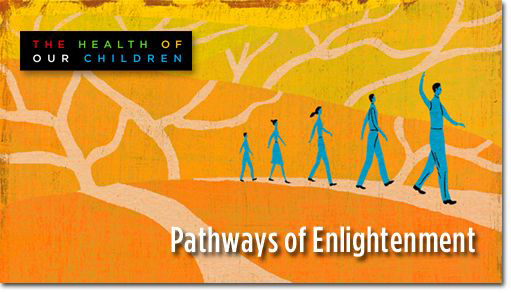 The most recent issue of Findings, the University of Michigan School Public Health alumni magazine, includes an article, "Pathways of Enlightenment: Could Public Health Help Improve America's Schools?," about distinguished alumnus, Dr. James P. Comer who received his MPH in 1964 and the 2009 he received the prestigious John H. Romani Award from the UM SPH. The most recent issue of Findings, the University of Michigan School Public Health alumni magazine, includes an article, "Pathways of Enlightenment: Could Public Health Help Improve America's Schools?," about distinguished alumnus, Dr. James P. Comer who received his MPH in 1964 and the 2009 he received the prestigious John H. Romani Award from the UM SPH.
Findings editor Leslie Stainton came to New Haven to interview Dr. Comer about the year he spent at the UM SPH and the impact his public health training had on his thinking and life's work. Stainton writes:
"During his year at Michigan, Comer learned valuable organizational and management skills. He'd studied epidemiology and environmental ecology and become fascinated by the parallels between these and what he called 'human ecology, the study of how policies and institutions interact with families and children.' He wrote a term paper in which he argued that schools were the only organizations strategically positioned to help all children grow--and to compensate for the difficult conditions that too often interfere with their growth."
Stainton also visited Davis Street 21st Century Magnet School in New Haven to see Dr. Comer's ideas in practice. "Step into a school like Davis," said Stainton, "and you feel the difference. Kids walk peacefully through the halls. Teachers are affectionate.......And it's not just window dressing--the good feelings generated inside Davis Street, as in other Comer schools, translate into higher-than-average scores on standardized tests."
"Working on this piece, and more importantly, seeing the Comer program in action in New Haven, convinced me that Dr. Comer has indeed found an answer to our nation's troubled educational system, and I now include myself on the long list of advocates of the program," said Stainton. "In short: I'm a believer. It was also incredibly eye-opening to see the connections between public health and education."
To download "Pathways to Enlightenment," click here.
|
 What I Learned in School: Reflections on Race, Child Development, and School Reform
By James P. Comer, M.D., M.P.H.
What I Learned in School highlights, in one volume,
the major contributions of world-renowned scholar Dr. James P. Comer,
whose visionary work has dramatically shaped the fields of school
reform, child development, psychology, and race. This small collection
of Dr. Comer's work is beautifully arranged and includes an
introduction and engaging updates from the author. These works paint a
remarkable picture of what we've all learned so far, and what we all
must learn going forward.
|
|
Our Mission
The School Development Program is committed to the total development of children and adolescents by helping parents, educators, and policy makers create learning environments that support children's physical, cognitive, psychological, language, social and ethical development.
Our Vision
Our vision is to help create a just and fair society in which all children have the support for development that will allow them to become positive and successful contributors in family, work and civic life.
|
|
Please forward this newsletter to friends and colleagues and visit our YouTubeand Facebook pages.
Cynthia R. Savo
Communications Director
|
|
|


