Who We are:
Central Iowa Paddlers is an informal group of paddlesport enthusiasts formed in 1997.
|
| |
|
What We Do:
The mission of the club is to share paddling
information, promote paddling opportunities and paddlesport safety, and encourage care of our aquatic resources for both new and experienced paddlers.
|
| |
|
|
Greetings!
Hot Hot Hot! Despite the scalding temperatures, paddlers are still getting out and enjoying Iowa's rivers and lakes.
There is a lot going on in the busy month of August--enjoy the rest of your summer and paddle whenever and where ever you can, as the days are getting shorter.
This issue is dedicated to the children of paddlers--the future of our waterways is in their hands.
John Wenck
CIP President
|
|
Paddling Iowa with Children
by Ben Petty
 Taking children out on paddling trips can be a great way for them to learn outdoor skills while fostering an appreciation for the natural environment. We've taken our three children out on paddling trips since before they could walk, and I think the many trips down Iowa's rivers have helped them to develop greater self-confidence, awareness and appreciation of Iowa's natural beauty, have fun, and is a great way to spend time as a family while leaving the video games and MP3 players behind for awhile. In my mind, smaller rivers (but not so small as to encounter many strainers or tight turns) with frequent sand or gravel bars at moderately low levels make for ideal rivers to expose children to paddling. Some rivers I'm familiar with that I'd consider good for this include sections of the Iowa River in Hardin County, the Upper Iowa and Turkey Rivers in northeast Iowa, and the Boone River south of Webster City. These rivers also have many good camping opportunities along their length and enough sand or gravel bars (at moderately low levels) to make for several spots to take "breaks". Speaking of breaks, that's one of the priorities to consider when paddling with children. Although my paddling trips with friends often include stopovers on gravel bars for lunch and exploring, these stops should probably be considered necessities when paddling with children. A typical trip for us may only be a 4 - 6 mile stretch of river, but it's pretty easy to make it last several hours. Frequent stops should be planned for (and make the trip more fun), and for us, often include the following - - exploring / "rock-hounding" / searching for fossils
- swimming / wading
- using a dip net to catch various aquatic creatures
- skipping rocks
- snacks or cooking hot dogs over a driftwood fire (this is also how our kids learned why you want to find a "green" stick for cooking hot dogs, but that they don't make good firewood!)

The time spent in Iowa's natural beauty has also helped the kids develop a better appreciation for the waterways and a disdain for the trash that we come across sometimes along the way. We usually pack a couple garbage bags and the kids help clean up the sand / gravel bars we stop on. There are some campgrounds along the river that have collection points for cans (Gilbertson along the Turkey and Pine Lake along the Iowa River are two that come to mind with can deposit bins), and this is a good way for the kids to not only help clean up the rivers, but give a little help to the parks and campgrounds along the way. Safety on the river is obviously a top priority with children. Properly-fitting PFDs are a must. We always pack along a basic first aid kit and plenty of drinking water and sunscreen. Although we tend to stick to fairly mild water with the kids, we teach them about the power of river currents, "upstream" and "downstream" V's, and why strainers and lowhead dams are so dangerous (although we've never taken the kids down stretches in which we had to worry about portaging dams). we've never taken the kids down stretches in which we had to worry about portaging dams). Paddling has allowed our kids to experience nature in Iowa in ways they wouldn't have otherwise - watching bald eagles soar directly overhead, snakes swimming up alongside the kayaks (which my wife didn't necessarily appreciate at the time), and exploring a separate little "pool" in an Iowa River gravel bar that contained minnows, crayfish, and baby catfish. One of the things I like about taking the kids paddling is that every trip seems to bring them new experiences or something unexpected, and to watch the kids' sense of wonder at these moments. I hope to see you and your family on the river soon!  |
Project AWARE: A Newcomer's Perspective
by Jerah Sheets
 Around every bend of new adventures, excitement and fear for the unknown pumps through our veins. The 2011 Project Aware river clean up hosted by the Iowa DNR was full of first times; first time canoeing with my younger brother, first time on a river clean up event, first time on a northeast Iowa river, and the list goes on. Growing up with limited camping and river experiences, my brother and I sat at our campsite the first night asking ourselves, "How did we get here?" The three whole camping experiences we reminisced from our childhood where mildly traumatic then and borderline comical now. Without a background of outdoor adventures, why would we be sitting in a campsite preparing to be launched down an unknown river in an unfamiliar vessel. I'll tell you why, because the shear thrill of the adventure continued to outweigh the fears of the unknown. During the first evening of Project Aware, introductions from both the coordinators and the participants were in order. As the group went around, person by person, sharing the basics of their name and where they live, they also shared the watershed their home was located within and their past experiences on Project Aware. First, I was deeply ashamed not knowing my personal watershed. No one seemed to be correcting anyone so I picked the closest creek to our home and guessed/made up the name of my watershed. As the group continued to share their past Project Aware stories, my astonishment grew. Although there was a scattering of first time participants among the 100+ newly established community, many of the participants have attended year after year, following the Project Aware crew across the state tackling one river at a time. Their joyous stories of triumphant trash finds by size or uniqueness touched ones heart by the passion and pride they told their tales. Now, some of these stories were straight out of the "What Not to Do" booklet. Vessels sank, boats lodged, and creating impromptu floating apparatuses should have turned any weak of heart but for us, it only made sleeping that evening difficult in anticipation of our first river clean up. We were ready to get on the river and begin this adventure. Day one started with some of the best river food one could imagine and best yet, someone else cooked and cleaned. After breakfast, a canoe awaited us at the shore of the Little Turkey River. I stood there frozen - I was experiencing another first, seeing the bottom of a river in Iowa. The water was clear! As we found out during the first 3 hours of the river clean up, I dilly dallied a little too much by taking pictures, staring at the clear water, and chatting with my brother - we had no trash in our vessel. With about 100+ people ahead of us on the river, they combed the river bed and shores and collected all the good stuff. There were a number of instances where I had to reassure my brother that 1) we were not going to get "kicked off" the river for not finding enough trash, 2) no one will laugh at us, and 3) there is no scale at the end of the river measuring our trash collection. By pure accidental luck, while walking the canoe through some shallow rapids, we literally tripped over a piece of metal the size of a frying pan. Finally! We have a piece of trash! But then our luck took a turn for the worse (at the moment) which became a cherished memory (as we look back now), we hit a boulder in the center of our boat, swiveled perpendicular to the river, and instantly sank to the bottom of the river. Some amazing volunteers helped us maneuver the waterlogged vessel to shore where we bailed water and discovered two of the structural braces were broke. The last half mile on the river to the midpoint was challenging. Thankfully the Project Aware coordinators were waiting at the halfway point to unload boats of trash and also rescue us. Even with some misadventures and a lot of lessons learned, I can't wait to return next year. The dates of July 7-14, 2012 are already marked on my calendar. To any first timer, truly experienced, or a weekend adventurer, Project Aware is the event for you. For just few dollars, all one has to do is show up with a tent and sleeping gear and everything else is taken care of for you - food, vessels, entertainment, transportation, and more. Can't wait to see you next year! |
Iowa Rivers Revival River Rascals
by Robin Fortney
 Do you remember your first experience on or by the water? Those of us who had childhood experiences on a river of any size are lucky. I grew up on two streams. Once was the Antietam Creek in western Maryland. We kids swam and played in the creek, grateful for the cool water on summer days. My dad built a rope swing and we'd swing out over the water and drop in. When we got older, he built a 2-person rowboat that we kids used during our courting phase. There was an island, and we watched herons, bitterns, deer and other wildlife seek food and shelter there. The other stream was the Rappahannock River in tidewater Virginia where our grandmother lived. There the river became a mile-wide estuary, muddy and salty. Grannie taught us to fish and catch blue crabs. My parents had a small sailboat and my dad taught us to sail. We explored the beach at low tide and found fossil and colonial era treasures. Those river experiences are joys that I would wish for every child. 
When Iowa Rivers Revival (IRR) conceived the River Rascal program in 2009 as a way to connect kids and rivers, I decided to help out. Paddler Linda Danielson helped connect IRR with Children and Family Urban Ministries, which runs a before- and afterschool program for students at Moulton School in Des Moines. We developed a program that actually gets these urban kids onto water in three Saturday sessions. However, the on-water program requires an experienced adult paddler to partner with each child. The first session introduces the kids to the water's edge at Chichauqua Bottoms in NE Polk County where the kids can net critters and learn to paddle in still water. In session two, the kids get to paddle moving water, treasure hunt on sand and gravel bars and learn about the IOWATER water quality monitoring program; the Middle Raccoon River is a favorite venue. The final session connects the kids with a community river cleanup event like Polk County's River Run Garbage Grab - we think it's important that these kids see there are lots of people who enjoy being on rivers and who care about them. CIP has been a long-time supporter of IRR, a state-wide river advocacy organization. We look to central Iowa paddlers to assist with the River Rascal program in central Iowa, to encourage good paddling skills and to share your love of Iowa's rivers. We still need experienced adult paddlers for this year's moving water sessions scheduled for August 13 and 20, 2011. Please contact Robin Fortney at rbfortney@midamerican.com if you'd like to be a paddling buddy and for more information. Help us plant the seeds of future river enthusiasts! 
|
A Great Blog for Iowa Paddlers:
John Pearson's "Out and About"
 | | Photo By Diane Lowry |
A few days ago, I sent a colleague a copy of the most recent blog that I wrote for a business website. The colleague called me and said "I always wondered what the difference was between a "blog" and a "tweet". I want to recommend a blog that clearly isn't just a collection of tweets. "Out and About" is a blog written by CIP member John Pearson. It is a wonderfully crafted collection of articles, pictures and videos. As some readers know, John is an ecologist and botanist with the Iowa DNR, and has plenty to blog about. I've been tracking his blog for the past year, and I find it a day brightener whenever I see that a new article has been posted. "Out and About" is an interesting amalgam of adventure tales, natural science reporting, personal reflections, and, of course, plenty of kayaking information. Some of the paddling information involves trip reports (much like I do in this newsletter), some of it is instructional (be sure to view one of his rolling demonstrations), and some of it is creative writing ... reflecting the joy of paddling. No tweets, no harangues. Rather, thoughtful postings that remind us of the wonder and beauty of the outdoors, especially when seen from the water. Why are you wasting time reading my review of "Out and About" when you can read it yourself by clicking this link? http://outaboutiowa.blogspot.com/ |
Paddling the San Juan Islands
by Steve Parrish
 I suspect many people have heard of the San Juan Islands, but they don't know where the islands are located, and they don't know why this destination is so popular. I'm not their tourist bureau, but let me answer these questions from a kayaker's perspective. Why is kayaking in the San Juans exciting? - Location The San Juans are part of the island groups that separate Seattle, Vancouver and Vancouver Island. Located in the extreme northwest corner of Washington State, this location, just south of Canada's Gulf Islands, is a popular tourist destination particularly for Americans. Tourists will often enjoy the urban sites of either Seattle or Vancouver first, and then bask in the serenity and seclusion of a cabin, resort, or tent in the islands. You can access the San Juans via a Washington Ferry or a float plane; so once you're there, you're likely there for the duration.
- Variety Whether you want open waters, long beaches, lush mountains, or secluded woods, the San Juans have them. I was there mainly for the waters, but I have friends who honeymooned at a quaint resort on Orchas Island. From tall bluffs of glacial tills to bedrock cliffs, to wild and rugged shoreline, the variety is overwhelming. There are laid back villages, tour boat excursion from the mainland, and "human and wind powered" tent camps in tiny state protected islands. Most people do not go to the San Juans to see just one thing. Yes, seeing Orcha whales is the tourist brochure "come on", but there is so much more.
- Challenge The good and bad news is that one does not want to paddle in the San Juans without either a qualified guide or a good understanding of tides and currents. The confusing and driving currents in the region are epic, and, while I really enjoyed the challenge of figuring out how to deal with currents, it was a project a solo paddler should only take on with good research and good local support. This is sea kayak territory. I did not see rec kayaks or canoes in the open waters.
- Beauty This is not an island group that hides its beauty. The San Juan Islands are an "in-your-face" collection of spectacular sites that demand your attention. Whether viewing the monstrous snowcapped mountains on the mainland, or listening to the deafening roar of birds, or admiring the architecture of cabins on islands with alluring Latin names, the San Juan Islands' top applicable adjectives relate to the beauty of the location.
CIP paddler Brian "Doc" Lange first told me of the great paddling opportunities in Anacortes and the San Juan Islands. I've paddled Lake Union in Seattle several times, but there is simply no comparison between "inland" urban paddling and the wild off-coast experience available in this extreme northwest corner of the U.S. If you're ready for a wild, challenging and gorgeous trip, go west! Last year I rented a sea kayak and paddled in and around Anacortes WA, including taking on the notorious Deception Pass (see my article Deceived by Deception Pass in the October CIP Newsletter). It was there that I learned there is a significant difference between tides and currents. Armed with that knowledge, this year I arranged with an outfitter to paddle in the San Juan Islands this July. I took a ferry from Anacortes to Lopez Island and paddled 30 miles in the San Juans, camping on two "sail or human power" islands. This archipelago of glacial islands is a well known destination for honeymooners, bicyclists, fishermen, and, of course, kayakers. What makes it so appealing is its lush vegetation (most of the trees are evergreens), its sheer number of islands (from small acre-sized hillocks to mountainous Orcas Island), and its frequent migration of whales. The islands were surprisingly busy, with float planes, ferries, sailboats, motorboats and kayaks keeping a steady hum of activity. And yet, it was easy to paddle away from the maddening rush at any time. Different from the subtle beauty of deserts, this area is a sensory overload. Too much to see - in the waters, on shore, in the air. 
Having learned my lesson the year before about the wicked waters in the area, I worked with my kayak outfitter to understand the prevailing winds, the tides and, most importantly, the currents. He helped me map out a general route, and I wrote down what currents to expect and where. Venturing north from Lopez Island, I traveled the western side of Shaw Island, ogled the cabins in privately owned Crane Island, and eventually landed on Jones Island. The whole time I marveled at the beauty of San Juan Island on my left, while keeping an eye out for whales in the water. Washington State has taken several of the smaller islands and designated them "human and wind powered" islands. No motorboats allowed. Jones Island is one such island. I was able to land my kayak on a gravel beach, walk uphill, and set-up a campsite overlooking the majesty of the San Juan Islands. There were teenagers at a nearby group campsite, but they minded their own business. While unloading some gear from my boat, I noticed several of the teens sitting on shore, talking. One girl sat alone on a drift log, ignoring the others, playing with pebbles. The next day, as I was loading gear back into my boat, I noticed pebbles on top of the drift log the girl had occupied. The pebbles spelled out "SOMEDAY".  That image still haunts me. Was she happy or sad; reveling or sulking? I'll never know. The only other occupants were deer and raccoons, and they were, unfortunately, way too friendly. I had to batten down the hatches to keep them from enjoying my food and water. Jones Island offers seclusion and privacy from the cabin and resort crowd on the big islands. The next day I broke camp and travelled north of Shaw Island, skirting Orcas Island. Eagles were plentiful as well a large variety of seagulls and shorebirds. As I paddled some decent sized crossings, it was interesting to be in open water and suddenly see waves pillowing in front of me. The currents were not as pronounced as Deception Pass, but they were highly unpredictable and demanded respect. During one crossing, I suspected I was in a current, but didn't really know until I looked down at my GPS, and saw that I was surging past 7 mph even though I wasn't paddling hard. I stopped for lunch at Blind Island, another "human and wind powered" campsite. When I go back, I'll definitely camp on this beautiful bay island ... an island that looks into the mountainous Orcas Islands. However, because it was only lunchtime, I called my outfitter (they tell me that spot is one of the few places in the Islands where you have clear cell coverage), and inquired about campsites closer to my take out. An afternoon paddle to Turn Island worked out perfectly. This aptly named island is less than two miles west of Lopez Island, and has a number of secluded, beautiful campsites. I camped by myself on a site in the western set of campsites. While hiking I ran into two Frenchmen camping on the Southside. When I asked them a question, one replied "We are French; we just got here; we know nothing!" That was the extent of my conversation with the only other campers on Turn Island. While I was enjoying my quiet little island, I was visited by a young guy that was moored offshore on a very elaborate Tri Catamaran. We visited for only awhile. He figured out that I wasn't impressed his boat was solar powered and had satellite TV, and I figured he wasn't impressed that my boat got "5 miles to the candy bar". So, he eventually drove back to his yacht to watch TV. Later I was visited by a dingy with 4 adults and 2 dogs. They came in off of an anchored cabin cruiser simply to have dinner on the island. An hour later, after providing me with brownies and pleasant conversation, they motored back to their cruiser, and headed back to their cabin on Orkas Island. I got up and broke camp early the next morning because I needed to be in Seattle to do a lecture that evening. So, I hit the water at 6:30 a.m. in mild fog and flew through the crossing to Lopez. The currents generated pillows and pools in open water, but they also kept me burning along at fast speeds. Once on Lopez I hitched a ride to the Ferry landing, and took the 50 minute ride to Anacortes. All in all, an amazing day of waking up on an island occupied only by me, two Frenchmen, and a thirsty raccoon (witness the gallon water jug it ate through), and ending up that night in a business suit in Seattle. |
|
Charles City Whitewater Park, Charles City, Iowa
by James B. Keyes
 The Iowa boating community is still buzzing over the first whitewater park in the state. Located at Riverfront Park on the Cedar River in Charles City, IA, this park was pitched to the city by local whitewater boaters, Steve Weliver(Waterloo) and Ty Graham(Cedar Falls), working in concert with a design firm (Recreational Engineering and Planning of Boulder, CO). Steve and Ty have worked tirelessly since 2000 to get a similar project implemented in various communities across Northeast Iowa. Charles City is the first community to truly realize the potential of such a riverfront redevelopment. So far, it is also the only city to take the plunge. 
Voila! The Charles City Whitewater Park is now a reality. A very important feature of this park is the fact that the park replaces a low-head dam that was constructed at the site during the Great Depression, and it opens up the area to better fishing while mitigating the dangers present in low-head dams. On any given weekend during the Spring and Summer, you will find an assortment of river enthusiasts at the park. While whitewater boaters are really excited about the new park, it was designed to attract boaters, tubers, anglers and people who just enjoy the river. The park has also seen the appearance of several paddlers on the new Stand-Up Paddle (SUP) boards, and the features at Double D (and possibly Exit Exam) are ideally suited for this new paddlesport. Features:  | Dam Drop
 | | Doc's Drop |
Wave |
Dam Drop Wave (aka Double D) replaces the former Beauty Dam (low-head), and it features glassy front surfing with a nice foam pile that is a great starting point for beginners/novices and intermediate boaters. Doc's Drop is a fairly retentive and powerful hole that will attract the more advanced whitewater boater. From personal experience at this feature, you will ride it like a rodeo star before it dares to spit you out. This feature is slated to be the site of future whitewater rodeo competitions.  | | Exit Exam |
Exit Exam is the last feature down-stream, and it is more amenable to beginners to intermediate boaters. From personal experience with Exit Exam, I found the feature to be a little more problematic to enter. This may be due to fatigue setting in after having so much fun and carnage upstream at Double D and Doc's! This park was designed with boater safety in mind. Plenty of eddies and it is important to note that there is plenty of room downstream from the feature for the boater to roll up upon capsize. I have played at whitewater parks such as San Marcos(Texas) where, if a boater capsizes on the big monster top wave, he has one chance to roll up before he goes over the next wave feature upside down! Not so at Charles City, where there is plenty of room downstream to recover from a missed roll. For those of yo u wishing to stay overnight, there are several lodging options. The Super 8 and Sleep Inn are located only about a mile and a half from the park, on Grand Avenue. Also, about six blocks away from the park on Clark Avenue, "R" campground provides RV and tent-camping, with the tent sites situated right on the Cedar River. u wishing to stay overnight, there are several lodging options. The Super 8 and Sleep Inn are located only about a mile and a half from the park, on Grand Avenue. Also, about six blocks away from the park on Clark Avenue, "R" campground provides RV and tent-camping, with the tent sites situated right on the Cedar River. I was pleasantly surprised to find a really cool pub right on the Cedar River, only a block or less from the whitewater park. The Pub On The Cedar is a boater-friendly pub with indoor and outdoor (overlooking the river) seating, and offers several varieties of ales on tap, and has a great sandwich and appetizer selection. River, only a block or less from the whitewater park. The Pub On The Cedar is a boater-friendly pub with indoor and outdoor (overlooking the river) seating, and offers several varieties of ales on tap, and has a great sandwich and appetizer selection. Though the park has been open since late May, the grand opening weekend is slated for 29-31 July. The three wave features can be seen at the Charles City web cam: http://kayakcc.com/ Click here to see a great video representation taken on May 22 at Double D feature. The park has its own web site: http://ccwhitewater.com/ (Photos and video courtesy of Bret Ensor, Brett Mjelde, Charles City Whitewater Park) |
Flash Flooding on Weldon Fork of Grand River or "The Case of the Missing Kayak!"
by Mark Metelman
 | Tributary of Grand River on Trip Day
|
After the Grand River trip in Iowa was cancelled due to sudden flash flooding, we decided to try to paddle another place. It did not appear that it had rained much in the area of Princeton Missouri, some 60 miles farther away upon arrival.
The Weldon Fork had little current then. The weather was nice then. After spotting the boats down below the bank, within minutes the water began to rise dramatically. The other two were able to get their boats to high ground, but I was up at the vehicle and my boat washed down stream.
We hurried to the next bridge downstream, some 10 miles. It would take a couple of hours for the water surge to reach this bridge. Since there were trees, logs, and debris now washing down, we reasoned that the boat would snag somewhere. I un-wisely decided to borrow anothers boat to to try see if the boat could be recovered in this area.
What I soon discovered was that trees and logs were washing downstream at a faster float rate then I. They would be constantly closing in from behind while paddling. The stream here bends several places, and in the bends the current was powerfully accelerating with substantial waves developing.
After about two hours of this, I was now becoming tired, so it was very pleasing to see the Mill Grove bridge and people above it.
I believed that others had prayed for my safety, and the task was met. Surprisingly, the boat had washed under the bridge about 1/2 hour later, after the first flood waters came through.
Since the boat made it this far, we reasoned that it was possible that it would make it to the next bridge also. We proceeded downstream to the bridge at Trenton Missouri. We then discovered that this is where the Iowa Grand River (Thompson Fork) and the Weldon Fork meet, and it's a lot wider here, but still had litte current--yet! We estimated that it would take a few hours before the flood waters would reach here.
I set up about 1/2 mile above the bridge with anothers boat hoping to spot the lost boat and shoring it at the bridge. The flood rise came well later, but it was now becoming too dark to see, so we decided to call it quits. As we were loading up, we saw the boat wash through under the bridge. It was kind of good to see because it provided a sense of closure.
The gauge at Trenton showed a spike of 4000 CFS within fifteen minutes. Over the next several hours the gauge would rise another 4000 CFS. Incredibly, it is possible that the boat could have washed all the way to the Missouri River.  | Bridge on Grand downstream of takeout on day trip was canceled
|
 | Same bridge two weeks after high water event
|
 | View of log jam from above
|
|
CIP July 4th Paddle Trip & Picnic Report
by Robin Fortney
 Some 35 paddlers met at the Redfield Dam for CIP's annual July 4th paddle trip and picnic. It was great to see old friends, as well as meet some new paddlers. We were fortunate to have a clear warm day. After shuttling drivers down to Pleasant Valley Access, paddlers put on the Middle Raccoon River for a fine relaxing 8-mile float trip. The river level was up, which limited our choices for a lunch stop. However, paddlers are a flexible group, and the lead boaters found a wide rocky ledge which provided some shade and plenty of room for all. Big thanks to Bill Graham and Luke Wright, who took charge of cooking burgers, brats and hot dogs (and to Dick Howard who supplied the propane-fueled Hibachis). Several people brought along roll-a-tables which are perfect for a riverside buffet and paddlers contributed some fabulous side dishes as usual. We celebrated our nation's 235th birthday with good friends and good food on a beautiful river. Life doesn't get much better than that! 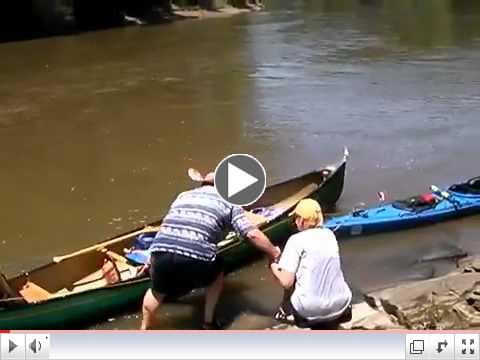 | | Bill Graham's Official Video Trip Report |

|
Lots of Activity on an lesser-known, idyllic river in northern Iowa: Winnebago River Water Trail
by John Wenck

The Winnebago River is a narrow, idyllic, free-flowing prairie/ wetland stream in Winnebago County. The public areas along the way are also well-maintained, and the river is frequently paddled between Dahle Park and Forest City , especially since becoming a 26-mile water trail last year, thanks to locals who care deeply about their river.
One of the many blessings of my job with the Iowa DNR is getting out to places I've not been and meeting land stewards like Robert Schwartz who is just as passionate about his job as I am mine. Robert has been the director of Winnebago County Conservation for the past 20+ years and hails the Winnebago River as one of the county's nicest natural resources. He states he has seen an increase in recreational activity on the river since it became a water trail. It has wide stakeholder support and a number of events are planned throughout the year. On August 13 they are hosting the Tree Town Adventure Race where paddling is part of a triathlon style event.
I'm drawn to this little gem like a moth to flame, and it's just begging me to explore its tight, winding bends. It's character is quite different from the types of rivers I'm used to seeing in central Iowa. The longest stretch of the water trail is 14 miles. Robert said he might consider putting a paddle-in/ paddle-out primitive campground somewhere along this long stretch, but there is concern for prairie fires in dry times.  | | Robert Schwartz at one of the accesses on the water trail |
Each access is a small low-impact, step-down type and begins in a pond-like setting that joins the river a short distance away. As a result, the accesses don't get the silt load or beating that accesses on many other rivers receive, ones that aren't as well protected. Maintenance is less labor-intensive at these accesses and launching and landing is much easier, too.
If you haven't paddled this gem, I'd strongly encourage you to make the trip. Winnebago County Conservation has a map on their website.
To see the interpretive panel designed for the trail, click here!
 |
Heatwave Paddle on the Des Moines River (Trip Report)
by John Wenck
 | | Photo by Dick Howard |
Six adventurous paddlers sought comfort on the Des Moines River Water Trail on Tuesday, July 19th. Meant to be relaxing after-work mini excursions when I scheduled these events last winter, I feared today that few if any would show because of the 100 degree temperature and 110 heat index. This was actually a rescheduled event from the previous month when flash flood warnings caused me to cancel.
My wife and I drove to Sycamore Access and parked in a shady spot and rolled our windows down. Not confident we'd have company, I remained inside the car with canoe tightly strapped to the top. A couple minutes later two of our newest and enthusiastic members rolled in: Carol Schrader and Linda Dugan. Shortly after, Don McLaughlin, who teaches canoe classes at Gray's Lake, arrived. Dick Howard, recipient of last year's CIP worker bee award, called me earlier to let me know that while he wasn't going to paddle he would gladly help with the shuttle--this really saved us some time at the end of the day because all our cars were at the takeout when we got off the river.

The trip was quick because the water level was at a blazing 20,000 cfs. Once we got on the water we all were surprised how much cooler the air felt, especially in the shade. There was a lot of shade on the right side of the river with the setting sun, and a nice, gentle breeze cooled our sun-drenched skin. We met a few speed boats, but all of them slowed out of courtesy except one. Linda and Carol, however, enjoyed the waves the boats sent our way and wished we'd encountered more.

Just as we were about to pass under the Euclid Ave bridge, less than a mile from Prospect Park, we saw an aluminum canoe quickly approaching. It was being propelled by a double bladed paddle--it was apparent the canoeist was paddling hard to catch up to us. We waited, and it turned out to be fellow CIP member, Chuck Mauer, who saw us make the first bend in the river as he was driving across the NW 66th Ave bridge--it took him 5 miles to catch us, but he made it. It was good to see him. He continued down to Birdland as we exited at Prospect Park.

All in all it was a superb day on the river and much cooler than on land. We were a bit sad that it went so quickly. 
The next tour of the Des Moines River Water Trail takes place Tuesday, August 16th at 5:30PM--we will spend about 2 hours on a one mile stretch of the water trail between Prospect Park and Birdland. We will visit an old ice house foundation at what used to be called Crocker Woods, and discuss a significant event that took place at the 6th Ave Bridge in 1965.
|
Don McLaughlin's Canoe Classes at Gray's Lake
Classes/Outings are all booked through Des Moines Public Schools (Amy Myers), held at Gray's Lake or on local rivers, and are still $25/$30 each. Click here to go to the Des Moines Adult Education Website
If you have questions or experience trouble enrolling call 242-8529
Tues Aug 2 Canoeing Basics I
Thurs Aug 4 Canoeing Basics I
Tues Aug 9 Canoeing Basics II
Thurs Aug 11 Whitewater Basics (requires Basics I, Basics II, and preferably River Canoeing classes)
Sat. Aug 13 Whitewater Outing (Local Stream but dependent on water level)
Tues Aug 23 River Canoeing Basics
Thurs Aug 25 River Canoeing Basics
Sat. Aug 27 River Trip (Beaver Creek, Raccoon River or Des Moines River depending on water level; Participants should have taken a Canoeing Basics I or a River Canoeing class to go on trip)
Thurs Sept 1 Canoeing Basics I
Tues Sept 6 River Canoeing Basics
Thurs Sept 8 River Canoeing Basics
Sat. Sept 10 River Trip (Beaver Creek, Raccoon River or Des Moines River depending on water level; Participants should have taken a Canoeing Basics I or a River Canoeing class to go on trip)
|
|
IRR Cedar River Rocks Event: Saturday August 27th
Iowa Rivers Revival and Iowa Senator Bill Dotzler are inviting the public to enjoy a float down the Cedar River, learn more about current issues relating to the river, and enjoy a picnic on the river bank. The event will be Saturday, August 27, floating from Senator Dotzler's property in Waterloo near Evansdale to the Cedar River Access just above the Brett Kilma Wildlife Area (Harmon Rd, LaPorte City).
A shuttle will be provided, and some canoes and kayaks will be provided at no additional cost by the Black Hawk County Conservation Board.
A picnic and brief program will take place prior to the float and will include Senator Dotzler discussing the economic development qualities of rivers, a review of Cedar River Watershed Coalition progress by co-chairs Kamyar Enshayan and Senator Rob Hogg, and an update on dam access by Black Hawk County Conservation Board Director Vern Fish.
A shuttle will depart at 10:30 a.m. from the take-out location at the Cedar River Area access. The shuttle can accommodate only people, not boats.
People doing their own shuttling need to be at the put-in at Senator Dotzler's at 11:00 a.m. American Canoe Association certified instructor Darrin Siefkin will provide instructions and IRR will need to obtain waivers from participants.
The float will begin at 1 p.m. and take approximately three hours (including sandbar stops). Paddlers must wear life jackets and should bring water and sunscreen. The picnic and program will take place at the put-in location, and those who would like to make additional plans are invited to camp overnight (at no cost) and explore the river more.
The $10 cost for participants includes food, drink, and insurance. Register by contacting Iowa Rivers Revival Executive Director Rosalyn Lehman at rlehman@iowarivers.org or 515.202.7720. A limited number of canoes and kayaks are available at no additional cost. When those are reserved, additional boats will be available at $30 per day for canoes and $20 per day for solo kayaks.
Iowa Rivers Revival board president Jerry Peckumn of Jefferson believes this is a great opportunity for residents in the area to explore the river and learn more about river issues: "We all live in a watershed and are impacted by the quality and quantity of the water in our home river. The Cedar River is one of our major rivers that has not been pleasant to us in the last few years. This is an opportunity to enjoy a paddling opportunity on the river and learn more about how to appreciate it and live in harmony with it in the future."
|
|
Thank you for letting us inform you of important announcements. If you ever have suggestions or comments, please feel free to share them with us at centraliowapaddlers@gmail.com.
Sincerely, Board of Directors
Central Iowa Paddlers
|
|
|



