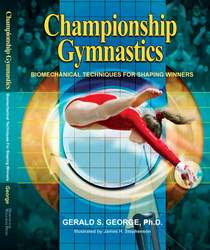
Concepts of Balance Beam*
by Gerald S. George, Ph.D.
February 21, 2012 |

Absolute balance is to experience a
"moment of ecstasy"...
Like Floor Exercise, the Balance Beam event provides a unique venue for each performer to tell her story through complex maneuvers combined with classical ballet and expressive dance elements. Although these skills are in effect no different from those in Floor Exercise, the physical constraints of the Balance Beam, coupled with its added dimension of height, demand significantly higher levels of technical exactness and balance, and entail greater risk.1 Seemingly minor miscalculations in skill execution that would be scarcely discernible on the floor often manifest themselves as gross errors in performance on the beam. Consequently it would be fair to say that the beam's narrow performing surface and greater height give this event an unforgiving nature, which ruthlessly exploits and sorely magnifies even the smallest of mistakes.
IN-LINE SPACE
Imagine the surface area of the beam extending directly outward and upward and then returning in a giant circle, as illustrated in figure 10.1. Gymnasts should use this "in-line space" as the conceptual framework for the execution of all beam skills. While the height dimension is limited solely by the gymnast's capability, the forward/backward and particularly the side-to-side dimensions of the beam require uncompromising technical excellence. And as in Floor Exercise, the more a gymnast can call upon advanced tumbling maneuvers to explore the upper range of this "in-line" space, the greater the potential for success, particularly at the elite level.
1 The performing surface of the competitive beam is only 4 inches wide by 16 feet long and is raised approximately 4 feet above ground level.
|