|

___________________________________________________________
|
The Mechanics of Swing
The Tangent-Release Principle
August 24, 2010
|
|
|
|
|
|
The Mechanics of Swing
|
Dr. Gerald George
 |
From a mechanical standpoint, swing is essentially a form of rotary or angular motion. It can be defined as circular
movement of an object about an axial line in a fashion such that all parts of
the object travel through the same angle, in the same direction, in the same
amount of time. This line, often referred to as the "axis of rotation," always lies at a right angle to the object's plane of
motion.
The human anatomy, with its numerous
joints and segments, can be thought of as an articulated system of swinging
levers that circle about one another in a properly coordinated sequence to produce
a desired movement. To qualify as swing, the movement need not necessarily be
complex. Any joint of motion of one body
segment about another can be considered an elementary form of swing.
In my new book, Championship Gymnastics,
I discuss all of the aspects of swing: internal swing, external swing,
optimizing swing mechanics, and fundamental concepts of swing. But today
I want to focus on one aspect of optimizing swing mechanics: The Tangent-Release Principle.
of Championship Gymnastics
|
|
|
|
|
The Tangent-Release Principle
|
Force always acts in the precise straight-line direction
in which it is applied. Consequently, any body in motion as a result of applied
force tends to travel its same straight-line path, and speeds up (accelerates) at a rate proportional to that force's magnitude. The
only factor which can alter this state of affairs is the introduction of one or
more additional forces. If, for example, force is applied in a direction
opposite the already-existing motion, the body slows down (decelerates). The
relationship between the magnitude of force and the direction of the applied
force determines whether the body will move, and if so, at what rate of speed
and in which direction.

For example, during the descent phase
of the Overgrip Giant Swing, the force of gravity tends to accelerate the
performer's mass downward in a straight line. The body's mass center, however,
does not travel straight downward. Rather, it continuously changes direction,
circling relative to its fixed axis of rotation (bar). Because the performer's
hands are firmly anchored to the apparatus, the body tends to follow a circular
path equal in length to its radius of rotation.
This circular movement pattern is due
to the mutual force relationship between the gymnast and the bar. The action of the performer pulling against the bar causes
a simultaneous reaction of the bar pulling against the performer. Because this action-reaction relationship
is equal in magnitude and opposite in direction, the effects would seem to
cancel out. Yet this is not the case, for the action of the performer pulling
against the bar cannot possibly move the apparatus, as it is firmly attached to
the colossal mass of the earth! However, the reaction of the bar
pulling against the performer does possess sufficient magnitude to produce a
continuous change in direction of the performer's light mass. The observed
effect of this action-reaction scenario is a circular pattern of the total body
unit about the bar. As long as this mutual force
relationship is maintained, the performer's external swing motion is preserved.

However, if the performer were to release her hand-grasp at any
time while circling about the bar, this mutual force relationship would cease to exist, and her body would be projected away from the bar in a
straight-line at an angle perpendicular to its radius of rotation. Once airborne, the body's mass center
would then travel a perfectly regular, curved path (parabolic trajectory). This is
precisely what occurs in the Double Backward Somersault Dismount presented in the illustration on the right. The performer's pulling does bend the bar in the direction
of the pull. The only exception to the parabolic trajectory outcome would
be if the performer's center of mass were at either the 3 o'clock or 9 o'clock
position when the hand-release occurred, in which case her body would be
projected either straight up or straight down. At the instant of release, notice how
the performer's body is
projected in a straight line at a 90° angle to its radius of rotation, and how, once
airborne, her center of mass follows its predetermined parabolic trajectory.
Every release from any external-swing movement always results in
the center of mass being projected at a right angle to its
radius.
|
Summary of Tangent-Release Principle
|
Because the body's mass center exits
from any external swing at a 90° angle to its radius of rotation (tangent to
the swing), the gymnast can confidently take
advantage of the Tangent-Release Principle to direct the flight pattern
properly for any dismount or release-grip skill on the uneven bars. Effective use of this principle,
however, requires a clear understanding of the intended direction and objective
of the skill's airborne phase, so the release phase can be timed accordingly.
Simply put, proper timing of the release is
critical to success in all airborne movements generated by external swing.The wise gymnast becomes
well aware that:
Just as the archer's bow establishes the flight direction
of the arrow,
so too
does the tangent
release establish the flight direction of the gymnast.
|
I invite you to send me your questions regarding coaching mechanics and techniques. Go to my website and click on the "Contact Us" button (at the top of each page) and submit your question. Questions having the broadest application will be addressed in each eNewsletter. Click HERE for past eNewsletter Archive.
Thanks for your participation and continued support!
Gerald S. George, Ph.D.
WinningGymnastics.com 888-796-5229 (Toll-free in U.S.)
760 458-4993 (M-F 9-5 PST)
|
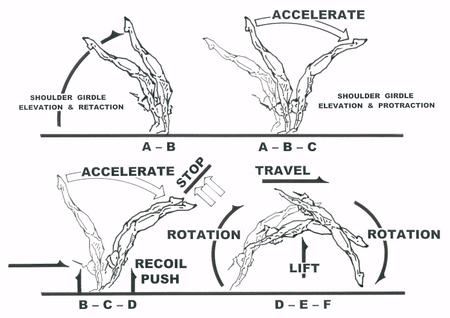
| Championship Gymnastics: Featuring 140 Gymnastic Illustrations |  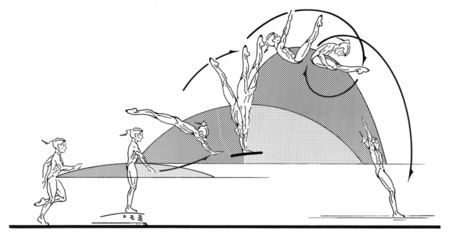 140 Illustrations Show You the Exact Positions and Movements for Achieving Success and Shaping Championship Winners. 140 Illustrations Show You the Exact Positions and Movements for Achieving Success and Shaping Championship Winners.
Rather than laboring on complex physics formulas, fundamental principles
of biomechanics are clearly explained and presented in layman's terms.
Easy to read and expertly illustrated, readers are guided effortlessly
through a "conceptualization process" for developing ideal movement
patterns. The book includes 140 technical illustrations by noted artist
and gymnastics coach Jim Stephenson.
|
|
Get the Tools and Learn the Techniques You Need to Become a Championship Winner!
- Learn Time-Tested Principles for Shaping Winners
- 140 Illustrations Show You the Exact Positions and Movements for
Achieving Success and Shaping Championship Winners
- Understand the Biomechanical Principles Underlying All Gymnastics Skills
- Learn the Fundamental Concepts of Proper Training for Power and Flexibility
- Apply an Easy-to-Follow System for the Fundamental Patterns of
Gymnastics Movement
- Discover Ten Key Teaching Concepts for Success in Each of the Four Olympic Gymnastics Events for Women
Take this opportunity to be the first to receive the valuable information contained in this book, and start or continue your journey to achieve success in winning gymnastics championships!
|
|
|
|
|