The Birth Of Talking Dolls
The earliest type of "talking dolls" were the "mama" dolls of the 1800s. These baby dolls elicited a crying sound when tipped, caused by a counterweight operating a bellows which vibrated a reed. It was a start, but it wasn't what doll owners or doll makers dreamed of... They wanted dolls to talk with true human voices.
So did Thomas Alva Edison.
In 1877, Edison declared, "I propose to apply the phonograph principle to make dolls speak, sing, cry and make various sounds, also apply it to all kinds of toys such as dogs, animals, flowers, reptiles." (One can't help but wonder what sounds the flowers were to make!)
Despite Edison's claims and desires, he was not the first to patent a talking doll. That honor would go to William White Jacques ten years later, in 1887.
Prior to filing the patent, Jacques wrote a letter to Edison requesting a license to use Edison's cylinder technology. Not only was the license contracted, but Edison agreed, in exchange for royalties and stock, to lend his name to the project. In 1887, Jacques and his partner Lowell Briggs officially started the Edison Phonograph Toy Manufacturing Company.
In 1888, Charles Batchelor joined the Edison talking doll project. Many experiments with materials were used, including a metal cylinder which was just rediscovered in 2011. In 1889, at the Paris Universal Exposition, a prototype of the doll, complete with French recordings, was exhibited.
On April 7, 1890, the Edison talking dolls first went on sale at an Edison exhibit at the Lenox Lyceum in New York City. Not long after, the dolls were sold by retailers, including F.A.O. Schwartz, and could be ordered through the mail. These dolls stood 22 inches tall and weighed four pounds. They had articulated wooden arms and legs, metal torsos, and bisque heads made by German doll company Simon and Halbig (model number 719). The Edison talking dolls sold for between $10 (with a simple chemise) and $25 (with a full dress). These dolls were expensive, costing roughly two weeks salary for the average person.
The dolls metal torsos were where the small Edison phonograph and cylinder was housed. Like phonographs at the time, a small horn emitted the sound which was heard through the holes in the doll's chest. The phonograph itself was inaccessible, so even though there were twelve different recordings they were not interchangeable.
Although Edison's patent and license stated that a sapphire stylus should be used, the dolls were made with a metal stylus -- a stylus which, more often than not, ruined the wax cylinder recordings. This metal stylus proved disastrous. Of the 10,000 dolls manufactured, only 2,500 were approved for sale. Less than 500 of those dolls were actually sold -- and of those, most were returned. For even when the dolls were received in working order, they were too fragile to withstand the average play of a child. Worse yet, those dolls which did work properly and were treated gently were deemed unsatisfactory too.
Since there was no mechanical means of controlling the speed, finesse was required to maintain the correct revolutions per minute (RPM) to achieve the proper sound. As a result, the dolls generally produced creepy sounds. Edison himself would later say, "The voices of the little monsters were exceedingly unpleasant to hear." You can see and hear one of the Edison talking dolls in this link.
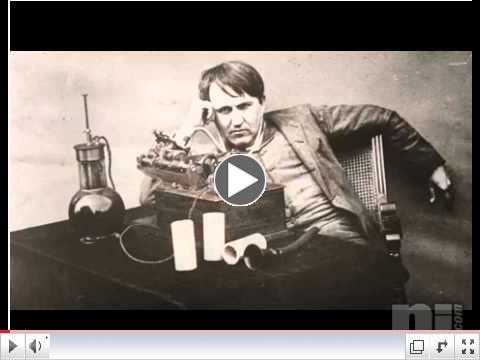 |
| Voice of Thomas Edison's talking doll heard again after 123 years |
.
Such expensive dolls -- being sold with the Edison name, yet -- which did not work disappointed the public, to say the least. By May of 1890, The Edison Phonograph Toy Manufacturing Company ceased both the manufacture and sales of the talking dolls.
A number of the dolls were sold off without the phonographs to minimize losses. However, returned dolls and a large number of unsold talking doll inventory were buried in the ground at Edison's laboratory and residence -- where they remain to this day.
There were other early dolls which used phonographs to talk.
Emile Berliner, of The National Gramophone Company, hired German firm Kammer and Reinhardt to make a talking doll using, of course, a small gramophone in 1889. This doll was about two feet tall. There is only one known surviving example of this doll and it is in a museum in Waltershausen, Germany.
In 1893, the Jumeau doll company hired Henri Lioret to create a talking doll. As an improvement over Edison's wax cylinder, Lioret chose to work with the more durable celluloid. The doll, called the Bebe Phonograph or the Lioretgraph Jumeau, was made of articulated composition and stood roughly twenty-five inches tall. The dolls were made until Jumeau became part of the Société Française de Fabrication de Bébés et Jouets in 1899.
German mechanical dolls manufacturer Max Oscar Arnold (MOA) patented a composition body doll that played a wax cylinder in 1906. Dolls were sold under both the Arnolda and Arnoldia names.
The Jenny Lind Doll Company of Chicago produced a talking doll in 1916.
Between 1918 and 1921, the Giebeler Falk Doll Corporation of New York (trade name Gie-Fa) made Primadonna dolls which had the phonographs in their aluminum heads. Lifting beneath the real hair wig opened the hinged head to expose the phonograph! There were variations in body (wooden, composition, and all aluminum dolls); but all the heads were aluminum. The hands and feet were also aluminum. Crank handles on the necks wound the clockwork mechanism which ran the phonograph.
In 1922, there were the Dolly Reckord dolls given out as premiums. Made by the Averill Manufacturing Company of New York, the dolls are marked Genuine Madame Hendren Doll in ink on body. The twenty-six inch tall dolls have cloth bodies with composition shoulders, arms, legs and heads. These dolls also have sleep eyes. The celluloid cylinders are marked Averill Manufacturing Co., but are believed to have been manufactured by the Indestructible Record Company of in Albany, New York.

*****************************************************
Repair of Your dolls voice.
This is an area we often wish we could be more help. We can repair the "crier" of a baby doll or a "Mama" doll. We can repair most pull string dolls and toys such as Chatty Cathy, Mrs. Beasley,Casper and others. but most dolls that contain an electronic voice box or a cassette recorder are just not repairable. There are no parts available from the manufacture so the only parts are from used or parts doll, many of which no longer work either. If you have a doll with a cassette rec order or a phonograph inside, call before sending it for repair. Chances are we will not be able to find replacement parts for those dolls.
*****************************************************
Other Talking Dolls
Once Mattel developed the simple and relatively inexpensive pull-string talking mechanism used in the Chatty Cathy dolls, the talking doll phenomenon was really born. Finally, doll lovers could have far more reliable conversations with their pretend friends!
Quickly Chatty Cathy and even the series of Chatty Cathy dolls wouldn't be enough for anyone. Doll lovers, and Mattel as well, were smitten with all the possibilities. Mattel then implemented the same basic talking mechanism in many different dolls. The talking mechanism would receive a few tweaks and alterations, including a push-button battery operated version, and the 1960s would become the golden age of talking dolls.
Many of these Mattel talking dolls were soft-bodied or cloth dolls. Some, like Sister Belle, the talking girl, and Matty Mattel, the talking boy (both of which arrived in 1961), had rubber heads or faces. Others, such as Shrinkin Violette, also known as Shrinking Violet (1963), were completely fabric or "stuffed" cloth dolls.
A few other classic talking Mattel dolls that evoke nostalgia and cause collectors to raise their bidding paddles are Scooba-Doo (1964), Drowsey (1964-1980s ), the Patters Pillow doll series (1964-1967), Patootie (1966), and Baby Whisper (1967).
There were more educational talking dolls too. Timey Tell (1964) was a doll with a watch that helped children learn how to tell time on a clock. The popularity of Mattel's See 'N Say led to Baby See 'N Say in 1966. And Randi Reader (1967) was a read-along doll.
Two big pop culture phenomena of the 1960s would greatly impacted talking doll creation. One was the fashion doll market; so Barbie, as well as G.I. Joe and other action figures, got voices too. The other big thing was television.
Character dolls, already quite popular, could now do more than look like favorite TV characters but sound just like them as well. Now there was no need to wait for your favorite television show to hear the voice of your favorite TV character -- just pull the string! You and your doll could even watch the show together!
It's hard to explain the delight of these talking character dolls to kids today who can download and press "play" to hear (and see) virtually any character they want, any time... But it was huge then. And remains so for many of us. Plus, there still is something so satisfying about holding the dolls while they talk to you.
These vintage talking character dolls (and puppets) were soft-bodied cloth dolls, many with rubber heads or masked faces. Some characters came in both doll and puppet versions.
Among the first talking TV character dolls and puppets were Bugs Bunny, Bozo The Clown, Casper the Friendly Ghost, Captain Kangaroo, Beany Boy and Cecil the Seasick Sea Serpent, Herman Munster, Porky Pig, Tom and Jerry, Woody Woodpecker, and Mr. Ed, the talking horse. Perhaps the most famous of all though, was Mrs. Beasley. Mrs. Beasley was the doll of Buffy on TV's Family Affair. Talking with Mrs. Beasley, and wearing her black glasses, was nearly a right of passage for those of us who are now at "a certain age".
There was a flurry of talking furries produced too. Mattel's line of Animal Yakkers included Bernie Bernard, Chester O'Chimp, Lilac and Sniffy the skunks, Biff Bear, Crackers the Parrot, and Larry Lion. They also made Linus the Lionhearted and other talking animal dolls and puppets which were not a part of the Yakkers series.
By the middle of the 1960s, advances in technology ushered in walking, dancing, and other animated dolls. Some of them had talking versions too, such as Baby First Step's walking-talking version, Talking Baby First Step (1965-1967). Baby Tender Love (1969) was a talking doll that drank and wet. Hi Dottie was a talking doll with her very own telephone for conversational phone fun.
Talking dolls continued to be made throughout the 1960s and well into the 1970s. In 1967, there was Sister Small Talk and Teachy Keen. In 1968, Mattel's Grampa & Grandma talking dolls. And Myrtle arrived in 1969.
Things got more than a little weird with Talk Up's (1971). To make these small dolls talk, you pulled the heads "up" off the bodies! Perhaps more fittingly, there were cartoon character versions of Talk Up's dolls. (It may be less frightening to pull the heads off cartoon characters, right?)
Other classic talking Mattel dolls of the 1970s are Talk a Littles (1970), Talking Twin Kip (1971), and Hush Lil Baby (1975).
Of course, other companies made talking dolls too.
In 1963, Eegee produced Tandy Talks. And in 1972, Kenner amazed one and all with Gabbigale. Raise Gabbigale's arm, pull the string while speaking, and your voice was recorded; lower Gabbigale's arm, pull the string, and she played your voice back!
But it was Mattel which developed the talking technology and Mattel who created the iconic dolls which most of us recall when we think of the golden age of talking dolls.



