Athletic Footwear Market Tops $18 Billion
|

The athletic and sports footwear market reached $18.4 billion in 2011, according to NSGA's soon-to-be-released "Sporting Goods Market in 2012." This represents a 5% increase from the $17.5 billion in sales in 2010. In 2010 sales had increased 2% from the previous year. Sales in 2011 mark the first time the footwear market has surpassed the $18 billion mark.
Once again, the largest category of athletic and sport footwear was walking shoes, which reached over $4.5 billion in 2011, up 7% versus 2010, when consumers spent $4.23 billion.
Among other footwear categories with $1 billion or more, gym shoes/fashion sneakers showed an 8% increase to $3.86 billion, up from $3.58 in 2010. Purchases of cross training/fitness shoes ($2.27 billion) showed a 7% increase. Sales of hiking shoes/boots which reached $1.02 billion were up 3% from $989 million in 2010.
Jogging/Running shoes increased 6% to $2.46 billion versus $2.32 in 2010. In 2010 they had slipped 2% from $2.36 billion in 2009.
This information is contained in NSGA's annual study that provides an overview of the sporting goods market and where 26 types of athletic and sport footwear are tracked. Aerobic shoes, lightweight/minimalist shoes, and football shoes are among the footwear types that are surveyed. The total U.S. market for athletic equipment is expected to reach $18.4 billion in 2011, with the final data to be released by the end of May.
"The Sporting Goods Market in 2012" is a copyrighted NSGA consumer study that projects 2011 purchases of sporting goods products based on a survey of over 41,000 U.S. households. The online consumer panel used in this study is maintained by TNS. The panel is balanced to parallel the American household distribution as reported by the U.S. Bureau of Census, so that the data can be projected nationally. The report is prepared for NSGA by Irwin Broh Research.
"The Sporting Goods Market in 2012" is available for $250 for retailer/dealer members of the Association and free to manufacturer and sustaining members. For non-members, the cost is $340. For more information and/or pricing for other NSGA research reports, please contact the NSGA Research Department, (847) 296-6742, ext. 108, or e-mail dkasen@nsga.org.
|
March CPI for Sporting Goods Continues Negative
|

The CPI for Sporting Goods fell 3.1% in March and follows declines of 2.9% in February, 2.9% in January, and 4.4 % in December. The spread between the two indices was 5.7% in March. In 2011 the average spread between the two indices was 7.8%.
The CPI for All Items continued positive in March with a 2.6% increase. This followed a 2.9% increase in February and a 3.0% increase in January.
For 2011, The Sporting Goods CPI averaged a 4.7% decrease, following a 3.0% decrease in 2010. This was the second year in a row that Sporting Goods CPI had shown a decrease. It increased 2.1% in 2009.
In the past five years (2011 versus 2006), the Sporting Goods CPI average has declined 1.2% in the face of a 3.0% rise in the CPI for All Items.
|
|
|
Time is running out to register for the 2012 NSGA Management Conference & Team Dealer Summit, which will take place May 6-9 in San Antonio. If you're worried because you can't attend the entire event, the good news is there are one-day registrations available that provide you access to all of the educational and networking events on the day you choose to attend.
Attending Monday will give you the chance to learn from Basketball Hall of Famer Bill Walton and ESPN Executive Sean Bratches, while also attending breakout sessions on several topics of interest to retailers and team dealers. Monday also includes access to the Inaugural All-Star Awards Luncheon, where industry leading companies will be recognized for their excellent work.
Tuesday gives you access to the session led by industry leader Rob DeMartini, the president & CEO of New Balance. In addition, breakout sessions will be held all morning and afternoon, while the evening provides you the opportunity to attend the Sporting Goods Industry Hall of Fame Dinner and Induction Ceremony.
For additional information on the event, and to register, please visit www.nsga.org/conference. Make plans to attend today!
|
March Golf Weather Impact: Baffling yet Benevolent Favorability Continues
|

March provided a continuation of the baffling yet benevolent weather which closed out the official "winter" season of 2011-2012. March marked the 3rd successive month in 2012 of widespread, incredibly temperate weather as Golf Playable Hours (GPH) registered +52% vs. last March at the national level! That brings the national Year-to-Date (YTD) GPH results to +47% vs. the same period a year ago. The regional breadth for the YTD period was similarly favorable at 9:1 with 18 regions having favorable weather against 2 regions with unfavorable weather (the remaining 25 were either in the neutral zone of +/- 2% or out of season).
Looking back on February rounds demand, as reported by Golf Datatech/NGF to calculate the facility Utilization Rate, it comes out mathematically as a big drop in Utilization but given that many northern geographies had exponential gains in Capacity Rounds (CR), we know it's unlikely that a doubling of the CR is going to produce a doubling of rounds. The YTD Utilization registered at 43% (comprised of a 15% increase in Played Rounds against a 40% increase in Capacity Rounds) which is 9 points lower than the 2011 year-end value. In other words, rounds demand responded to the widespread incredibly favorable weather but not on a one-to-one basis.
For more specific information on how Pellucid's Weather Impact capabilities answer key business performance questions, including a sample report and pricing, contact Jim Koppenhaver at jimk@pellucidcorp.com.
|
|
|
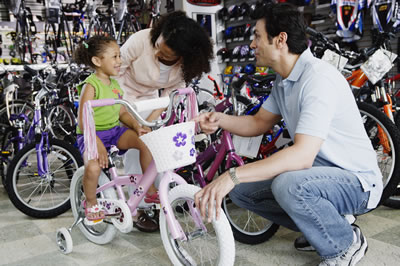
Bicycle imports jumped 27% through January 2012 Year-to-Date compared to January 2011 according to U.S. Department of Commerce Data. Total units imported through January were 1,247,505 up 267,153 from January 2010.
The total increase came from imports of kids' bikes which were up 82% to 407,888 with a value of $11.9 million, through January.
Imports of 27-inch and 700C bikes fell 1% to 125,412 (valued at $36.8 million) for the first month of 2012, compared to 126,417 units through January last year.
Average unit value of an imported bicycle fell 22% for 2012 from $108.36 in 2011 to $84.62 in 2012.
In 2010, 19.77 million bicycles were imported into the U.S., with a value of $1.43 billion. Unit imports increased 33.2%, and their value dropped 1.7%.
In 2009, 14.84 million bicycles were imported into the U.S., with a value of $1.09 billion. Unit imports fell 19.6%, and their value dropped 20.2%.
|
Monthly Report: Sporting Goods Store Sales
|

Sporting goods store sales rose 9.4% in February according to the Monthly Retail Trade Survey prepared by the U.S. Census Bureau. The rise in December compares to 4.0% increase from the same month in 2011 and follows a 3.4% increase in January. For the most recent reporting month (February) sales were $2.8 billion (preliminary).
Sales for 2011 were $40.9 billion, up 1.7% for the year. That compares to the 6.6% jump in 2010 when sales were $40.2 billion. Sales for 2009 were $37.7 billion, up 1.6% for the year. Sales for 2008 were $37.1 billion, up 2.3% from the 2007 sales of $36.3 billion.
The annual sales estimate for sporting goods stores in the U.S. Census Bureau Monthly Retail Trade survey is consistent with sporting goods sales reported in the NSGA study "The Sporting Goods Market 2011." The U.S. Census Bureau estimates are based on data from the Monthly Retail Trade Survey, Annual Retail Trade Survey, and administrative records. They have been adjusted using results of the most recent economic census. The NSGA study is based on a sampling of 41,000 U.S. households.
|
Firearms Indicator Shows another Big Increase in March
|
 Background checks rose 19.2% in March according to data from the FBI's National Instant Criminal Background Check System (NICS). This comes after an 18.8% increase in February. In March 1,727,881 background checks were performed compared to 1,449,724 in March 2011. Background checks rose 19.2% in March according to data from the FBI's National Instant Criminal Background Check System (NICS). This comes after an 18.8% increase in February. In March 1,727,881 background checks were performed compared to 1,449,724 in March 2011.
For 2011, total background checks numbered 16.5 million, up 14.2% from 14.4 million in 2010.
For 2010, total background checks were up 2.7% from 14.0 million in 2009.
FBI background checks are required under federal law for all individuals purchasing firearms from federally licensed retailers and are considered a strong indicator of actual sales by industry experts.
|
|



