
The Monthly Newsletter from RachaelsCentre.org
January 2010 / Tevet-Shevat 5770 - Vol 1, Issue 4
|
|
|
Podcast of the Week
|
 This week, Rachael delves into Parashat Va'eira. This week, Rachael delves into Parashat Va'eira.
|
|
Candle Lighting Times |

Want to know when Shabbat begins in Toronto, Tel Aviv, or anywhere else? |
A Chesed Project
|
Do you knit? Know someone who does? A project that is underway called Scarves for Soldiers equips members of the IDF with handmade scarves. If you would like more information on this project please email Naomi. |
|
|
|
 January 1, 2010, marks the beginning of a new year, a new
decade, a new page on the calendar.
As with any new beginnings it is exciting and somewhat anti-climactic at
the same time.
January 1, 2010, marks the beginning of a new year, a new
decade, a new page on the calendar.
As with any new beginnings it is exciting and somewhat anti-climactic at
the same time.
There is so much attention paid to the secular new
year. The parties, the champagne
toasts, the first kiss of the new year.
It builds the expectation of magic that will somehow enter our lives as
the clock strikes midnight. But
many of us know that life is not filled with unexpected magic waiting for us at
some enchanted hour.
So I invite everyone to turn the calendar page with me and
enter January of 2010. I do not
expect a magical year to float down from above but I'm excited at the
opportunity to create a reference point of beginnings.
New beginnings mean each of us has a moment to make a fresh
choice, to change a routine and break a pattern. We can make the year a productive one, a year of growth and,
if we're lucky, we find happiness from within that we can share with others.
Here at Rachael's Centre, January marks the beginning of a
new session of classes and new ideas to be shared. I always look forward to hearing the thoughts of everyone as
we study together.
So I'd like to raise a glass together, in this virtual
world, and toast our commitment to more learning, more healing and more peace.
L'chaim!
 Dr. Rachael Turkienicz Executive Director, RachaelsCentre.org |
|
Please help and donate to RachaelsCentre.orgRachael's Centre is a not-for-profit registered charity. We rely on you to help support our online videos and content.
Click here to donate to RachaelsCentre.org
Canadian Charitable Registration
# 80744 7016 RR0001
|
|
|
|
|
From the Many Voices Blog
|

As written by Laya, January 11, 2010
"I seem to be suffering from Blogger's block. When I consulted the Internet on this topic, I was instructed:
1) Not to panic
2) Be honest
3) Blog about something I have never blogged about
So, here it goes. Read more...
|
| On the Breath of Children |
 Judaism teaches us that the world exists on the breath of
children. We'd like to share some
of the true moments where the words of children have inspired us.
Judaism teaches us that the world exists on the breath of
children. We'd like to share some
of the true moments where the words of children have inspired us.
One year I was teaching the biblical story of Jacob who
loved Rachel but ended up marrying Leah when he was tricked by their
father. It can be a tricky text
for kids to learn since it is taught in grades 1 or 2 and there are many
different names and different family relationships going on.
As a concluding activity, I told the class they could each
pick a moment from the story they thought was very powerful and draw it in
their notebooks. The last part of
the activity was to name each of the people in their pictures (so I could make
sure they had the various names and people down right).
Most of the girls drew a picture of Jacob standing with
Rachel under a chupah. Jacob was
dressed very simply while Rachel had the most elaborate bridal gown and veil
complete with train and flower girls.
One little girl brought me her picture and it was also the
wedding scene. However, I noticed
that she hadn't given names to the people. I told her that she needs to write the names Jacob and
Rachel under the people and her face immediately changed.
She looked up at me and quietly said 'that's not
Rachel'. She then pointed to
something in the picture. I looked
closely and saw that she was pointing to the chest of the woman in the bridal
gown. Next to this girl's little
finger I could see she had drawn a broken heart.
'That's Leah', said the girl. For the first time I was forced to glimpse what Leah must
have felt standing next to her groom, Jacob, knowing she was not the chosen
bride.
I am forever grateful to this little girl whose heart opened
mine.
|
Listening to Nature - 'Olameinu': Our World, Our Environment
|
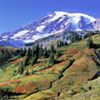 Jewish texts are filled with descriptions of how all of
nature is communicating. Many
texts speak of the relationship that everything in nature has with God and that
each of these relationships are unique and cherished. Jewish texts are filled with descriptions of how all of
nature is communicating. Many
texts speak of the relationship that everything in nature has with God and that
each of these relationships are unique and cherished.
There is a midrash that asks how it is that two trees can
grow next to each other, one tall and the other small. The question centres on the fact that
the water measure would be wrong for one of them. The tall tree needs much water and if so much water fell, it
would flood the small tree. Of
course the opposite would be true the other way around. If the right amount of rain fell for
the small tree, it would starve the tall tree.
The answer of the midrash is that the waters above (the
rain) and the waters below (the water table in the earth) are communicating
with each other at all times. The
waters above tell the waters below that they should rise to a specified level
and the rain above will augment what is needed.
The trees hear this conversation and are reassured. In fact, according to the midrash, all
of nature participates in these conversations except humanity. It is not that we never learned this
language of creation, the midrash states that we made ourselves deaf to it and
have therefore forgotten.
Tu Bishvat is coming up soon and usually the birthday of the
trees is commemorated by buying and planting trees in Israel. Perhaps with the midrash in mind, this
year we must continue to buy and plant the trees but we must also introduce a
moment of getting outside, closing our eyes and taking a few minutes to relearn
a beautiful ancient skill...listening.
|
|
Mussar Moment Recap |
 Last month
we presented a 'Mussar Dilemma', a day to day situation we all have experienced
with a Mussar question attached.
Last month
we presented a 'Mussar Dilemma', a day to day situation we all have experienced
with a Mussar question attached.
While
checking out at the supermarket, the person in front of you continuously delays
you by running back into the aisles to pick up just a few forgotten items. Although you have nothing scheduled for afterwards, you are getting annoyed at the ongoing delay.
I offer food for thought from a Mussar perspective:
There are 2
different things to consider at this moment. The first thing is your reaction outwardly to either the
cashier or the person shopping.
The second thing to consider is your growing internal feeling of
impatience and annoyance even though you have no pressing deadline.
Option
1: Complain to the cashier while
the shopper has run back into the store.
Although it
is understandable why someone might opt for this, it would obviously involve
speaking of someone behind their back.
Option
2: Tell the person delaying you
that you are in a hurry, even though you are not.
This option
might well bring about an apology and a change of behaviour (best case) but it
is clearly based on an untruth.
Option 3:
Tell the person delaying you that you would appreciate if they would finish all
their shopping before going to the cashier.
This person
will likely feel awkward and embarrassed.
Since Judaism takes this very seriously, you'd need a strong purpose for
publicly chastising someone. Since
the purpose is to vent your frustration, Mussar would question choosing to make
yourself feel better by making someone else feel badly.
Option 4:
Subtly change to another cashier.
By choosing
a different cashier you are effectively changing your environment. Environments and events speak to us as
powerfully as do people and sometimes a subtle change in environment is just
the choice that fits the moment.
Mandatory
Option 5: Address your frustration
Mussar would
now strongly recommend that you explore the frustration and irritation you
experienced. With no deadline at
stake, why were you so annoyed by the delay?
|
|
This Month's Mussar Dilemma: A Real-Life Moment We've All Faced |

You attend a social gathering filled with family. Across the room you see someone you
recognize that you haven't seen in a while. You remember that the last time the two of you spoke there
was a minor falling out and then you lost touch.
You could:
-
cross the room and greet the person with a smile
-
wait for the person to greet you first and then
you will respond warmly
-
pretend you didn't see the person
Suggested solutions
will appear in next month's issue of Koleinu
|
|
|
|
|
|
|



