- Sponsored By -
| |  |
|
|
|

The Handgun Trigger Pull Assessment for New Law Enforcement/Security Candidates
By Bruce Cameron
Recruitment plays a crucial part in the success or failure of a business. In terms of organizational or corporate behavior, hiring the right people can make all of the difference in the world. This really rings true with law enforcement and security departments. Police and security administrators and trainers need to know what kind of people they will be bringing on board for a variety of very important reasons. It is essential that they learn as much they can about the individual candidate before the hiring and training process begins. The more information they have the better. Their decisions will indeed affect the future and safety of the department and the outcomes of people's lives. Currently, there are a number of performance tests and other evaluations that law enforcement and security departments can use to ascertain, diagnose, and measure certain skill levels. Here are a few examples and all have their place:
|
|
~~~~~~~~~~~~~ A Message From Our Sponsor ~~~~~~~~~~~~~

Meeting the Challenges of the 21st Century. Online Criminal Justice Administration Master's Degree from Loyola University New Orleans
Crime prevention is not what it used to be. Today's law enforcement agents are constantly meeting new challenges, from state-of the art criminal technologies and media management to the global war on terror. Acquiring a graduate degree to meet and understand these challenges is essential for your professional advancement. Loyola University New Orleans' Master's degree in Criminal Justice Administration focuses on honing the skills and knowledge required to succeed, and lead, in today's demanding criminal justice administration environment. The program is offered in two specializations:
· Criminal Justice Administration
· Forensic Science Administration
For more information, click here >
~~~~~~~~~~~~~~~~~~~~~~~~~~~~~~~~~~~~~~~~~~~~
|
 By Brian Willis By Brian Willis
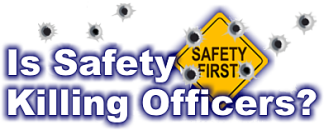
Let me start by saying I am a huge advocate of safety in training and it is critically important that you have safety rituals in place for conducting reality based training. We must stop killing officers in 'training accidents'. Having said that, I have come to the realization over the years that too many trainers are using 'safety' as a crutch and an excuse not to conduct realistic and potentially life saving training.
Trainers preach to officers to "never place yourself in a crossfire situation". Avoiding crossfire is sound tactical advice. What if however, the subject places the officers in a crossfire situation? Are the officers prepared to win that fight or are they going to hesitate because of training, or lack there of?In Lakewood, Washington the subject entered the coffee shop intent on killing four officers and created a crossfire situation. In Maryland, a bank robbery suspect leaves a bank with a gun to a hostages head and is challenged by a number of armed officers. When he slips on some ice the hostage runs away and the hostage taker runs into the group of armed officers creating a crossfire situation. An officer is fighting over his weapon with a subject who is attempting to disarm and kill him. Because they are in contact range the cover officer now finds herself in a crossfire situation. In each of these situations the subject's actions created the crossfire situation. The officers did not violate their tactical training and place themselves in this position. These situations often cause officers to hesitate as they have never been trained to shoot effectively at close range or when a crossfire situation exists.
article continues >>
|
|
~~~~~~~~~~~~~ A Message From Our Sponsor ~~~~~~~~~~~~~

You can do this
Earn an affordable, flexible and state-accredited online degree
from the University of Wisconsin-Platteville The University of Wisconsin-Platteville's accredited, online master's and bachelor's degrees in criminal justice (MCJ) are recognized and respected throughout the nation. Students are working law enforcement professionals, criminal justice educators, and those who want to enter the field or accelerate their careers. For maximum flexibility, no campus visits are required and you can view course materials at your convenience. And to consistently meet the demands of the criminal justice field, UW-Platteville's curriculum is reviewed annually by faculty and supervisors employed with federal, state, and local law enforcement and corrections agencies, such as the FBI, ATF, the Wisconsin Department of Justice Training and Standards Bureau and municipal police departments.
To learn more, visit www.GoUWP.com/PT2
~~~~~~~~~~~~~~~~~~~~~~~~~~~~~~~~~~~~~~~~~~~~
|

By John Reid & Associates
A witness is anyone who possesses direct information pertinent to an investigation. Sometimes witnesses are forthcoming and fully cooperative, other times they are reluctant to get involved and occasionally they are deceitful in an effort to protect themselves, an accomplice or loved one. There are many factors that may influence the accuracy of a witness' statement including trauma, passage of time, prejudices, influences of drugs or alcohol, age, and psychological/ physiological disorders. Finally, witnesses are interviewed in a number of different settings, ranging from a totally uncontrolled setting (outside a bank that was just robbed) to a semi-controlled environment (the witness' home or office) or in a controlled setting (the investigator's office).
With all these variables, obviously there is no single best technique to develop information from a witness. Consequently, this web tip will present a number of different concepts relating to witness interviews which the investigator will need to appropriately apply. There is, however, a single underlying principle: the more time the investigator spends talking to the witness, the more information will be learned. Regardless of how cooperative a witness may be, the investigator should never accept a witness's first version of an event as final and complete. A witness rarely initially volunteers all the information he or she possesses; the investigator must draw it out by asking follow-up questions and perhaps even consider using memory-enhancing techniques.
article continues >
|

Reprinted from WWW.PATC.COM
Supreme court vacates warrant requirement for child interviews
June 2011
by Brian S. Batterton, Attorney
On May 26, 2011, the United States Supreme Court decided Camreta v. Greene et al., [i] and vacated a decision of the Ninth Circuit Court of Appeals which had effectively required child protective service officers to obtain warrants in order to interview victims of child abuse, absent parental consent. The facts of Camreta are as follows:
In February 2003, police arrested Nimrod Greene for suspected sexual abuse of a young boy unrelated to him. During the investigation of that offense, the boy's parents told police that they suspected Greene of molesting his 9-year-old daughter S.G. The police reported this information to the Oregon Department of Human Services, which assigned petitioner Bob Camreta, a child protective services caseworker, to assess S.G.'s safety. Several days later, Camreta, accompanied by petitioner James Alford, a Deschutes County deputy sheriff, went to S.G.'s elementary school and interviewed her about the allegations. Camreta and Alford did not have a warrant, nor had they obtained parental consent to conduct the interview. Although S. G. at first denied that her father had molested her, she eventually stated that she had been abused. Greene was indicted and stood trial for sexually abusing S.G., but the jury failed to reach a verdict and the charges were later dismissed. [ii]
article continues >
|
|