|
~~~~~~~~~~~~~ This Month's Featured Product ~~~~~~~~~~~~~

ILEETA will be hosting the 2011 ILEETA Training Conference and Expo April 11 - 16, 2011 at the Westin Chicago Northshore in Wheeling, IL. The 2011 Event will offer more than 150 courses and over 25 instructor certifications/armorer courses. Topics include use of force, officer survival, defensive tactics, instructor development, specialized and firearms including a live fire track. Don't miss the opportunity to network with instructors from around the world who are on the cutting edge of industry training and technology. For more information please visit www.ileeta.org or call 262-767-1406.
~~~~~~~~~~~~~~~~~~~~~~~~~~~~~~~~~~~~~~~~~~~~~~
|
|
|
 By John E. Reid & Associates By John E. Reid & Associates
Each year in the United States hundreds of thousands of polygraph examinations are administered. The primary value of the polygraph technique is to eliminate innocent suspects early during an investigation. This greatly assists an investigation in that investigators can focus their efforts on other suspects. When a suspect is identified as deceptive, frequently the suspect will confess during an interrogation that follows the polygraph examination. While this may sound like a positive finding, it is not because it encourages incompetent examiners to use the polygraph instrument as a psychological prop to elicit confessions.
Properly administered, the polygraph technique is a non-accusatory diagnostic procedure that allows an examiner to collect physiological data to infer whether or not a subject is telling the truth to relevant questions (see August web tip). Accusatory interrogation has no place in a properly conduced polygraph examination (Reid and Inbau, Truth and Deception the Polygraph "Lie-detector" Technique, Williams and Wilkins, 1977). Unfortunately, the private environment and intimate relationship an examiner forms with a subject during a polygraph examination creates an ideal breeding ground for a confession. This factor is significant enough that some state supreme courts have ruled that taking a polygraph examination is so inherently coercive that any confession made during the course of a polygraph examination should be suppressed. It should be understood that a confession obtained during an interrogation following a polygraph examination is accepted in all states
.
|
|
~~~~~~~~~~~~~ A Message From Our Sponsor ~~~~~~~~~~~~~

Meeting the Challenges of the 21st Century. Online Criminal Justice Administration Master's Degree from Loyola University New Orleans
Crime prevention is not what it used to be. Today's law enforcement agents are constantly meeting new challenges, from state-of the art criminal technologies and media management to the global war on terror. Acquiring a graduate degree to meet and understand these challenges is essential for your professional advancement. Loyola University New Orleans' Master's degree in Criminal Justice Administration focuses on honing the skills and knowledge required to succeed, and lead, in today's demanding criminal justice administration environment. The program is offered in two specializations:
· Criminal Justice Administration
· Forensic Science Administration
For more information, click here >
~~~~~~~~~~~~~~~~~~~~~~~~~~~~~~~~~~~~~~~~~~~~
|
|
By Rick Armellino
Baker Ballistics, LLC
The critical need for "Immediate Action Rapid Deployment" in school invasions
The nightmare scenario
Two armed men carrying handguns and knapsacks reportedly have entered a local elementary school. You are the closest responding patrol asset.
What will YOU do?
Upon your arrival, what happens next greatly depends upon the policy of the law enforcement agency that signs your paycheck. What you would do if your child was in this school may be vastly different than what your department expects you to do. Here's a few of the most common patrol first responder actions:
- Not hearing any gunfire, establish an outer perimeter to prevent escape and call for backup.
- Hearing gunfire, wait for the predetermined amount of officers to arrive, make a plan, and enter the structure in accordance with your agencies' active shooter response procedures.
- Whatever you want, as your agency has no formal policy, training or equipment.
article continues >>
|
|
~~~~~~~~~~~~~ A Message From Our Sponsor ~~~~~~~~~~~~~

Dedicated To Serve You
At Portland State University, you have the option to complete either a Bachelor of Arts or Bachelor of Science in Criminology & Criminal Justice online. Designed and taught by scholars and leaders of the field you will study in areas such as crime analysis, criminal behavior and the American justice system. In addition to the degree, you will also have the option to follow education tracks to earn one or more certificates. Police Academy experience may also apply towards your bachelor's.
For more information, click here >
~~~~~~~~~~~~~~~~~~~~~~~~~~~~~~~~~~~~~~~~~~~~
|
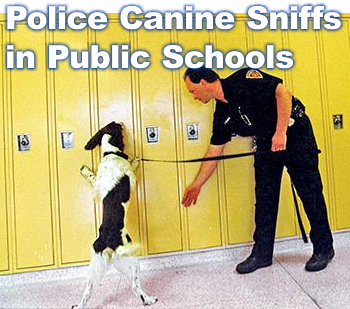
By ©2010 Brian S. Batterton, Attorney, Legal & Liability Risk Management Institute (LLRMI.COM) As public school officials attempt to combat the problem of illegal drugs at school, the use of police drug sniffing canines is becoming more prevalent. It is well established that canine sniffs of lockers and parked cars do not constitute a "search" under the Fourth Amendment.[i] However, in some situations, the facts leading up to the use of a canine may implicate the Fourth Amendment by constituting a seizure of a person or property prior to the use of the canine. On March 5, 2010, the Court of Appeals of Texas (Austin) recently decided In the Matter of D.H.[ii], which dealt with such an issue. The facts of D.H. are as follows: In October 2006, officers from the Austin Police Department arrived at Reagan High School to conduct a canine search of the school. D.H., who was sixteen at the time, was a student at the school. Assistant Principal Mike Perez led the officers through the school, allowing the dog to sniff several classrooms on each floor of each building. For every inspection, Perez entered the classroom and informed the teacher of the sweep. The students were then instructed to leave their property in the classroom and wait in the hall, and the police entered and allowed the dog to sniff the items left in the room. The students were not allowed to refuse the instructions or to take their items with them. When the officers searched D.H.'s classroom, the dog reacted to her backpack. The officers called D.H. into the classroom, read D.H. her rights, and searched her bag, where they found a small bag of mariJuana. [iii]
D.H. filed a motion to suppress with the trial court alleging that her bag was seized without reasonable suspicion when she was required to leave it in the class while the canine conducted a sniff of all bags in the room. The trial court denied the motion to suppress.
article continues >
|
 The Top Ten Worst K-9 Names: The Top Ten Worst K-9 Names: - Fluffy
- Not Guilty
- Massive Bite
- No Warning
- Civil Liability
- Killer
- Bad Nose
- Worms
- Psycho
- Throat Ripper
|
|