|
|
|
|
|
|
|
Welcome to the Policetraining.net Newsletter
In this issue
we continue to bring you important training topics of current interest.
Thanks for subscribing, and please forward this along to a law enforcement collegue you think may benefit. |
|
|
By John E. Reid & Associates
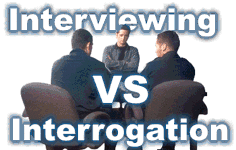
A concept we teach in our basic course is, "If you're going to interview, interview. If you're going to interrogate, interrogate." There are two important parts of this lesson. The first is that there are significant procedural differences between interviewing and interrogation. The second is that if these procedures are intermingled, the investigator will often be ineffective in accomplishing the goals of either one.
An Interview
An interview is a non-accusatory question and answer session with a suspect, victim or witness. The goal of an interview is to gather information and make an assessment of the subject's credibility. Some of this information will be investigative in nature. Examples of investigative questions include, "When did you arrive home last night?"; "Do you have access to a handgun?"; "Do you know who Gloria Smith is?" Other interview questions are specifically designed to elicit behavioral responses from a subject such as, "Do you think this lady really was raped?" or, "Tell me why you wouldn't force a woman to have sex with you?"
|
|
~~~~~~~~~~~~~ A Message From Our Sponsor ~~~~~~~~~~~~~

Dedicated To Serve You
At Portland State University, you have the option to complete either a Bachelor of Arts or Bachelor of Science in Criminology & Criminal Justice online. Designed and taught by scholars and leaders of the field you will study in areas such as crime analysis, criminal behavior and the American justice system. In addition to the degree, you will also have the option to follow education tracks to earn one or more certificates. Police Academy experience may also apply towards your bachelor's. For more information, click here >
~~~~~~~~~~~~~~~~~~~~~~~~~~~~~~~~~~~~~~~~~~~~
|

Recognizing the problem is only half the battle, but it's the most important half.
We have a problem in law enforcement. It's a problem that gets us hurt and killed, and it gets us sued. It also gets us disciplined and fired, and it gets us blasted in the media and the court of public opinionon a regular basis.It's a problem we all know about and that we have always known about. We have in various ways and for many years talked about it, lectured on it, researched it and written about it in articles and books (and now online). We have spent untold hours in emergency rooms and in intensive care wards because of it. We have suffered post traumatic stress disorder because of it, and we have medically retired because of it. We have buried cops because of it. We have argued about it, won (and lost) elections because of it, and gotten fired over it. We have filed grievances because of it, and we have staged walkouts and work slowdowns because of it. We have made movies about it, and we have seen entire television series based upon it. Volumes have been written about it, in both fiction and non-fiction genres, and we have turned a former LAPD Sergeant into one of the country's best known authors because he wrote about it. We are routinely called stupid, murderous racists because of it. We are often afraid to speak of it to the media, or to the families of those that are affected by it. We have started associations to address it, created accreditation agencies to try to manage it, and have passed laws to force ourselves to deal with it.
article continues >> |
|
~~~~~~~~~~~~~ A Message From Our Sponsor ~~~~~~~~~~~~~

Meeting the Challenges of the 21st Century. Online Criminal Justice Administration Master's Degree from Loyola University New Orleans
Crime prevention is not what it used to be. Today's law enforcement agents are constantly meeting new challenges, from state-of the art criminal technologies and media management to the global war on terror. Acquiring a graduate degree to meet and understand these challenges is essential for your professional advancement. Loyola University New Orleans' Master's degree in Criminal Justice Administration focuses on honing the skills and knowledge required to succeed, and lead, in today's demanding criminal justice administration environment. The program is offered in two specializations:
· Criminal Justice Administration
· Forensic Science Administration
For more information, click here >
~~~~~~~~~~~~~~~~~~~~~~~~~~~~~~~~~~~~~~~~~~~~
|

Danger is posed by the way someone uses a weapon, not what the weapon is
Exactly how many weapons do you carry? How prepared are you to use them? How prepared are you to keep someone else from using them, and maybe use them on you? Most officers carry at least one firearm, most of the time. Some officers carry a back-up firearm, at least while they're on duty. And each of us knows at least one officer that carries more than two guns. There's an old joke in there somewhere that involves a fellow officer carrying so much hardware that he rusts in place if he gets caught in the rain. Of course, aside from your sidearm, many of you have some sort of long gun in the vehicle you drive on duty, whether it's a shotgun of patrol rifle. So it's safe to say that most officers have at least one and maybe two firearms at their disposal. Is that all? Many officers work for departments that have provided them with one or more non-lethal alternatives. This category can cover many different things, such as aerosol spray, batons, electronic control devices, and less-lethal munitions. We should also consider the various restraint systems that we use, i.e. handcuffs and the like, as weapons, since that is what they are. Is that all? That's a lot of technology at an officer's disposal. Of course that means you have to train with it all, and then hit the street carrying it all.
article continues >
|
|
~~~~~~~~~~~~~ A Message From Our Sponsor ~~~~~~~~~~~~~

Protect More & Serve Better with a Master's from University of Cincinnati
The professors of the University of Cincinnati's Online Master of Science in Criminal Justice program are the most published, most recognized, and most respected in the industry. Our graduates are truly empowered to become leaders in their communities, with a confidence that can only be gained by learning from the greatest minds in their field.
Download your free brochure and learn more about the online Master of Science in Criminal Justice >
~~~~~~~~~~~~~~~~~~~~~~~~~~~~~~~~~~~~~~~~~~~~~~~~~
|
|

Traumas of Law Enforcement Training
Sgt. Tom Hamann of the Lake Oswego (OR) Police Department is the peer support coordinator for his agency so he thought the "Traumas of Law Enforcement" training in March 2010 would be beneficial to attend. He had no idea that he would use what he learned just two months later.
Since 1996, Concerns of Police Survivors (C.O.P.S.) has provided this highly-acclaimed training to help agencies deal with officer death, injury, disability, police suicide, and the after effects of losing a co-worker. Although law enforcement loses between 140-160 officers each year, some agencies have no protocol for how to make an appropriate death notification, how to deal with the surviving family, or how to carry out the sensitive, compassionate support that surviving families need to deal with the loss of a loved one to sudden, often violent death.
article continues >>
|
|
|
~~~~~~~~~~~~~ A Message From Our Sponsor ~~~~~~~~~~~~~

Earn your BS in Criminal Justice online from a top-ranked university
Make a difference in your career with Drexel University Online. Earn a Bachelor's in Criminal Justice from Drexel University - ranked among "America's BEST Colleges."Provides in-depth training, specialized coursework in Forensics, Cybercrime, and Crime and Procedures and total flexibility with 24/7 online access. You'll earn the same prestigious degree as on-campus.
Learn More >
~~~~~~~~~~~~~~~~~~~~~~~~~~~~~~~~~~~~~~~~~~~~~~~~~
|
|
View a list of law enforcement training offered throughout the country.
|
|
|