 By John E Reid & Associates
During an interrogation, an investigator attempts to persuade a suspect to tell the truth, oftentimes to provide incriminating evidence that will be used in a subsequent prosecution. Further, interrogations are generally conducted in situations where there is insufficient evidence to assure a conviction and, in many cases, the suspect's actual guilt may not be 100% certain. If an investigator was required to be completely truthful with a suspect, the interrogation would sound like this: "Joe, I am not sure you committed this crime and we do not have enough evidence to prosecute you for it. Therefore, I would like you to confess to me so that we can convict you and send you to prison." Obviously, under this circumstance, no suspect would ever confess. Out of necessity, therefore, interrogation relies extensively on duplicity and pretense. An Investigator may exaggerate his confidence in the suspect's guilt, establish a misleading reason for the interrogation, such as needing to establish the circumstances that led up to the crime, display feelings of sympathy and compassion toward the suspect that are far from genuine, and, in some cases, falsely tell the suspect that evidence exists which links him to the crime. Trickery and deceit during an interrogation, therefore, occurs on a continuum. It is the latter extreme (lying to a suspect about evidence) that raises most questions.
|
|
~~~~~~~~~~~~~ A Message From Our Sponsor ~~~~~~~~~~~~~

Portland State University Now Offering Online Certificate in Criminal Behavior
Starting Fall 2009, Portland State University will begin offering an exclusive Certificate in Criminal Behavior. Courses in the certificate examine various forms of criminal behavior and offender typologies. Particular attention is paid to the biological, psychological, and social factors associated with the onset and persistence of antisocial behavior among youths and adults. Intervention and treatment strategies for preventing and controlling criminal activity also are covered.
For more information, click here.>
~~~~~~~~~~~~~~~~~~~~~~~~~~~~~~~~~~~~~~~~~~~~~~~~~ |
|
By Rick Rosenthal - ILEETA Media Advisor
Trainers are subject-matter experts. As such, reporters will seek you out as valuable sources of facts and information. I've always encouraged you to cooperate with reporters: it's the best way for you to have an impact on what they say and how they say it, and help them get it right. And I've always encouraged you to be prepared before you work with those reporters. The Double Nickel is a part of that preparation.
The Double Nickel, as recommended in media relations training at the FBI National Academy, encourages you to ask yourself the 5 questions you pray the media will ask, and the 5 questions you pray they won't ask, and then answer all 10 questions before you do an interview. Frankly, I don't really care about how you answer the 5 questions that you pray the media will ask. That's T-ball. If you strike out in T-ball, you're beyond help. I'm far more concerned about the 5 questions you pray the media won't ask. Those are the tough ones on which you should focus. (And don't stop with 5 hard questions if you see a 6th, or a 7th, or a 30th also lurking.)
article continues >> |
|
~~~~~~~~~~~~~ A Message From Our Sponsor ~~~~~~~~~~~~~

Protect More & Serve Better with a Master's from
University of Cincinnati
The professors of the University of Cincinnati's Online Master of Science in Criminal Justice program are the most published, most recognized, and most respected in the industry. Our graduates are truly empowered to become leaders in their communities, with a confidence that can only be gained by learning from the greatest minds in their field.
Download your free brochure
and
learn more >
~~~~~~~~~~~~~~~~~~~~~~~~~~~~~~~~~~~~~~~~~~~~~~~~~ |
|
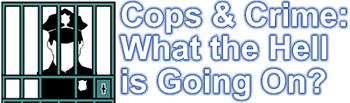
As I look at law enforcement headlines across the country on a day to day basis
I see the same two topics repeatedly coming to the forefront.
Number one is story after freaking' story of cops committing crimes, from
dealing drugs to committing burglaries and armed robberies, not to mention the
sexual assaults on duty in squad cars.
Number two, right after I read how bad the criminal element is that seems
to be steadily creeping into our profession, I read how department after
department is lowering their hiring standards.
"PD to remove entrance exam", and "past marijuana usage OK for new
recruits", and "bad credit, no problem".
Am I the only one that wants to raise the question as to whether or not
these problems correlate?
"Chief arrested for selling dope", "sheriff sentenced in conspiracy", "off-duty
officer commits burglaries", "DUI's out of control in law enforcement....The
newspaper headlines go on and on about cops committing crimes and becoming part
of the criminal element. Yet society
still holds us to a "higher standard".
If we are continually held to a higher standard, should we not continue
to hire new officers that meet that higher standard?
article continues > |
|
~~~~~~~~~~~~~~ A Message From Our Sponsor ~~~~~~~~~~~~~~~
Keep Moving Up in Criminal Justice with a CJ degree from Excelsior College
Earn your degree studying at your own pace through flexible programs from Excelsior College, an accredited leader in online education. Apply approved academy and military training toward your degree. Excelsior College courses and examinations, plus student support services, will take you from start to finish. Five emphases, including Homeland Security.For more information, click here.
~~~~~~~~~~~~~~~~~~~~~~~~~~~~~~~~~~~~~~~~~~~~~~~~ |
 TOP 10 Reasons Why Your Chief Should Be Fired: TOP 10 Reasons Why Your Chief Should Be Fired:
- Wants to be called by his new title, "Most Holy One".
- Spends more time out of town than Geraldo Rivera.
- Wears his thong outside his uniform pants.
- Slaps the prisoners around every afternoon.
- Calls everyone on the department, "little buddy".
- Thinks it is a good idea to call in the FBI.
- Has three adjutants (you only have a five man department).
- Still thinks Patty Hearst is "wanted".
- Doesn't believe in flossing.
- Believes roll calls should always start with a group hug.
| |