|
|
|
|
|
|
|
Welcome to the Policetraining.net Newsletter
In this issue
we continue to bring you important training topics of current interest.
Thanks for subscribing, and please forward this along to a law enforcement collegue you think may benefit. |
|

by John E. Reid and Associates
Interviews
in the popular television show Dragnet were often preceded with the
admonition, "Just the facts ma'am." The emotional detachment displayed by
Sgt. Friday, however, is generally not conducive to eliciting meaningful
information from a subject. People are more comfortable telling the truth to
someone whom they trust and can relate to. This is precisely why an
investigator should spend the first several minutes of an interview
developing a rapport with the subject. For the purposes of an investigative
interview, rapport can be defined as "a relationship marked by conformity."
If proper rapport has been established, a subject should feel comfortable
discussing the issue under investigation in a question and answer format.
Questions addressing the issue under investigation should not be asked until
the subject's behavior reflects this relationship. Some behavior symptoms
that indicate rapport are an uncrossing of the arms, a forward lean or
comfortable posture in the chair, longer, more detailed responses and head
nodding in agreement with the investigator's statements. |
~~~~~~~~~~~~~~~ A Message From Our Sponsor ~~~~~~~~~~~~~~~

Keep Moving Up in Criminal Justice with a CJ degree from Excelsior College
Earn your degree studying at your own pace through flexible programs from Excelsior College, an accredited leader in online education. Apply approved academy and military training toward your degree. Excelsior College courses and examinations, plus student support services, will take you from start to finish. Five emphases, including Homeland Security.For more information, click here.
~~~~~~~~~~~~~~~~~~~~~~~~~~~~~~~~~~~~~~~~~~~~~~~~ |

Many
officers have trouble understanding the psyche of a successful
drug interdiction officer. Interdiction officers may get
wrongly stereotyped as "cocky" or "a suck up" or "too Gung Ho"
by other officers. This has to do with the fact that many
officers don't understand what makes an interdiction officer
tick, what it is that drives them to find that next big load of
dope, so to speak. So to help their cause, below, I have
outlined what I believe to be five essential characteristics of
successful interdiction officers. It is the presence of these
traits that fuels the interdiction officer to be a successful
combatant in the war on drugs. If you possess these traits,
perhaps you are not "cocky" but rather an officer that is
totally committed to justice and the defense of our country
against the war on drugs.
- VIGILANT. Abraham Lincoln once said, "....But
with energy, and sleepless vigilance, go forward
and give us victories." The vigilant spirit is the art of
keeping watch, always avoiding danger. Being vigilant
means always being on the hunt for drug haulers, around
every turn and down every stretch of highway, using your
trained eye and gut instinct to track down and apprehend the
next drug hauler.
|
|
~~~~~~~~~~~~~ A Message From Our Sponsor ~~~~~~~~~~~~~

Robert F. Kennedy once said that most high officials "...learn how
to make decisions but not what decisions to make".
Executive Decision Making,
offered by the Northwestern
University Center
for Public Safety (NUCPS), teaches students how to make the right decisions, at
the right time, in the right way.
Executive Decision Making is designed for senior command
level members of law enforcement organizations who are looking to improve their
decision-making skills in order to enhance their leadership and management
competencies.
Executive Decision Making provides participants with in-depth
knowledge regarding decision-making processes, and participants learn methods
and techniques for making critical decisions that reduce risk and help discern
the best course of action for their organizations and the communities they
serve.
Executive
Decision Making begins January 4, 2009.
NUCPS has secured funding allowing
us to cover the cost of lodging for all students who register by November 25,
2008, a savings of $1,400 off the regular course price of $4,800!
To receive
the reduced price of $3,400, please click here and register no later
than November 25, 2008.
For
information regarding other courses and programs offered by NUCPS, please click here.
~~~~~~~~~~~~~~~~~~~~~~~~~~~~~~~~~~~~~~~~~~~~~~~~~ |
|
 The Difference Between Rookie & Veteran Cops The Difference Between Rookie & Veteran Cops
A Rookie loses his lunch at a
homicide scene.
A Veteran eats his lunch at a homicide scene.
A Rookie uses McDonalds drive thru so he won't miss a call.
A Veteran spends 45 minutes drinking coffee at Dunkin Donuts.
You can't read a Rookies name plate because it's polished so brightly.
A Veteran doesn't wear one for liability reasons.
A Rookie puts too much in reports.
A Veteran doesn't put enough into reports.
A Rookie loves foot pursuits.
A Veteran makes the rookie do foot pursuits.
A Rookie is given 40 hours training on communications at the academy.
A Veteran was given 40 rounds of ammunition when he left the academy.
A Rookie wants everyone to know he is a cop.
A Veteran doesn't want anyone to know he is a cop.
|
|
~~~~~~~~~~~~ A Message From Our Sponsor ~~~~~~~~~~~~~
THERE IS NO INTERNET POLICE and these neighborhoods reside in
every office, living room, and bedroom around the world. These virtual
neighborhoods often go unpatrolled; therefore virtual crimes and online evidence
are completely disregarded. The Internet is NO different than the town where
you live or work; there are good and bad neighborhoods filled with helpful
friendly people and those who threaten the safety and well being of the public.
WebCase™
is a straightforward approach to conducting online investigations allowing for
the collection, preservation and presentation of legally defensible evidence in
a forensically sound manner. WebCase™ has been designed as an easy-to-use
solution which employs forensically sound procedures that have been the
industry standard for the last 10 years. Finally, there is an all in ONE tool,
WebCase.
Download
your free 30 day demo now at www.veresoftware.com
"Make
the Internet your regular beat."
~~~~~~~~~~~~~~~~~~~~~~~~~~~~~~~~~~~~~~~~~~~~~~~~~ |
|
|
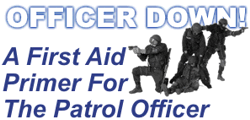 By Scott Sheldon
www.thesertgroup.com
"Officer down, I need backup
and an ambulance!" The two words we dread hearing or saying most. Unfortunately
it is a reality that you may have to face sometime in your career. How you
react, and what you can do to help that officer will largely depend upon your
training. "As we train, so shall we fight" is as true today as the first time
those words were said, and any experienced officer can attest to that. This
article will deal with the emergency medical skills that you need to learn in
order to buy a fellow officer time before the ambulance arrives, and may
actually save his or her life. It has been my observation that most officers
don't like to use the first aid skills they were taught in the Academy,
preferring to leave it to the medics to provide medical care, and normally that
is fine, but this is one instance when waiting for the ambulance to arrive on
scene is unacceptable Remember you may already be at the scene, or the first car
to arrive. Would you want someone to wait if the downed officer was you? The
first order of business is a quick review of the basics.
But First a Reminder: Planning
is not Training!
It is a common albeit
extremely dangerous mistake to think, "it will never happen to me". Most likely
every officer killed or wounded on the job had the same perception. Ask yourself
these questions:
1. Am I prepared to
give first aid to a downed officer? To myself?
2. Do I practice these
skills, or "war game" them in my mind?
3. Do I have a survival
mindset?
4. Can I do more to
prepare even if it's out of my own pocket and time?
|
|
|
~~~~~~~~~~~~~ A Message From Our Sponsor ~~~~~~~~~~~~~

Reverse
Cellular Numbers Instantly
From adults
to children to those who seemingly can ill afford what was once considered a
luxury, mobile phones are everywhere.
Over the past decade, mobile phones have become an integral aspect of
every day life - including criminal activity.
In turn, law enforcement's ability to uncover the subscriber of a
wireless phone number is often critical to an investigation. While tracing a cellular number can be a
daunting task, Entersect Police Online (EPO) specializes in dynamic cellular
searches that can help break the toughest of cases.
EPO's
nationwide Reverse Cellular Phone Number Search allows investigators to
identify the subscriber of a cellular number by reverse searching the phone
number. Search results may include the subscriber's name, cellular carrier, and
other identifying information that can help further an ongoing investigation.
Key Features of the Reverse Cellular
Phone Number Search:- Locate subscriber's first/last
name by phone number
- Locate possible addresses
associated with the subscriber
- Instantaneous results
- No hit/No fee
- Frequent updates
-
Nationwide coverage
Contact
Info:
Entersect Police Online
www.entersect.net
info@entersect.net
~~~~~~~~~~~~~~~~~~~~~~~~~~~~~~~~~~~~~~~~~~~~~~~~~ |
|

View a list of law enforcement training offered throughout the country.
|
|
|