Greetings!
Greetings, fellow travelers. The past few months have been very active at the Center, and we are excited to continue deepening and expanding our work. Our new Vision & Mission has focused our work and our new initiatives provide an energized strategy to enliven and transform higher education and our society. One of our new focal areas is on our work to ensure greater inclusion, accessibility, and diversity of our programs and network. While we have sought to consider these issues in the past, we believe the time has come for increased emphasis. We believe that this focus is especially important given the increasing dis-integration of our nation and our special position as contemplative scholars and teachers adept at accessing and sharing tools proven to assist others in heightening awareness and increasing positive feeling.
The annual conference of the Association of Contemplative Mind in Higher Education has as its theme this year, "Contemplative Approaches in the Diverse Academic Community: Inquiry, Connection, Creativity, and Insight." We hope that the presentations, no matter their focus, will stimulate greater connection and inclusion to support our community of scholars and teachers in recasting the traditional foundations of higher education to be truly integrative, transformative, and communal: wholly open and inclusive of all backgrounds, and cultivating each person in the fullest possible way.
We realize, of course, that there are many, many different ways to define both "diversity" and "inclusion." Similarly, there are as many ways, if not more, of bringing a greater focus to these issues into our abiding, unifying contemplative awareness, and into contemplative pedagogies--for example, continuing our commitment to greater attendance at our events among traditionally underrepresented identity groups (for example, African American men), and ensuring that we are open to forms of contemplative practice that arise among different underrepresented cultural identity groups (for example, gospel singing or Christian centering prayer). This is one of the reasons we are so excited about the theme of our September conference. We view it as an invitation to our entire contemplative community to contemplate the meaning of diversity and inclusion in our work, together. We hope to explore and bring new insight to the development of contemplative pedagogies and practices across the curriculum and into our increasingly diverse and interdependent society while at the very same time holding and experiencing awareness of our common humanity and keeping our hearts open to so-called others. We have received far more presentation proposals for the conference than we are able to accommodate, indicating that we are not alone in our appreciation of the importance of examining these intersections at this critical time.
We very much look forward to continuing and deepening our consideration of these issues beyond the Fall conference, and to examining the processes and practices we adopt along the way. Indeed, as a further effort toward this ongoing goal, we hope to continue our efforts with an event in San Francisco next year that will begin to explore the manner in which our contemplative approach to self-awareness, self-development, and interpersonal communication can effect broad-based, positive change in this area. We hope you will join us and share your experiences and insight at every step along the way.
Sincerely,
Rhonda Magee
Board President, The Center for Contemplative Mind in Society
Professor of Law and Co-Director, Center for Teaching Excellence,
University of San Francisco
 Daniel Barbezat Executive Director, The Center for Contemplative Mind in Society Professor of Economics, Amherst College
|
|
|
OUR UPCOMING EVENTS
Contemplative Approaches in the Diverse Academic Community: Inquiry, Connection, Creativity, and Insight
The 4th Annual ACMHE Conference
September 21-23, 2012
Amherst College, Amherst MA
$252-$405
Everyone sits in a different place, yet we are all inextricably connected. Bringing the benefits of contemplative education to greater numbers of students asks us to honor wider and more diverse cultural contexts. Contemplative practices invite us to expand our capacity to commune with others in concrete, lived experience, all the while sensing into the inter-connectedness of each and everyone with whom we share the earth. Are we listening closely enough to those with whom we speak, and are we fully aware of the contexts into which we are speaking? And, what practices assist us in attending both to the diversity of situated reality and to the reality of our shared existence in the world?
Keynote Speaker:
Rhonda V. Magee
Friday, September 21, 8:00 pm, Cole Assembly (Red Room), Converse Hall
 Rhonda V. Magee is Professor of Law and Co-Director of the Center for Teaching Excellence at the University of San Francisco. She is the author of the 2011 article, "Educating Lawyers to Meditate?," 79 U.M.K.C. L. Rev. 535 (2011), examining the movement for contemplative practice in law and its promise as a response to long-standing and wide-ranging criticisms of contemporary legal education and law practice. For more than ten years, she has taught and written about law and legal education and race in America, with a focus in recent work on contemplative approaches to pedagogy and practice. She is Professor of Law and Dean Circle Research Scholar at the University of San Francisco, where she teaches or has taught Torts; Insurance Law and Policy; Immigration Law and Policy; Racism and Justice in American Legal History; and Contemporary Issues in Race and Law and Evolving Notions of (In)equality; and Contemplative Lawyering. She has been appointed Co-Director of the University of San Francisco's Center for Teaching Excellence, beginning in August 2012. Rhonda V. Magee is Professor of Law and Co-Director of the Center for Teaching Excellence at the University of San Francisco. She is the author of the 2011 article, "Educating Lawyers to Meditate?," 79 U.M.K.C. L. Rev. 535 (2011), examining the movement for contemplative practice in law and its promise as a response to long-standing and wide-ranging criticisms of contemporary legal education and law practice. For more than ten years, she has taught and written about law and legal education and race in America, with a focus in recent work on contemplative approaches to pedagogy and practice. She is Professor of Law and Dean Circle Research Scholar at the University of San Francisco, where she teaches or has taught Torts; Insurance Law and Policy; Immigration Law and Policy; Racism and Justice in American Legal History; and Contemporary Issues in Race and Law and Evolving Notions of (In)equality; and Contemplative Lawyering. She has been appointed Co-Director of the University of San Francisco's Center for Teaching Excellence, beginning in August 2012.
Professor Magee is a long-time practitioner of a variety of contemplative practices, including centering prayer, mindfulness and insight meditation, contemplative writing and contemplative dialogue. She is associated with the Project for the Integration of Spirituality Law and Politics, and currently serves as President of the Board of the Center for Contemplative Mind in Society. She works with the Bay Area Working Group for Lawyers, a group of mindful lawyers, law professors and others which has sat together for many years, and she has served on the executive board of the Humanizing Legal Education Section of the American Association of Law Schools. She is committed to the development of contemplative pedagogy, law practice and leadership. Building on the insight that contemplation is essential to experiencing love-in-action through our work and relationships in the world, she aspires toward reforms in legal education, law practice and law, guided by the compassionate heart of contemplative practice.
Attention Lawyers and Legal Professionals: Call for participants in a Mindfulness and Law study
Rhonda Magee, Professor of Law and Co-Director of the Center for Teaching Excellence at the University of San Francisco, is conducting the first-ever widespread study of the effects of mindfulness in the worklives and professional identities of legal professionals, beginning with a short online survey, and followed-up by a selected number of in-depth interviews. If you would like your experiences to be counted, please take a few minutes to participate in the short online survey.
Reports of her findings will be made available to all participants. Thank you in advance.
8th Annual Summer Session on Contemplative Pedagogy July 29 - August 3rd, 2012 Smith College, Northampton, MA
The application period for the Summer Session is complete and our 2012 Session is now full. The Summer Session prepares participants to return to their institutions with a deeper understanding of the practice of contemplative pedagogy and methods adapted for classroom and co-curricular use. Summer Session Participants will devote the week to rigorous investigation, reflection, writing, and discussion, guided by distinguished scholars and experienced contemplative educators.
Speakers will include:
 | Daniel Barbezat
Professor of Economics, Amherst College
Executive Director, The Center for Contemplative Mind in Society |  | Loriliai Biernacki
Associate Professor of Religious Studies, University of Colorado at Boulder |  | Willoughby Britton
Assistant Professor of Psychiatry and Human Behavior (Research) and Assistant Professor of Behavioral & Social Sciences (Research), Brown University |  | Mirabai Bush
Co-Founder, Associate Director, and former Executive Director, The Center for Contemplative Mind in Society |  | Veta Goler
Division Coordinator for Arts and Humanities and Associate Professor of Dance, Spelman College |  | Marilyn Nelson
Professor Emeritus of English, University of Connecticut |  | Paul Wapner
Professor of Global Environmental Politics at the School of International Service, American University |  | Arthur Zajonc
President, Mind & Life Institute,
Former Director, The Center for Contemplative Mind in Society and Professor of Physics at Amherst College |
Contemplative Retreat for Educators
Thursday, October 18 - Sunday, October 21, 2012
The Garrison Institute, Garrison, NY
$425 - $700

The 2012 retreat is an opportunity to step away from our day-to-day pedagogical efforts and cultivate our inner lives. There will be instruction in a variety of contemplative methods, including some adapted for the classroom. We will devote special attention to focused, guided inquiry and spend much of the time in silence (including some silent meals). Through meditation, mindful walking, yoga, and journaling, the retreat aims to enable us to reenter our teaching lives from a place of greater skillfulness and insight. The final day of the retreat will include discussion of contemplative pedagogical methods and the relationship of the contemplative perspective to teaching, learning, and knowing. These practices cultivate capacities central to teaching and learning-focused attention, deepened understanding of course material, greater kindness and compassion, and enhanced contemplative inquiry and insight.
The retreat is designed to appeal to participants with a wide range of experience in contemplative practice, from beginners to seasoned practitioners. Registration is open to college and secondary school educators, administrators and staff.
2012 Retreat faculty:
 | Mirabai Bush
Co-Founder, Associate Director, and former Executive Director, The Center for Contemplative Mind in Society | | Paul Wapner
Professor of Global Environmental Politics at the School of International Service, American University |  | Anna Neiman Passalacqua
Yoga Teacher |
|
|
UPCOMING ACADEMIC PARTNERSHIP EVENT
 The Science of Compassion: Origins, Measures & Interventions The Science of Compassion: Origins, Measures & InterventionsJuly 19-22 in Telluride, Colorado
Learn more and Register at http://ccare.stanford.edu/telluride.
The Stanford University Center for Compassion and Altruism Research and Education presents The Science of Compassion: Origins, Measures and Interventions, the first large-scale international conference of its kind dedicated to study of compassion. It will provide an unprecedented meeting of leading experts in research on compassion, altruism, social connection and service presenting their latest research findings. The conference will explore the origins and antecedents of compassion and compassionate action, how it can be measured, and how we can develop and foster it through interventions.
The conference is open to researchers and community members interested in compassion, altruism, and service. Among the presenters are leading figures in Psychology such as Dr. Phil Zimbardo and keynote speaker Dr. Richard Davidson, pioneer of research on meditation and the brain. In addition to researchers, other invited speakers include distinguished figures and academics in the world of compassion such as Thupten Jinpa Langri. "While compassion is a fundamental part of every religious tradition, there is an ever enlarging body of scientific evidence that being compassionate has immense positive impact on the individual both in regard to their mental and physical health. This first of its kind conference will highlight these scientific findings and provide a forum for researchers from around the world to collaborate with colleagues from a variety of disciplines. We are very excited at CCARE to sponsor the conference and contribute to this expanding field." says Dr. James Doty, director of CCARE. Co-sponsors of the conference include the Telluride Institute, the University of California-Berkeley's Greater Good Science Center, the University of Wisconsin's Center for Investigating Healthy Minds, and the Swedish Association for Contemplation in Education and Research. Between sessions, compassion meditation opportunities and interactive breakouts will be offered. Seats limited. For more information/registration, please go to http://ccare.stanford.edu/telluride. For questions and media inquiries, please contact:
Emma Seppala emmas@stanford.edu (650) 723-3248 Preceding the conference is a day-long compassion festival hosted by the Telluride Institute July 18-19. For more information/registration: http://ccare.stanford.edu/telluride

|
|
UPCOMING PRESENTATIONS & APPEARANCES
Contemplative Pedagogy and Dealing with Technology
37th POD Conference, October 24-28, Seattle, WA
Daniel Barbezat, Executive Director of the Center for Contemplative Mind in Society and Professor of Economics, Amherst College, and David Levy, Professor at the Information School at the University of Washington, will present a session on contemplative pedagogy and technology at Pencils & Pixels: 21st Century Practices in Higher Education, the 37th POD (Professional and Organization Development Network in Higher Education) Conference, October 24-28, 2012 in Seattle, WA.
The accelerating pace of life is reducing the time for thoughtful reflection, and in particular for contemplative scholarship, within the academy. Contemplative forms of inquiry can offset the constant distractions of our multi-tasking, multi-media culture, and show how the particular needs of this generation of students can be met through innovative teaching methods that integrate secular practices of contemplation.
The session will review research on the impacts of technology and demonstrate some practices that can respond to them. Participants will gain an understanding of the core principles of contemplative pedagogy as a research-based practice of innovative, effective teaching, with concrete benefits for today's students. In addition, they will better understand their students' relationship with new technologies and have better strategies to respond to them.
Mindfulness and Management AOM Annual Meeting, August 3, Boston, MA Mirabai Bush, Founding Director and current Associate Director of the Center for Contemplative Mind in Society, will be speaking at a workshop featuring cross-disciplinary conversation about mindfulness at the American Academy of Management's Annual Meeting, The Informal Economy, in Boston on August 3, 2012. While mindfulness has become a subject of great interest in both the Academy of Management and beyond, the conversation about mindfulness within management science is disconnected from other fields and practice. The event will begin integrating those separate conversations and communities. Importing external knowledge about mindfulness will help inform management research and practice, foster interdisciplinary collaboration, and develop a more compassionate society. Mirabai will discuss how leaders and organizations can develop mindfulness, as well as the benefits of this investment.
|
|
RETROSPECTIVES
reports & reflections on recent events

A Report on the Center for Contemplative Mind in Society at the International Symposia for Contemplative Studies
April 26 - 29, 2012, Hyatt Regency, Denver, Colorado
The first International Symposia of Contemplative Studies (ISCS) brought together over 700 researchers, academics, students and contemplative practitioners to share new research and to network across the fields of contemplative science, clinical science, philosophy and education. The Mind & Life Institute planned the symposia with the aim of advancing understanding of the human mind and how contemplative practices can lead to reduced suffering, enhanced health and happiness and greater social harmony.
The program consisted of a broad range of keynote addresses, master lectures, workshops, roundtables, individual and organized papers and poster presentations. Each morning offered yoga practice, followed by meditation led by teachers from a variety of traditions. Keynote and Master Lectures were web-streamed during the event and webcasts may now be viewed on the ISCS website.
As a co-sponsoring institution, the Center for Contemplative Mind in Society organized four concurrent sessions led by leaders in its higher education network and two poster sessions from the Center staff. The well-attended concurrent sessions were especially designed for members of the Association for Contemplative Mind in Higher Education (ACMHE) but open to all symposia participants. The two poster sessions updated symposia participants about the Center's core programs and new initiatives.
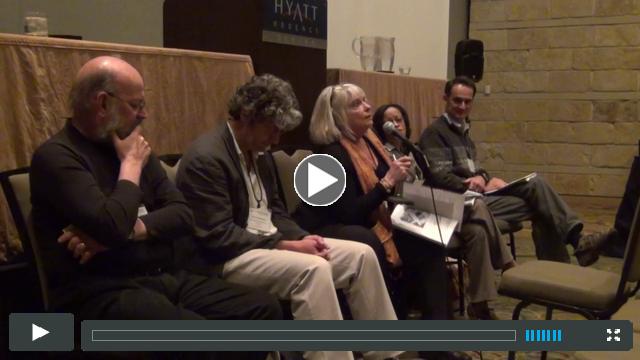 | |
Watch the video of Session III:
Contemplative Courses Throughout the Curriculum
|
Between the months the Center's sessions were planned and the ISCS occurred, Arthur Zajonc, our former director, accepted the position as the President of the Mind & Life Institute. So the occasion also marked an important transition in organizational leadership. On Saturday evening, the Center hosted a gala reception recognizing Arthur's immense contributions to the Center's success and welcoming Dan Barbezat as our new Executive Director. The gathering included founding and current members of the Center's Board, ACMHE and higher education community members and guests. While the relationship between the Center and the Mind & Life Institute had always been cooperative and complimentary, Arthur's pivotal role promises greater exposure for the Center's work in higher education and opens new opportunities for collaboration with the researchers and clinical professionals who are part of the wider Mind & Life network.
ACMHE Session Descriptions
Session I:
Renewal in Higher Education: Integrating the Contemplative Dimension
with Diana Chapman Walsh, President Emeritas, Wellesley College; Daniel Barbezat, Amherst College and the Center for Contemplative Mind in Society; Carolyn Jacobs, Smith College School of Social Work
New approaches to renewal, grounded in contemplative awareness, can promote vital teaching and learning. This session addressed the following questions:
- How can higher education become a more multidimensional enterprise, one that draws on the full range of human capacities for knowing, teaching and learning?
- How can we bridge the gaps between the disciplines, and forge stronger links between knowing the world and living creatively in it?
- Can the inclusion of contemplative methods and the development of a contemplative culture bring renewed meaning and purpose to the academy?
- How can colleges and universities become places that honor the whole human being and awaken deeper understanding in students, faculty and staff?
This roundtable discussion on how to rethink the higher education enterprise gravitated toward issues of strife and discord between faculty and administration, and the need to work against strong divisive tendencies. The discussants shared their experience s bringing contemplative awareness to these places of tension, and using their own practice to discover new solutions.
---
Session II:
Contemplative Inquiry as a Research Method
with Arthur Zajonc, Mind & Life Institute and Dept. of Physics, Amherst College
Contemplation as a method of inquiry can be a path of knowledge that has many applications in sciences, humanities and the arts. Contemplative inquiry is not opposed to conventional methods, but rather transforms and extends them. The same values of clarity and integrity can infuse contemplative exploration as have supported scientific and critical investigations.
In addition to contemplative practices used in educational settings to strengthen attention and emotional balance, capacities can also be developed that support the discovery process. As Goethe has written, "Every object, well contemplated, opens a new organ in us." Engagement with works of art or natural phenomena is not only deepened through contemplation, but subtle cognitive changes take place within practitioners that support fuller understanding. Contemplative exercises can assist in the creative process and the generation of insight.
Bringing together meditative practices from contemplative traditions and contemporary adaptations, Arthur Zajonc offered instruction in exercises that cultivate capacities for insight and creativity. These contemplative exercises also enhance empathy and compassionate connection to others, shaping ethical orientation and action.
---
Session III:
Contemplative Courses throughout the Curriculum
with Mirabai Bush, Center for Contemplative Mind in Society; Daniel Barbezat, Center for Contemplative Mind in Society and Dept. of Economics, Amherst College; Rhonda Magee, University of San Francisco School of Law; David Haskell, Dept. of Biology, University of the South; Peter Schneider, Dept. of Architecture, University of Colorado
The Center for Contemplative Mind in Society began granting fellowships and hosting conferences and trainings in 1996 for professors to explore the use of contemplative practices in their teaching at colleges and universities. There are now hundreds of educators using contemplative exercises, and the Center has gathered a rich collection of methods in disciplines from architecture to astrophysics.
Mirabai Bush and Contemplative Practice Fellows described practices adapted for secular educational settings that develop capacities central to teaching and learning. View a video of this session.
---
Session IV:
Developing a Multiculturally Inclusive Contemplative Pedagogy
with Rhonda Magee, University of San Francisco School of Law; Daniel Barbezat, Center for Contemplative Mind in Society and Dept. of Economics, Amherst College; Peter Huang, Dept. of Law, University of Colorado; Ali and Atman Smith, Healthy Life Foundation
This conversation was intended to increase understanding and possibly extend the range of contemplative practices used in higher education to be more inclusive, welcoming and rooted in the lives of diverse groups.
The panelists shared personal stories of their experiences, identities, and the contemplative influences in their lives. As we come to understand how contemplation is deeply rooted in human experience, it may be helpful to consider that practices don't need to be taught as much as they need to be found. Professors and students may connect to practices already in use within their communities. Contemplative approaches may help to surface and raise up contemplative understanding that is already present.
Contemplative teaching creates relationships in the classroom and a community of support. Educators well established in their own practice can open to the culture of the students: begin where they are--and honor the cultural context of others.
 | | Manuel Gomez, Retired Vice Chancellor for Student Affairs, UC Irvine, reads from TS Eliot at the January 2012 meeting of educators at the Garrison Institute. |
Cultivating the Field of Contemplative Teacher Education:
A report on a meeting of professors of education
by Mirabai Bush, Sunanda Markus and Susan Fountain
The Garrison Institute and the Center for Contemplative Mind in Society share a common interest in bringing the benefits of contemplation to society through education. Garrison's focus and experience is in K-12, while the Center's is in higher education. In January 2012, we partnered in hosting a 3-day invitational meeting at the Garrison Institute on "Contemplative Practices and Pedagogy in Schools of Education." The 21 participants included education professors and educational researchers from diverse sub-fields of education (curriculum, educational psychology and philosophy, school administration) as well as those developing curricula for classroom instruction. The purpose was to assess the state of the field and consider ways of strengthening it.
Introducing Contemplative Pedagogy into Teaching and Learning in Israel
by Rona Wilensky and Sunanda Markus
A workshop on Contemplative Pedagogy was held February 6 - 9, 2012 at Neve Shalom, Israel. Neve Shalom, which means "oasis of peace," is a unique community where Jews and Palestinians have chosen to live side-by-side. This was the first gathering of its kind in Israel and it was moving and inspiring to see the interest and commitment of all those who attended.
Organized by the Center for Contemplative Mind in Society in coordination with Professor Ofra Mayseless, Dean of the Faculty of Education at the University of Haifa, the workshop introduced a diverse group of 17 Israeli educators to the field of contemplative education. Through presentations, informal discussion, and contemplative practices, participants shared their experience and explored how contemplative practices can help educators. The group included university professors and researchers, teacher and counselor educators, adjunct faculty, post-doctoral fellows, teachers in technical institutes, teachers working with youth outside of formal schooling, the coordinator of a national movement for spirituality in education as well as two primary school teachers. What they had in common was personal experience with contemplation and strong interest in how to connect their personal practice with their work as educators.
Read the complete report (.pdf)
5th Gathering of Leadership Educators with Parker Palmer
On March 27, 2012, the Center for Contemplative Mind in Society co-hosted, with Jerry Murphy, Professor at the Harvard Graduate School of Education (HGSE) and Pamela Seigle, Executive Director of Courage & Renewal Northeast, the fifth in a series of gatherings at Harvard University for leadership educators. Arthur Zajonc invited Parker Palmer, founder of the Center for Courage & Renewal, to share his understanding of contemplation and how it relates to leadership. Arthur recently co-authored The Heart of Higher Education: A Call to Renewal (Jossey-Bass, 2010) with Parker Palmer and Megan Scribner. Members of the ongoing contemplative leadership group were invited to bring guests, and the Eliot Lyman Room at HGSE was filled near to capacity with over 50 participants. (Jossey-Bass, 2010) with Parker Palmer and Megan Scribner. Members of the ongoing contemplative leadership group were invited to bring guests, and the Eliot Lyman Room at HGSE was filled near to capacity with over 50 participants.
Foundation for Teaching and Learning
March 16-18, 2012, at Bryn Mawr College
The Fifth Annual Mindfulness in Education Network Conference in Bryn Mawr, Pennsylvania, was co-sponsored by the Center. This three-day event explored the uses of mindfulness in education.
- Friday, March 16: "Improving Attention and Working Memory with Mindfulness Training," Keynote Address by Dr. Amishi Jha, Associate Professor of Psychology, University of Miami
- Saturday, March 17: Mindfulness in Education Conference
- Sunday, March 18: A Day of Mindfulness: Alive and Awake
Information on the conference plenary speakers and breakout sessions, including videos, is available at mindfuled.org.
Arthur Zajonc will be the keynote speaker at the next MiEN Conference at Lesley University, March 15 - 17, 2013.
Workshops on Contemplative Engagement and Well-Being at St. Cloud State
by Daniel Barbezat
St. Cloud State University begins each semester with a series of workshops and meetings. On Thursday, January 5, 2012, I presented two workshops, one on contemplative practices and teaching and the other on contemplative approaches to remain engaged with students and colleagues. I also ran a 3-hour session on the possibilities for establishing a Center for Well-Being at the University.
The program was created by Lalita Subrahmanyan and Caryn Thole from St. Cloud's Center for Excellence in Teaching and Learning. Each workshop was had about 60 attendees. For the second workshop, the Provost and President of the University attended. The questions were very good and the sessions were lively. It went very well.
Here are descriptions of the workshops:
Workshop 1:
Engaging and Inspiring Our Students in Our Classrooms Introspection and reflection are a powerful means for students to engage deeply with the material presented in our classrooms. By reflecting and becoming aware of their own experience of what we present, students find themselves in the heart of their own education. They come to see directly the relevance of their courses and deepen their understanding of their studies, themselves and their relationship to others. Workshop 2:
Remaining Engaged and Inspired in Our Work with Students Throughout Academia, we are under increasing stress. Staff and Administration, responding to budget cuts, are stretched beyond their capacity yet still provide for the increasing demand for their services. Among the Faculty, increasing loads and diminishing resources have made committed, sustained engagement increasingly difficult. Students, young and overwhelmed, have responded to the pressure inside institutions and the grimness of labor markets in a variety of ways, sometimes even tragically taking their own lives. Like never before, this is a time for us to attend to ourselves and our relationship to others in a deep and sustained reflection into what means the most to us! The session on the Center for Well-Being was very productive. A group of Professors, Administrators, Counselors and Staff came together to create an environment incorporating contemplative approaches in student services. St. Cloud has been hit hard by the tough economy, and just days before I gave my presentations, the body of a student who had committed suicide was found in the Student Center, the building in which I gave my workshops.
I saw that they were really trying to establish a "Center for Well-Being" and framed my presentation around the nine domains of well-being established in the "Gross National Happiness" measures in Bhutan. The session was very productive. My advice was that they first try and integrate the resources already on campus, rather than try and create a separate center immediately.
|
|
|
RECOMMENDED READING
A Mindful Nation by Congressman Tim Ryan

In A Mindful Nation, Congressman Tim Ryan presents us with an inspiring and hopeful view of our country's future. Across America, people are feeling squeezed, exhausted, and running faster and faster while falling farther behind. Despite this bleak outlook, people are beginning to take action in a new way: by slowing down, paying attention, and gaining an awareness of the inner resources at their disposal.
This new way is based on the timeless and universal practice of mindfulness, the natural capabilities of our brains and minds, and the core American values of self-reliance, stick-to-it-iveness, and getting the job done. And it's manifesting in every sector of our society--helping sick people work with their pain, school children improve their learning, veterans heal from trauma, and CEOs become more inclusive and effective leaders.
In A Mindful Nation, Congressman Tim Ryan shares what's happening with mindfulness in the classrooms, hospitals, boardrooms, research labs, and army bases across the country--including the Center for Contemplative Mind in Society's work in education and with the military. A Mindful Nation paints a picture of emerging solutions that both benefit the reader and address the societal difficulties we are facing to show how the benefits of mindfulness apply to the current challenges that affect each of us and our communities.
Search Inside Yourself by Chade-Meng Tan
Chade-Meng Tan, a former board member of the Center for Contemplative Mind in Society, is Google's Jolly Good Fellow (which nobody can deny). As one of Google's earliest engineers, Meng helped build Google's first mobile search service and headed the team that monitored Google's search quality. After a successful eight-year stint in engineering and two years as GoogleEDU's head of personal growth, he currently serves to "enlighten minds, open hearts, create world peace" (yes, that's his job description!).
The Search Inside Yourself program was developed by Meng in partnership with Mirabai Bush and the Center for Contemplative Mind in Society. We're delighted that Meng has made the SIY coursework material accessible to non-Googlers through this new book, which has already been translated into 11 languages.
|
|
|
|
|



