|
|
|
Issue 4, Fall 2009
We're delighted to send you this autumn newsletter, with its harvest of another seasons' announcements from contemplative higher education. The circle of members continues to expand, in size and reach, and we now number over 400 from New England to West Australia. If you haven't visited the members' online community in some time, you'll find that opportunities to connect with one another have grown, and you might consider searching by your region or discipline to discover who else is around. And while you're visiting, be sure to check in with Rick Repetti, Assistant Professor of Biology at Kingsborough Community College, who is now our online community "moderator." He's befriending everyone he knows and will be happy to make your acquaintance as well. Rick will be updating the forums and has started a blog (on the left navigation bar of his profile page) inviting you to share your perspective on practice in the classroom and other topics. We're grateful to Rick and others who are enlivening the online community with their presence.
The resources on the public pages of the ACMHE website have also expanded. There are new tabs for our growing archives of Webinars (September brought us Dan Goleman, author of Emotional Intelligence and Ecological Intelligence, on conscious consumption, and in October Michelle Francl, professor of Chemistry at Bryn Mawr, presented on contemplative practice in the science classroom) and e-Newsletters. We've also added a Bulletin Board tab that members can use to post announcements in the following categories: Upcoming Events; Fellowships and Grants; Research Opportunities; Employment Opportunities; Seeking Employment; and New publications. Email text to carrie@contemplativemind.org and she will post.
We have the dates for our 2010 Annual Conference, which will be held once again at Amherst College. The call for papers will be posted soon, but please plan to join us September 24-26, 2010, to share your research, practice and presence with us in the splendor of the next New England autumn.
Kind regards,
Beth Wadham and Geri DeLuca
|
|
In this issue...
- 5th Annual Summer Session on Contemplative Curriculum Development
- The Contemplative Administrator
- Teaching Students to Turn Inside: Yoga and Mindful Awareness
- Announcements from Members
- Press Room: Members' recent publications and media channels
articles
|
5th Annual Summer Session on Contemplative Curriculum Development
August 9-14, 2009 at Smith College, Northampton, MA
by Beth Wadham
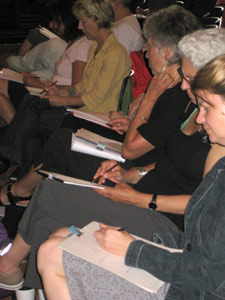 After five years, this gathering of educators in August at Smith College has become an established way to demonstrate how satisfying it can be for professors to work across disciplines to explore the role of contemplative practice in their courses. This year, faculty from Economics, Chemistry, Physics, Law, Art History and Architecture worked with the group of mostly English and writing professors to their mutual benefit. Although the plan for next year may well include faculty from Language and Literature, the recognition arose that there is a "contemplative heart" of each discipline that can be shared with all.
Continue reading... |
|
|
The Contemplative Administrator
The Center's work in higher education, particularly the Contemplative Fellowship Program, has primarily focused in the past on working with professors who are integrating contemplative practice into the classroom. But the question of whether and how contemplative practice can play a role in institutional change through administrative and co-curricular initiatives has been a recurring one.
In September, a group of administrators participated in a conference call with Arthur Zajonc and Mirabai Bush to reflect on practice as it relates to this sphere of higher education, to explore the benefits of practice, for administrators themselves and in service to their academic communities.
Mirabai related her experience at UC Davis Extension School of Continuing and Professional Education. She was contacted by an advisor to the dean who had an interest in mindfulness, and was invited to give a PowerPoint of Center's work in higher education. The 25 or so people attending found it interesting, and wanted to bring the theme of mindfulness to their annual meeting of 125 professionals, mostly administrators and some teachers. But most of those attending the annual meeting hadn't yet asked for mindfulness themselves.
Continue reading... |
|
|
Teaching Students to Turn Inside:
Yoga and Mindful Awareness
Interview with Carla Stangenberg
by Geri DeLuca

Carla Strangenberg
photo by Gina De La Chesnaye
Carla Stangenberg has been the director of the Jaya Yoga Center in Brooklyn, New York since October 2005 and has taught there since 2000. She received her certification at Om Yoga Center under the guidance of Cyndi Lee. Her teaching experience also encompasses the fields of theatre, acting, movement and voice. Carla holds a BFA in theatre from NYU's Tisch School of the Arts. She currently teaches yoga at Brooklyn College, CUNY as well as at Jaya. She is grateful to many teachers who have helped her along the way.
Geri DeLuca is a contemplative fellow at the Center for Contemplative Mind. She teaches English at Brookyn College.
G: How did you come to be a yoga teacher?
C: In 1999, I had been practicing yoga for something like seven years. I was working a day job I didn't really like, and one day I saw a sign up in the yoga studio where I practiced at the time (Om Yoga in Manhattan) that said "teacher training." So I thought to myself, that sounds interesting. What a nice way to deepen my practice. Doing the training meant I had to leave work in the middle of the day two days a week for 2 1/2 hours each time, but I got away for it. So that's how I became a yoga teacher. It felt like a natural extension of my yoga practice--like I had to teach.
G: Where did you begin teaching?
C: A few years before I was certified, I had taught movement and voice classes at a summer program at Northwestern University. When I taught those movement classes, I incorporated yoga, and it worked. Earlier, when I was in college at NYU, my movement teachers were incorporating yoga too, because they were all going to the same yoga studio, Jivamukti, on Lafayette Street, where I was going. So I followed their lead, and then I started teaching my friends. So I was teaching informally even before I got the certification.
Continue reading...
|
|
|
Announcements from Members
Contemplative Studies Group Proposed to American Academy of Religion
A group of colleagues has proposed the formation of a new program unit in the American Academy of Religion (AAR). The Contemplative Studies Group will be an interdisciplinary program unit aimed at the investigation of contemplative practice and experience. They will submit their proposal for group status to AAR this fall.
The leadership group includes Anne Klein, Rice University; Louis Komjathy, University of San Diego (co-chairs); and Thomas Coburn, former president of Naropa University; Fran Grace, University of Redlands; Harold Roth, Brown University; and Judith Simmer-Brown, Naropa University as steering committee members. They are currently seeking others who would support and participate in the Contemplative Studies Group, and have their names added to their supporting materials.
Graduate Certificate Program in Contemplative Clinical Practice, an advanced certificate program in Spirituality and Social Work practice at Smith College
An advanced certificate program in spirituality and clinical social work practice considers the clinical relationship as a potential locus of the sacred. The program provides a framework for assessing religious and spiritual development and explores issues of ethics and social justice as they relate to spirituality.
Cultivating awareness is crucial for clinical practice in a complex, global world. The capacity of the clinical social worker to pay attention to the dynamics of the clinical relationship can be enhanced by continuous self reflection and contemplative practice. Contemplative practices can deepen awareness and develop a stronger connection to one's inner wisdom. Practices originating in religious contexts and those being created in secular contexts can deepen the reflective experience for both the clinician and the client.
For additional information and application materials, visit this website.
Course on Restorative Solitude and Workshop on Distraction
Mara Adelman, Seattle University
solitudecourse.com
contact: mara@seattleu.edu
After attending the weeklong Summer Session offered for academics by The Center for Contemplative Mind in Society, I was inspired to create a new course in The Department of Communication at Seattle University entitled "Restorative Solitude." This course merges the research on contemplative practices, solitude, and voluntary simplicity and its significance for human communication. The website covers the curriculum, readings, exercises, and related information. Your feedback to this course and ideas for future courses would be greatly appreciated.
Short Description: The 21st century may well be characterized as the age of "solitude loss." We are wired as never before. Technological advances propel 24/7 engagement, responsiveness and feedback; but when can we find the solitude to reflect, to process information into ideas or even into inspiration? This interdisciplinary course examines the topic of restorative solitude and its meaning for everyday life. Prior works indicate that our human condition is a tension between connection with others and a profound need for solitude; for engagement and disengagement. Three overlapping areas in this course include restorative solitude, contemplative practices, and voluntary simplicity. Readings, lectures, and student research covers such topics as childhood preferences for time alone, the relationship of solitude to technology and the creative process, its significance for spirituality, and the dark side of solitude, meditation and faith, etc. The course also includes guest presentations, films, small-group discussions, solitude exercises, contemplative practices, and independent projects.
Workshop on Distraction
Many people have advocated meditation as an anecdote to our current state of distraction. Studies on meditation have demonstrated its helpfulness in reclaiming our capacity for attention, observation, reflection, and overall quality of life. In response to discovering that my own students reported an average of 26.5 hours a week on mediated (not meditative or medicated!) communication (cell phones, email, texting, internet, etc.), I felt compelled to address the issue of distraction among faculty. The website below describes a three-hour workshop on the impact of distraction students' personal and academic lives. Your feedback to this workshop and your ideas for future workshops would be greatly appreciated.
Initially I was stunned with the overwhelming faculty response. Many professors were frustrated with students' preoccupation with technology and their distraction within the classroom. Within two hours of announcing the workshop, over 48 faculty members responded. Although I only anticipated a small group of 5-8, over 31 faculty members attended. Note takers recorded the discussions which are synthesized on this website.
This workshop covered a brief overview of research findings regarding distraction and technology (e.g. attention, focus, quality of life), future projected scenarios, and reactions to Maggie Jackson's book, Distracted: the Erosion of Attention and the Coming Dark Age, (2008). Special attention was given to curricular and classroom practices that help students focus and reflect on technology/distraction in their lives, including meditation. WEBSITE: distractionworkshop.com
Elizabeth Bader's article, The Psychology of Meditation: Issues of Self and Identity and IDR Cycle," has been accepted for publication in Vol. 10, Issue 2 of the Pepperdine Dispute Resolution Law Journal (2009-2010). An abstract of the article (PDF) is posted on the ACMHE site's publications page.
Gesa Kirsch has published "Creating Spaces for Listening, Learning, and Sustaining the Inner Lives of Students" in the Journal of Expanded Perspectives on Learning (14, Winter 2008- 2009): 56-67. A pdf of the article is posted with permission on the ACMHE website under the Publications tab.
Mindful Journaling
Mary Ragno, Lecturer, Eastern CT State University, Willimantic, CT
This fall, Mary Ragno, Eastern CT State University, introduced meditative silence and journaling into her freshman level core course in health and wellness. As part of each weekly class, students engage a 5-minute exercise of meditative silence, followed by a 10-minute writing time in their private journals. Students receive (in class) a written reflective question that engages the particular lesson subjects of the week. While they are not required to write on the particular reflective question, Mary believes that the guided question enhances the students' awareness of self, while it enriches their comprehension of particular subject matters related to their own health and wellness. While the actual content of student's journals is private, they will be required to submit a summarizing reflection paper at the end of the term.
Mary developed this initiative after attending the "Contemplative Heart of Higher Education" Conference held last spring in Amherst. In particular, she appreciated the presentation of Northeastern University's Dorett ‘Pinky' Hope, and Jane McCool, who shared similar classroom activities that are engaged with nursing students.
Spirituality: Like the Humming of the House
By Ann T. Riley, PhD Candidate, University of Oklahoma
Spirituality within the individual self is like the quiet humming of the house. I had a friend who, in addition to being brilliant in her field, was gifted at decorating her home. She told me once that when she moved into her new, built in 1921, home that before she made any decisions about repainting she would sit quietly in a room for weeks sometime just spending time to get to know it. She said she waited until the room spoke to her about what color was right for it. Certainly, I couldn't help but admire her for her patience too.
But really, have you ever been at home in the quiet? When there are none of the usual noises? When there is no television, radio, music, alarm clock, doorbell, telephone, dog, cat, or people with high, low, or loud voices filling the air? All these sounds constitute many of our normal busy full lives, of course; but just occasionally or even regularly, try sitting at home in silence. When I meditate at home in the quiet, I can't help but notice the humming of the house: the soft background noise of the energy that surrounds me and provides support for my existence. This reminds me of my own inner spirituality. I am aware of the quiet pulsing energy that is always present and humming quietly inside me despite the noisy busyness of my usual daily life. I am grateful for this persistent source of energy that serves to propel me forward toward the right purposes for my life so that I may live in comfort within my own skin.
Let your home speak to you, and be reminded of the ongoing source of spirituality that is ever-present and supportive within you.
|
|
|
Press Room
Follow the links below to recent news about members and
topics relevant to contemplative higher education.
Daniel Barbezat, Professor of Economics at Amherst College and Contemplative Practice Fellow 2008 gave a radio interview on "Here and Now," public radio's daily news magazine, about "Consumption and the Pursuit of Happiness," the course he taught for his fellowship year. The interview is available online.
Emmanuel Charet has just published A Balancing Act, the book about Energize, a holistic approach to acting. The book presents acting as a mind, body, spirit practice and offers invaluable tools to rebalance the emotional strain resulting from performance. The book is available from Starlight Acting Books.
A review of A Balancing Act by Barbara Sellers-Young appeared in the Association for Theater in Higher Education Journal (September 2009).
Book of This Place
The Land, Art, and Spirituality
Deborah J. Haynes
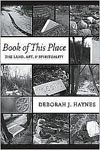 "Book of This Place is a hopeful tale of bonding--a leisurely meditation on self, nature, and art that is haunted by deaths and nourished by resilience and creativity. Haynes's stone sculptures define the narrative as she searches for her bedrock. A welcome addition to the literature of place."
--Lucy R. Lippard, author of The Lure of the Local
Deborah J. Haynes is Professor of Art and Art History at the University of Colorado at Boulder. She is both a writer and artist and the author of three books: Bakhtin and the Visual Arts, The Vocation of the Artist, and Art Lessons: Meditations on the Creative Life.
Barry Boyce mentions ACMHE members Harold Roth, Geri DeLuca, David Forbes and Ed Sarath in his article, "The Contemplative Curriculum," in his "Mindful Society" series in the July 2009 issue of Shambala Sun.
Paul Wapner, Director of Global Environmental Politics Program at American University and Contemplative Practice Fellow 2008, wrote on "Empathetic Climate Policy" in the January/February 2009 "Memos to Obama" issue of Tikkun Magazine.
Arthur Zajonc, Professor of Physics at Amherst College and Director of the Academic Program of The Center for Contemplative Mind in Society, maintains a regular blog at Psychology Today's website.
|
|
|
|


