|
FEBRUARY
EARTH MAGIC ORACLE CARDS
FIRE : Passion
"What are your passions? What turns you on? What ignites that inner flame, that creative spark? When you feel devoid of passion consider what is missing in your life!". Get Your FREE Online Reading with Dr. Farmer's
EARTH MAGIC ORACLE CARDS.
This unique online reading offers you a 1-card or a 3-card spread with extended readings included. |
Steven is taking your calls and offering his unique Earth Magic readings on Earth Magic Radio! Check the schedule for exciting guests too!

Using his intuitive skills honed during his years as a psychotherapist and shamanic practitioner along with his oracle cards, he'll help you discover answers to your questions about relationships, money, life purpose, spirituality or any other questions you may have.
Tune in HERE
During the LIVE Show you can call in at 1-877-230-3062.
Don't miss the party at the CTR Hotspot! Join now for access to shows, archives, blogs, articles and videos by Dr. Steven Farmer!
Go HERE to sign up today!
|
Finding Your True Passion

Ask yourself these seven questions to gain insight into your true passion!
~What makes you smile?
~What seems to come natural to you that may be challenging for others?
~What sparks your creativity?
~What would you do for free?
~What do you enjoy talking about and teaching others about?
~What service do you see yourself providing in the world to make a positive difference?
~What would you regret not having done? |

The Earth Magic March Tour includes:
Go HERE for complete details!
|
|
Greetings!
Greetings Fellow Travelers!
I recently spent a couple of days camping in the Mojave Desert with a long time friend, Bruce Belman. He and I first met in the mid-80s and from there became lifelong friends. When he lived close by, since our birthdays were only a few days apart-his being January 6, mine the 11th-we made a pact that we'd have dinner together in January every year. Well, he moved to Flagstaff years ago and although we've missed a few get togethers since he moved, we've m ade an effort to keep that agreement by either meeting up halfway or by me flying to Phoenix and going out for a couple days on his sailboat in a nearby lake. ade an effort to keep that agreement by either meeting up halfway or by me flying to Phoenix and going out for a couple days on his sailboat in a nearby lake.
This year we camped in a spot where we'd been before, near an old fort called Ft. Piute that was occupied for only six months in the mid-1800s. It was stationed next to a year round water supply called Paiute Springs. The pioneers coming westward across the extensive Mojave Desert would stop here so they could refresh and replenish their water supply before tackling the rugged trail across the mountains and on to the promised land of California.
It requires a four-wheel drive with plenty of clearance to get there, as once you're off the highway, it's a bumpy and rocky dirt road for about ten miles. But it's worth it! I love the desert because it's so quiet and peaceful, away from the usual noise of the city. It was a New Moon and we had a chance to witness the vast ocean of stars away from any intrusive lights. Someone once told me that this is why people get a bit crazy because they don't see the stars.
The challenge for me was to take this peaceful, easy feeling (to coin a phrase from an Eagles song) back to the wilderness known as civilization. Not always easy to maintain, but some of these ideas have helped me. First, Turtle spirit has reminded me continuously over the past several months to SLOW DOWN! To do so, I find when I get caught up in the "hurry up syndrome" I BREATHE three full deep breaths. Another is to go outside on a clear night and spend a few moments just GAZING AT THE STARS. And last but not least, be sure to spend some time in SOLITUDE, preferably in Nature where you can experience the quietness.
For this coming spring, check out my very active schedule here in and on my website, earthmagic.net.
May you have many blessings in the coming weeks, filled with peace, love, and harmony!
Blessings,
Steven
|
Spring is Here....Or is it?
Here we are in the second month of 2012 and depending on where you live, you may be seeing some hints of spring. Perhaps the days have warmed slightly, or some buds are starting to show on the trees, or at the least you've begun planting seedlings indoors to await the longer and warmer days to transplant them outside.
In the Celtic Wheel of the Year, this is officially the start of spring. This ancient circular calendar-rather than the linear Gregorian calendar we're accustomed to-separates the one year solar cycle into four quarters. Certain days (approximately) are marked as quarter days-February 1, May 1, August 1, and October 31-indicative of the start of the  corresponding seasons-spring, summer, fall, and winter. Other days are termed cross-quarter days, being March 21, June 21, September 21, and December 21. These dates on the Wheel mark the midpoint between the quarter days. It's a different way of marking the solar year that makes sense in the more temperate climes. corresponding seasons-spring, summer, fall, and winter. Other days are termed cross-quarter days, being March 21, June 21, September 21, and December 21. These dates on the Wheel mark the midpoint between the quarter days. It's a different way of marking the solar year that makes sense in the more temperate climes.
This particular quarter day that falls between January 31 and February 2 is known as "Imbolc" on the Celtic Wheel of the year but more typically known as either Candlemas or Groundhog Day. In my book Sacred Ceremony I go into more details about its origins and suggest some ways to honor this seasonal marker.
We look for the groundhog about this time of year to come out of hibernation, and as the story goes, if he sees his shadow, then we'll have six more weeks of winter. We also begin to come out of hibernation, though tentatively at first, looking for signs of renewed life as well as the evidence that winter's breath is still upon us. If we see our own "shadow", it may require us to examine and clear any fears of moving forward into the growing light of day.
Imbolc is the Celtic name for the womb of Mother Earth. This quarter day is also known as Oimelc, or Brigid's Day. Oimelc literally means "sheep's (or Ewe's) milk." This was the first milk of the Ewes, a few weeks before the lambing season, so the milk was a signal of the preparation for new life. Brigid, also called Brid (pronounced breed), Brigit, or Bride, is known as the Goddess of fire and fertility, of inspiration and poetry, and is healer and protector. Often she's visualized as a pregnant young maiden carrying the young seed of the Sun. At Imbolc, which is one of the fire festivals, she's said to wear a radiant crown of candles.
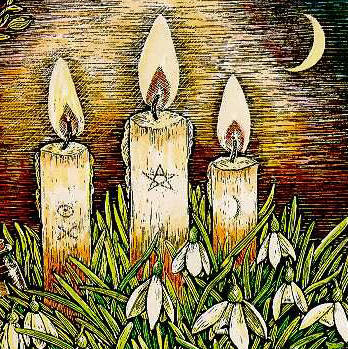 Candlemas is a derivation that grew from this fire Goddess. Christianized Celts associated Brigid with the Virgin Mary, and this festival came to be known as the "Feast of Mary of the Beginning of Spring," where candles were brought to the church to be blessed, thus a "Candle Mass." Candlemas is a derivation that grew from this fire Goddess. Christianized Celts associated Brigid with the Virgin Mary, and this festival came to be known as the "Feast of Mary of the Beginning of Spring," where candles were brought to the church to be blessed, thus a "Candle Mass."
Commemorating Imbolc-Planting and germinating are strong characteristics of this seasonal celebration. In southerly latitudes, you can plant some early seeds, whereas in northerly latitudes, you can germinate these seeds indoors and later transplant them outdoors. Do this with appreciation for the tenderness of the Mother's belly and Her receptiveness to the first signs of awakening life.
As the early peoples did at all the quarter days, a fire festival can be the basis for any other ceremonies. Perhaps planting a sapling, or some bulbs for flowers. If it's still cold outside, the indoor hearth can serve the purpose to warm everyone and be useful as a focal point for a release and renewal ceremony.
Candles, candles, candles, especially on the first night of Imbolc. Set up candles and meditate on the beginning seeds of this next cycle, those thoughts and desires that you had described at the winter solstice. Then quietly journal on what you see as the initial stages of manifesting those desires.
This seasonal marker is an excellent time for a cleansing fast. I'd suggest three days, though even 24 hours is an excellent way to greet the beginnings of the spring season. Coordinate the cleansing fast with a fire ceremony and a release and renewal ceremony, and you'll assure your own movement as you notice yourself thawing for an early internal spring.
No matter how you acknowledge or honor this quarter day, I'm sure for those of you in colder climes you're looking forward to relief from the snow and cold!
For more articles written by Dr. Steven Farmer - Go HERE. |

Since 1973, Dr. John Gottman has studied what he calls the "masters and disasters" of marriage. Ordinary people from the general public took part in long-term studies, and Dr. Gottman learned what makes marriages fail, what makes them succeed, and what can make marriages a source of great meaning. By examining partners' heart rates, facial expressions, and how they talk about their relationship to each other and to other people, Dr. Gottman is able to predict with more than 90% accuracy which couples will make it, and which will not. What advice does Dr. Gottman have to offer? Below are some of his top suggestions for how to keep your marriage strong.
Seek help early
The average couple waits six years before seeking help for marital problems (and keep in mind, half of all marriages that end do so in the first seven years). This means the average couple lives with unhappiness for far too long. Edit yourself
Couples who avoid saying every critical thought when discussing touchy topics are consistently the happiest. Soften your "start up"
Arguments first "start up" because a spouse sometimes escalates the conflict from the get-go by making a critical or contemptuous remark in a confrontational tone. Bring up problems gently and without blame. Accept influence
A marriage succeeds to the extent that the husband can accept influence from his wife. If a woman says, "Do you have to work Thursday night? My mother is coming that weekend, and I need your help getting ready," and her husband replies, "My plans are set, and I'm not changing them". This guy is in a shaky marriage. A husband's ability to be influenced by his wife (rather than vice-versa) is crucial because research shows women are already well practiced at accepting influence from men, and a true partnership only occurs when a husband can do so as well. Have high standards
Happy couples have high standards for each other even as newlyweds. The most successful couples are those who, even as newlyweds, refused to accept hurtful behavior from one another. The lower the level of tolerance for bad behavior in the beginning of a relationship, the happier the couple is down the road. Learn to repair and exit the argument
Successful couples know how to exit an argument. Happy couples know how to repair the situation before an argument gets completely out of control. Successful repair attempts include: changing the topic to something completely unrelated; using humor; stroking your partner with a caring remark ("I understand that this is hard for you"); making it clear you're on common ground ("This is our problem"); backing down (in marriage, as in the martial art Aikido, you have to yield to win); and, in general, offering signs of appreciation for your partner and his or her feelings along the way ("I really appreciate and want to thank you for...."). If an argument gets too heated, take a 20-minute break, and agree to approach the topic again when you are both calm.
Focus on the bright side
In a happy marriage, while discussing problems, couples make at least five times as many positive statements to and about each other and their relationship as negative ones. For example, "We laugh a lot;" not, "We never have any fun". A good marriage must have a rich climate of positivity. Make deposits to your emotional bank account.
HAPPY VALENTINE'S DAY!
|
|
|



