|
|
|
You 'Like' Us, You Really 'Like' Us!
| |
On March 14, SF CARD launched a social media contest inviting our Facebook fans to either 'Like' us and post a comment or to follow us on Twitter in order to be entered to win a 4-person emergency backpack valued at more than $100.
We're delighted to announce that the winner of our social media contest is Ms. Debbie Christou of Manteca, California. Congratulations to Debbie and we thank her for helping us to spread the message of preparedness! More and more, social media is a vital tool for communicating important information in a disaster and we want as many of our partners and allies connected as possible.
As always you can be a part of our Facebook community by liking what we do and follow us (and see who we follow!) on Twitter by clicking here.
|
|
Neighborhood Conferences
By Brian Whitlow
| |
In the first quarter of 2012, two local neighborhoods did something super cool. Individuals representing a variety of nonprofit, faith-based, and home owners associations attended a disaster preparedness workshop. What was unique about these workshops were that the agendas and topics of each training session were created by the neighborhood stakeholders. Individuals representing and working in a specific neighborhood worked with SF CARD and American Red Cross to develop a disaster preparedness conference. The conferences primarily focused on organizational preparedness with topics that helped attendees become empowered and better prepared so that they could be ready to respond with their organizations to the next emergency or disaster.
Those neighborhoods were Diamond Heights and Treasure Island.
The following is a brief recap of both neighborhood workshops.
Diamond Heights Emergency Preparedness Working Group...
For the past several years, the Diamond Heights Emergency Preparedness Working Group has gotten together once a month to talk about disasters. Individuals from a variety of Diamond Heights based organizations and businesses have come together to plan for the next big earthquake. They have decided to work together before something happens. After completing a fantastic personal preparedness website ( http://disasterreadydhsf.com) geared towards the residents of the Diamond Heights neighborhood, members of the Committee wanted to do more, such as, focus on organizational planning. So with the help of SF CARD and American Red Cross, they developed an agenda, divided responsibilities for committee members, and did all they could to recruit attendees.
The Diamond Heights Readiness Conference took place on March 8th and March 13th, 2012. During the planning process, committee members felt a half-day workshop, divided between 2 days was more realistic for the organizations to send staff during a work day. They focused on topics including disaster communication such as how and what to communicate with staff and clients. Red Cross gave a great presentation on providing mental health services for staff during a disaster, and SF CARD presented on developing organizational personal preparedness program. In addition to receiving some great training, they finished each session by discussing how they would work together to continue planning and to focus as a community to accomplish a few preparedness goals. On docket for the remainder of the year is a neighborhood party with disaster prep as the theme, and they are planning on working a few disaster prep goals together as a group such as holding a neighborhood exercise.
According to Betsy Eddy, Chair of the Workgroup, "For me, the highlights of the conference were the two discussions facilitated by Brian Whitlow in which we broke into agency groups to discuss projects and goals. It was exciting to see each of the twelve agencies present so raptly involved in discussing next steps for their emergency planning. Our Diamond Heights Disaster Ready Workgroup was delighted with the conference and with the progress made in working together on providing neighborhood assistance and resources after a disaster or a community emergency."
For more information on this conference, to rsvp for the upcoming party, and overall information Diamond Heights Emergency Preparedness Working Group, contact Betsy Eddy at betsy.eddy@gmail.com, (415) 867-5774.
Treasure Island Communications and Disaster Readiness Planning Conference...
In July 2011, SF CARD, American Red Cross Bay Area Chapter, and Providence Baptist Church worked together to put on a neighborhood disaster preparedness conference. Shannon Wise, TIHDI Administrator, attended the conference, liked what she witnessed and participated in, and asked if SF CARD could help her replicate the conference in her community on Treasure Island. Since helping neighborhoods prepare is part of our organizational mission and Shannon was so jazzed about the venture, we were super excited to be asked to assist.
Throughout the Fall of 2011 and 1st quarter of 2012, SF CARD attended the monthly meetings of the Treasure Island Workgroup. With input from representatives from over 12 organizations based on Treasure Island, an agenda was developed with training topics for their neighborhood conference. Primarily their conference focused on communication and emergency management. On March 26, 2012, 56 people attended the conference, received training from SF CARD on the Incident Command System. During the ICS portion of the conference, teams of seven got together and faced several different disaster scenarios. Working with colleagues from their organization or others from other organizations, they worked as a team to develop solutions and respond. When the after-action review of the ICS session took place, each team performed well and got to see how each group would respond using ICS.
The conference was a huge success, and agencies that participated walked away with a better understanding of their roles in assisting their community to respond to the next major disaster. Furthermore, several ideas were discussed and the conference helped Treasure Island Workgroup members come up with ideas and steps to focus on the remainder of 2012. The conference was not the end of the preparedness process, but more of a beginning where everyone got a better understanding of what they need to do as a community to come together to prepare. Additionally, attendees walked away from the conference better understanding that preparedness is an ongoing process and it is important to work together.

Elisabeth Whitney, SF CARD Program Manager -Health Sector Conducts an Incident Command System Training and Table-Top Exercise
According to Shannon (Wise), "We had a total of 62 registered attendees of which about 56 showed up. By far, the best presentation was done by SF Card. Elisabeth did a wonderful job and the attendees were very interactive when it came to the ICS group exercises. It was also great to have Treasure Island Director of Operations, Mirian Saez, in attendance to speak as well."
The following organizations were represented:
- Boys and Girls Club
- CCCYO - Catholic Charities
- CHP Community Housing Partnership
- Fotep-HAFC Walden House
- Good Neighbors Association
- Job Corps
- Rubicon Programs
- Swords to Plowshares
- TIDA- Treasure Island Development Authority
- TIHDI - Treasure Island Homeless Development Initiative
- Toolworks
- Treasure Island Villages/John Stewart Prop Mgt Company
- YMCA of Treasure Island
If you would like to find out more about either conference or would like to champion and organize a neighborhood disaster preparedness conference, contact Elisabeth Whitney at Elisabeth@sfcard.org or 415-955-8946 ext. 253.
|
|
Building An Earthquake Resilient Community
This is a Very Special Bay Area Earthquake Alliance Meeting
|
The meeting is FREE and open to all. RSVP today.
Register today at: http://bayquakealliance.org/meetings/rsvp/
DATE: Tuesday, April 24, 2012
TIME: 1 p.m. to 3 p.m.
PLACE: The Presidio Golden Gate Club, 135 Fisher Loop, Presidio, San Francisco 94129
Building An Earthquake Resilient Community
Disaster resilience measures how well residents and communities can respond to, recover from and adapt to challenges posed by a disaster. Building a resilient community is as much about ensuring the physical integrity of homes as it is about training residents to help their neighbors during a disaster, preparing businesses and organizations to resume operations post-disaster and coordinating emergency plans and services across different sectors so communities are empowered to help themselves.
The Bay Area Earthquake Alliance Meeting on April 24th will focus on how various programs play an integral role in engaging San Francisco residents and neighborhoods to become more prepared and readied for the next big earthquake and to increase their disaster resilience.
Special guests speakers include:
- Laurence Kornfield (San Francisco Earthquake Safety Implementation), The problem of providing services to an urban or suburban population living in damaged housing months after a large earthquake is critical. What services will be most critically needed, and what do we need to do to prepare to deliver these services?
- Alan Kwok (American Red Cross Bay Area Chapter), The Ready Neighborhoods initiative was launched by the American Red Cross Bay Area Chapter in partnership with PG&E to address the vulnerability of low income Bay Area neighborhoods during and after a disaster. How is the Ready Neighborhoods initiative working to increase the capacity of these neighborhoods to prepare for and respond to disasters big or small
- Erica Arteseros (San Francisco Fire Department), The San Francisco NERT has been trained to provide critical help in the immediate aftermath of a large earthquake. How will their mission evolve in the months following a large earthquake?
- Kristin Hogan (San Francisco Department of Emergency Management), SF Heroes is a smart phone app that uses game mechanics to educate, motivate, inform, and reward people for learning how to prepare for emergencies.
AGENDA:
- 1:00p - 1:05p: Opening Comments, Harold Brooks, President and CEO, American Red Cross Bay Area
- 1:05p - 1:35p: Safe Enough to Stay - What needs to be done to enable residents to shelter in place for days and months after a large earthquake? By Lawrence Kornfield, Earthquake Safety Implementation Program, City and County of San Francisco
- 1:35p - 2:05p: American Red Cross' Ready Neighborhoods Initiative: Building Disaster Resilience in Bay Area's Vulnerable Communities By Alan Kwok, Ready Neighborhoods Manager, American Red Cross Bay Area
- 2:05p - 2:35p: SF NERT in the Aftermath of a Large Earthquake By Lt. Erica Arteseros, Program Coordinator for the SFPD Neighborhood Emergency Response Team, San Francisco Fire Department
- 2:35p - 2:50p: Using Gamification to Promote Preparedness: SF Heroes By Kristin Hogan, Strategic Communication Planner, San Francisco Department of Emergency Management
- 2:50p - 3:00p:Open Discussion/Other Business
- 3:00p: Conclusion
|
Health Corner
By Elisabeth Whitney, CBCP, MPH&TM, MNA
- Calling all Healthcare Facilities, sign-up for CAHAN
- Disaster Healthcare News in SF
- Heads-up, cloud-based EHRs raise unique HIPAA challenges
|
Calling all healthcare facilities, sign-up for CAHAN

Source: http://bepreparedcalifornia.ca.gov
The California Health Alert Network (CAHAN) is the State of California's web-based information and communications system available on a 24/7/365 basis for distribution of health alerts, dissemination of prevention guidelines, coordination of disease investigation efforts, preparedness planning, and other initiatives that strengthen state and local preparedness. CAHAN participants have the ability to receive alerts and notifications via alphanumeric pager, e-mail, fax, and phone (cellular and landline).
CAHAN links critical health and emergency response partners together to provide:
- Rapid and secure communications system among state and local health agencies, health care providers, emergency management officials, and other emergency response partners
- Dissemination of announcements from local, state or federal public health authorities to inform health and medical service personnel of likely or imminent dangers to the health of their community
- Secure collaborative environment to develop and share information for emergency preparedness planning and response
The California Department of Public Health Emergency Preparedness Office provides CAHAN training, Help Desk support, and statewide administration. To request access, training, or assistance, contact the CAHAN Team at cahaninfo@cdph.ca.gov.
What is the purpose of CAHAN?
To have the ability to receive and confirm CAHAN alerts in minutes from state and local government during emergencies, urgent events, disasters, and transmit relevant information about emergency issues to public health and medical partners. CAHAN also provides a central collaborative work environment for health and medical emergency partners to securely share and store confidential and sensitive information.
Who participates in CAHAN?
Currently, there are over 12,000 users participating in the California Health Alert Network. CAHAN participants represent the following organizations:
California Department of Public Health
California Department of Health Care Services
California Health and Human Services Agency
Governor's Office of Emergency Services
Emergency Medical Services Authority
Local Health Departments
Medical Providers
Hospitals
Clinics
Long-Term Care Facilities
First Responders
Law Enforcements
Schools
You may enroll in CAHAN using the following ways:
San Francisco County Coordinator - Mary Macaluso - email: cahancoordinator.dph@sfdph.org
Phone: 877.376.4767
Email: cahaninfo@cdph.ca.gov
Website: https://cahan.ca.gov
Disaster Health News in San Francisco
San Francisco is becoming better disaster prepared in the health sector with new construction and the retrofit of various healthcare facilities.

Picture rendering of the proposed Cathedral Hill Hospital, looking northwest from the intersection of Van Ness and Geary.
Source: http://www.sfgate.com/cgi-bin/article.cgi?f=/c/a/2012/03/28/BAM61NR5E8.DTL&feed=rss.bayarea
San Francisco and the California Pacific Medical Center hospital group have struck a deal which includes building five new medical facilities in San Francisco, including a massive new hospital on Van Ness Avenue and CPMC will retrofit its St. Luke's campus. Mayor Ed Lee said, "This agreement with CPMC is an unprecedented opportunity to rebuild two seismically vulnerable hospitals. For more . . .
Heads-up, cloud-based EHRs raise unique HIPAA challenges
Cloud-based electronic health records are raising security issues that healthcare providers need to address. For the "healthcare information" which is stored, used, analyzed and accessed through the Internet, some of the particularly acute security issues in cloud computing include:
- How does one access data, back-up plans, and business continuity in the event of a disaster?
- What security incident procedures are in place in the cloud?
- How is physical access to the server in the cloud limited?
Attorney Howard Burde, speaking at the 20th National HIPAA Summit in Washington DC at the end of March 2012 recommended that providers need to conduct security management analysis of the cloud. This includes the ability to audit the cloud provider to ensure the workforce is adequately trained in HIPAA, and the cloud provider has a way to evaluate how the data is kept secure. "You need to do a stress test analysis of the cloud," Burde said. For more . . .
Source: FierceEMR http://www.fierceemr.com/story/cloud-based-ehrs-raise-unique-hipaa-challenges/2012-03-29
|
| SFIC Disaster Preparedness Congregations Workshop | |
|
|
Big Voices Recall the Big One
by Siobhann Bellinger
| |
Yesterday will mark the 106th anniversary of the day a 7.9 earthquake ripped open the San Andres fault and rocked the West from the Oregon border to Los Angeles. This tremor leveled much of San Francisco and led to a fire that consumed much of what was still standing. What began as a solid minute of shaking at 5:12 am on April 18th, 1906 ended up as the greatest loss of life from a natural disaster in California history.
As we look back at this historic moment, one window on the events that transpired are first person accounts from the many prominent people who happened to be present for the event. San Francisco at that time was the most populous and by a considerable margin the most cosmopolitan city in California. Many people of note were drawn to the Bay Area and yet others were born here as natives.
Ansel Adams
The photographer who made images of the West, especially spectacular Yosemite, famous the world over was a San Francisco native who was home during the quake.
"Born in his family's San Francisco flat in the Western Addition, Ansel's father moved them to be near healthy ocean air. The family home, built on the sand dunes at the western edge of San Francisco facing the Pacific Ocean, was surrounded by gardens and an adjacent green house.
Ansel Adams was four years old when he survived the San Francisco earthquake of 1906. At 5:15 in the morning of April 18, Adams and his nanny, Nelly, were jolted awake by a major noise.
Our beds were moving violently about....The roaring, swaying, moving, and grinding continued for what seemed like a long time; it actually took less than a minute. Then, there was an eerie silence with only the surf sounds coming through the shattered window and an occasional crash of plaster and tinkle of glass from downstairs.
The home suffered some damage - the brick chimney of the greenhouse crashed, and his mother's fireplace collapsed along with the living room fireplace. Adams, however, wore the mark of the disaster, a broken nose from a tumble into a brick garden wall during a severe aftershock. As Adams remarked later, " My closest experience with profound human suffering was that earthquake and fire."
Source: mceer.buffalo.edu/1906_Earthquake/personal_stories/ansel-adams.asp
Sarah Winchester
Heiress to the Winchester Rifle fortune and haunted by spirits of the dead to whom she thought her fortune was owed, Sarah Winchester by 1906 was deep into an obsession that would consume her the rest of her life. She had been constructing the whimsical estate, known by California natives of today as "The Winchester Mystery House," with no clear plan, and she had been at this project for years. Asleep in her favorite bedroom at the San Jose estate at the time of the tremor, she was subsequently trapped and it took her servants several hours to locate her and then to open the bedroom door to free her. According to Winchester lore, Sarah thought the earthquake was a message from the spirit world about the amount of money she was targeting towards that part of house's construction. According to the Winchester Mystery House website,'after having the structural damage repaired, she immediately ordered the front thirty rooms sealed up. ' She never again occupied her San Jose ranch and home full time.
Jack London
Perhaps one of the most important accounts we have is from famous author Jack London, the author of White Fang and other tales of the Western wilderness. At the time he and his wife lived on ranch land in Glen Ellen, north of San Francisco and hit hard by the earthquake. He composed a dispatch from the front lines for Collier's magazine in New York, for as they put it:
'Upon receipt of the first news of the earthquake, Collier's telegraphed to Mr. Jack London-who lives only forty miles from San Francisco-requesting him to go to the scene of the disaster and write the story of what he saw. Mr. London started at once, and he sent the following dramatic description of the tragic events he witnessed in the burning city.'
London had told his wife, 'I'll never write about this for anybody, no, I'll never write a word about it. What use trying? Only could one string big words together and curse the futility of them.'
But Collier's was paying a pretty penny and London had considerable debt. His words were published on May 5th, fewer than 3 weeks later, and it is a spectacular and harrowing account, by any measure. You can read it in its entirety here.
Mr. Bert L. Smith, Jr.
Of course, most of the survivors of 1906 quake and fire were not famous, but that does not make their accounts any less colorful. This 1977 interview, part of a US Geological Survey, with a survivor, Mr. Bert L. Smith, Jr. is a very engaging example. Bert was a young child traveling with his parents at the time, and his story gives a snapshot not only of the event but also of the rags-to-riches-to-rags economy of the West in the early 20th Century.
The Smiths had visited San Francisco at an 'affluent' point in their family life, so that the parents could see world famous opera tenor Enrico Caruso at the San Francisco Opera house. As it was in their budget at the time, the family stayed at the glamorous Palace Hotel, pictured after the fire, below.
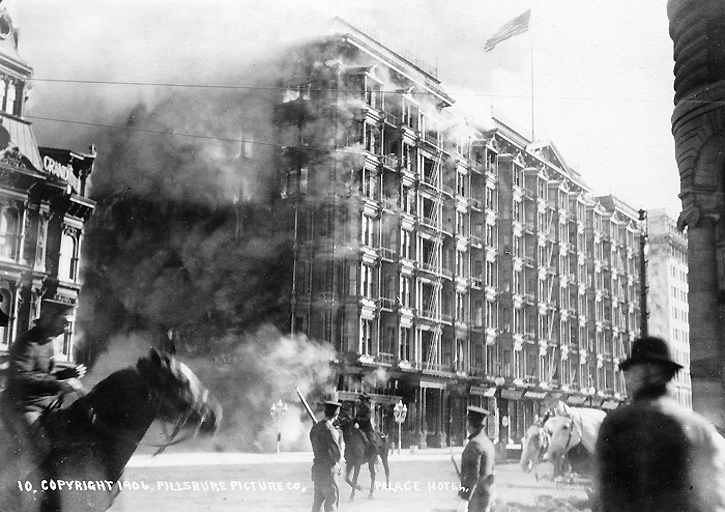
Because the Hotel Manager was convinced that the hotel was destined to burn, the Smiths and the other guests were allowed to keep their hotel keys as mementos of the experience.
Smith shares colorful stories of other big quakes he felt in California during his lifetime, as well as the impact that the 1906 quake had on mother:
"I don't think my mother ever recovered from the shock of going through something like that. From that day on she always wanted to have a light on at night or a candle with matches. She was never going to be caught in the dark again. She always had a money belt with money in it of course. When you think about it, these were very sensible precautions."
All of these years later, this preparedness advice is still relevant. And Smith added in 1977, yet more advice that is consistent with current recommendations
"Earthquakes are something we have to live with. You can take a few simple precautions. You can do certain things. If we get another big one, then so be it. That's life."

|
In an Earthquake, Fluffy Comes Too
Disaster Planning in Animal-Friendly San Francisco Follows a No-Pets-Left-Behind Policy
| |
An Excerpt from The Bay Citizen
By Matt Smith
April 14th, 2012
In a city known for accommodating pets - where pet dogs, not to mention cats, outnumber the city's school-age children - and where local laws regulate doghouse architecture, San Francisco emergency planners are working to take care of pets in the next big earthquake.
The planners hope legions of trained pet-disaster responders will help transport household dogs, cats, rodents and reptiles to 125 temporary animal shelters. Injured pets will be treated at a $300,000 mobile animal disaster medical command unit. And thanks to a no-pets-left-behind policy promoted by the city's department of Animal Care and Control, when people are rescued from collapsed or burning sections of town, their dogs, cats, birds and other animals will most likely be rescued, too.
To continue reading the article, go to Fluffy Comes Too.
|
72 Hours of Dog Food
by Siobhann Bellinger
| |
It's April again and that means National Preparedness Month! And if you are like many Americans, you have a furry family friend or two who shares your home and need your preparedness skills to keep them safe in a disaster. It can feel like a chore to stock up on water and batteries - take a break from building your kit and build one for your animal friends - they'll thank you for it!
The obvious things to include are food and water, a toy or two, a carrier, and any necessary medications or medical documentation (proof of insurance if you have pet insurance is key!). As is true with human emergency preparedness kits, you can buy them pre-assembled. I recently stumbled across these examples: the ER Emergency Ration Dog Survival kit for pups and a Catastrophe for Cats 35-piece kit that demonstrates what type of items you might want to include for kitties.
You may be able to assemble your own from items you have at home, however. The San Francisco SPCA, in collaboration with partners such as Paws and Animal Care and Control, offers an impressive and comprehensive Disaster Planning for Pets resource as part of the San Francisco Disaster Preparedness Coalition for Animals. Here's an excerpt that details what they recommend for a disaster kit for your pet:
- harnesses/leashes/collars
- their regular food (at least a 7 day supply for each animal), bottled water for 7 days, non-spill bowls, a manual can opener and plastic can lid for canned pet food
- litter boxes, litter and a scoop for cats
- fresh bedding for small mammals
- any medications that are routinely used, a copy of your pet's vaccine history, any special medical records for chronic conditions and a copy of your pet's microchip number
- phone numbers for your emergency contacts, relatives and family
- phone numbers and locations of your vet and the local emergency clinic, the phone numbers and location for SF Animal Care and Control
- plastic bags for feces clean up
- a Pet first aid kit and Pet First Aid book
- recent photos of the pet (especially with you in the picture)
- and any long-term caging you might need (baby gates, X-pens, portable fencing...)
They include specific pet first aid information that is critical for any pet owner. To that list, I would add that as with a child (or yourself!) the stress of responding to an emergency will be a very real thing for your pet - if your animal has a cherished toy that comforts them, consider including it (or one very similar) in their kit. It's also becoming more common for people to plan forward for a pet-related emergency by getting them micro-chipped, a process by which a scannable microchip with a unique code is implanted under your pet's skin. This option may not appeal to everyone but it is increasingly available at your local vet. More information can be found here.
Finally, remember to work your pet into your plan! Make sure your evacuation and meet-up plans incorporate the time and logistics of gathering your pets and their kits. Keep their hiding places and habits when fearful in mind - no one wants to go hunting for Mittens in the back yard after a big Quake! A little forward thinking is all you need to increase the safety of your whole family - not just the human beings. Happy (Pet) Preparedness Month!
|
| Upcoming Events, Trainings, & Services | |
Upcoming Events and Trainings Spotlighted:
Schedule of FREE Trainings by SF CARD, 2012*
(*for nonprofits and faith-based organizations)
STAFF READINESS
The SF CARD Staff Readiness training course is designed to help the staff of nonprofit and faith-based organizations to individually prepare for a disaster. The class is presented using a workbook to enable students to complete several of the components of staff preparedness in the classroom setting. The SF CARD Preparing Staff for Emergencies Workbook covers the following:
- Education on Emergencies - "What to do when a specific emergency happens?"
- Getting your family prepared - Home and go-kits, mitigating your home & your surroundings, and identifying those things you love.
- Pre-planning for emergencies - Family Communication Plan, Evacuation Plan: Getting out of the House, and Rally Spot: Reunifying with a loved one.
- Exercises and Resources - How to use what you have, Whistle & Flashlight exercise, and resources for Information and Supplies. (This interactive class lasts for an hour.)
INCIDENT COMMAND SYSTEM
The SF CARD Incident Command System (ICS) training is designed to teach nonprofit and faith-based organization staff and volunteers how to use this nationally accepted and tested disaster response and management system. This course introduces the Incident Command System by describing the history, features, principles, and organizational structure of the Incident Command System. The training also uses a tabletop exercise to reinforce the learning objectives in a scenario setting.
(This interactive class lasts for three hours.)
All these trainings are free and will take place at SF CARD. The address is 1675 California Street, San Francisco, CA 94109 (in the Volunteer Center).
SCHEDULE OF TRAININGS 2012:
April 20th ICS training - 1 - 4 pm
July 18th Staff Readiness training - 10 am - 12 pm
July 20th ICS training - 1 - 4 pm
October 17th Staff Readiness training - 10 am - 12 pm
October 19th ICS training - 1 - 4 pm
Please RSVP to Elisabeth Whitney:
elisabeth@sfcard.org (415) 955-8946 x 253
We look forward to seeing you then! Thank you.
Diversity Conference - Applies to Disaster Health Also
2012 Isms Conference, UC Berkeley School of Public Health - A Conference for health professionals and diversity champions led by Ken Hardy, PhD.
"Healing the wounds of internalized oppression and internalized privilege: Building hope and change in our health organizations"
April 26, 2012, 8:00 am - 5:30 pm at Samuel Merritt University, Oakland, CA
This is Part One of a 2-Part Series
Second Conference in October, 2012
Registration Now Open!
_______________________________________________________________________________
If you're interested in finding out about other ongoing events, trainings, & services visit the following agency specific websites:
|
|
|
|



