MARCH 2012
|
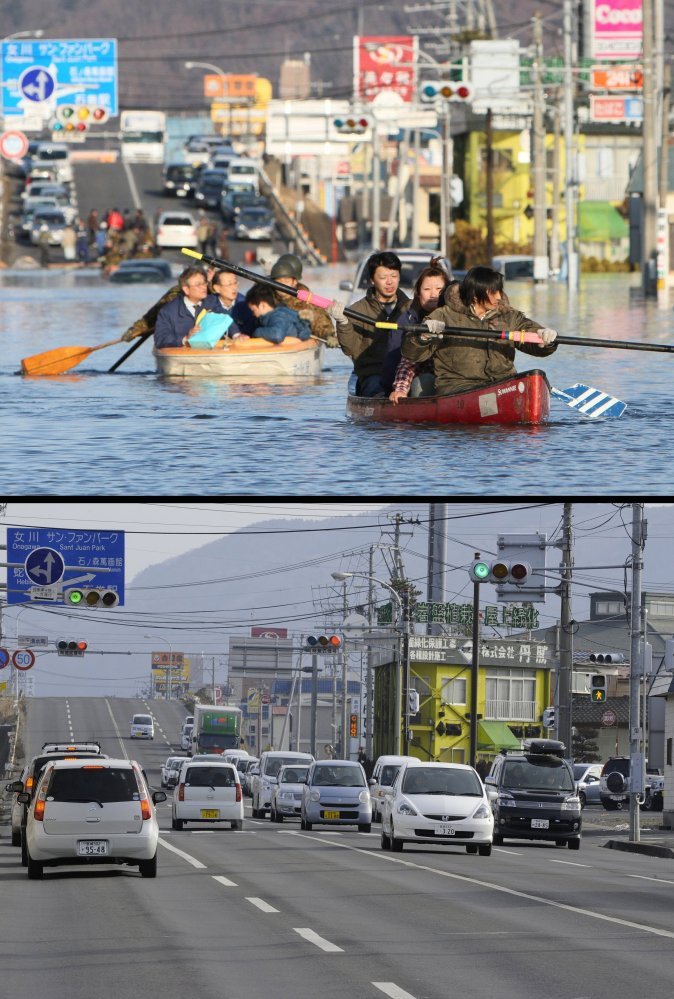
 HEROES! Rescue workers search for survivors in Otsuchi, Japan
Sources: http://www.wbez.org/story/earthquake/meltdown-feared-water-runs-out-japanese-nuclear-plant
|
|
|
|
|
Social Media Contest - Win a 4-Person Emergency Backpack
|
Social media is revolutionizing the world - literally. It is a wave of change that is moving so fast that Eric Qualman of Brandshout has to constantly update the statistics on his outstanding video, Social Media Revolution.
At SF CARD, as well as other emergency management agencies, social media has become an integral part of how we keep in touch with our communities. If you Like Us on Facebook or Follow Us on Twitter you will get preparedness information from us from time to time.
More importantly, this is one of the ways we will communicate following a disaster. Whether an isolated incident that affects a single neighborhood or a widespread regional disaster, we will be posting and tweeting as soon as communications are available. This is important because as a City and County of San Francisco Liaison to the nonprofit and faith community with a seat in the Emergency Operations Center, we are a trusted source of information. Certainly, this is not the only way we communicate, but it is an increasingly relevant means of communications-especially since social media is migrating to mobile platforms (cell phones, etc.).
In order to increase our visibility on these platforms, we are holding a contest. Go to our Facebook page, like us, and post a comment in our Social Media Contest Post. Or Follow us on Twitter. We will pick a winner from this group and ship a 4-Person Emergency Backpack valued at more than $100.00 to you (anywhere in the U.S. or Canada) from Your Safety Place/Nexis Systems - one of our partners in preparedness.
We do not post so often as to 'spam' followers, but we do put out information that we feel is relevant and sometimes post fun facts. So, to recap-here is how to participate in the contest:
- Go to our Facebook Page
- Like Us; and
- Post a comment in our Social Media Contest Wall Post.

OR - - -

- Go to our Twitter Page
- Follow us
That's it. We will collect the entries and pick a winner on March 30th. One entry per person/organization, however we encourage you to follow us on both our platforms. Good Luck!
|
| SFIC Disaster Preparedness Congregations Workshop | |
|
|
Health Corner: Disaster Health Surveillance Gets An Upgrade From The Internet & Medical Tattoos
By Elisabeth K. Whitney MPH&TM, MNA
| |
Disaster Health Surveillance Gets An Upgrade From The Internet
Most folks who wake up feeling crummy will sit down with a computer or smartphone before they sit down with a doctor. They might search the Web for remedies or tweet about their symptoms. And that's why scientists who track disease are turning to the Internet for early warning signs of epidemics. "Surveillance is one of the cornerstones of public health," says Philip Polgreen, an epidemiologist at the University of Iowa. "It all depends on having not only accurate data, but timely data."
Public health officials have been trying to speed up their responses to disease outbreaks since, well, they started responding to outbreaks. There's still plenty of room for improvement. The current system requires the Centers for Disease Control and Prevention to compile reports from physicians and labs all over the country - and that can take a while. There's typically a week-long delay between an outbreak and the release of an official report.
To get an early read on things, epidemiologists look for the first clues of illness - a rise in thermometer sales or increased chatter on hospital phone lines. Now, they're tapping into the Internet. . . ah . . . ah . . . AH-CHOOGLE . . . In 2008, Polgreen found a strong correlation between flu-related searches on and actual flu cases in the U.S. Around the same time, Google unveiled Google Flu Trends, which estimates flu activity based on Web searches. Google's estimates for the percentage of patients with flu-like illnesses closely match reports from the CDC.
Google Flu Trends

Source: Centers for Disease Control and Prevention, Google Flu Trends
Credit: Alyson Hurt
The principle is pretty simple. On the Internet, people who type "fever" or "flu medication" into a search bar are more likely to end up in a hospital a few days later. Data collected from millions of these searches can be shared as they happen, many days before official reports.
But this speed comes with questions of accuracy. Can these signals be trusted? "Skepticism is healthy," Polgreen says. "Because there's a novelty effect, there may be excessive expectations both among researchers and the public."
With this in mind, a team of researchers at Johns Hopkins wanted to see if Google's estimates would prove accurate and useful in the everyday operation of a hospital. They compared Google searches originating in Baltimore to the number of patients who showed up with flu-like symptoms at a local emergency room.
"It seems like a stretch, but what we found - amazingly - is that there's a really high correlation between these searches in the community and what we're seeing in hospitals," says Richard Rothman, the study's co-author. Search data were an accurate predictor of ER crowding. But that wasn't the study's most surprising tidbit. One weakness of online surveillance is that public hysteria about an epidemic might skew the results.
For example, when the bird flu outbreak was announced in 2009, there was a huge spike in flu-related searches in Baltimore. Public health officials labeled the phenomenon "fear week." "Even though this was technically a false alarm, it did mirror what we saw in the emergency department," says Andrea Dugas, the lead author of the study. There was a corresponding spike in ER visits. In fact, 6 percent more people showed up during the week of heightened anxiety about the flu than the week when swine flu reached Baltimore months later.
Tweeting Cholera
Search data aren't the only public health clues. John Brownstein and Rumi Chunara, researchers from Harvard Medical School, traced the cholera outbreak in Haiti by gathering data from all over the Web. Instead of counting search terms, they collected thousands and thousands of Twitter posts, and used HealthMap, an online disease surveillance tool, to compile cholera-related news reports. The first signs of a cholera epidemic could be seen in these data two weeks before official reports. If officials had been monitoring the Web, they might have been able to respond faster.
"Still, there are drawbacks to these Web-based data streams," Brownstein says. The correlation between online trends and real life can falter when public interest wanes, he says.
Tracking Haiti's Epidemic Online
Official reports on Haiti's cholera outbreak closely tracked data from Twitter and HealthMap (an online surveillance tool created by John Brownstein, an epidemiologist, and Clark Freifeld, a software developer) for the first 100 days of the epidemic.

Source: Rumi Chunara, John Brownstein - Credit: Alyson Hurt
In the early days of the cholera outbreak, Twitter and HealthMap data closely matched official reports. After 100 days, online activity dropped off even though the epidemic raged on. Disease is easiest to detecte when it is out of the ordinary. Regularly recurring maladies like malaria are hard to follow online.
Communicating About Disease
Online disease surveillance - or "Webidemiology" - is a cool new tool, and researchers are eagerly testing it out and double-checking the data they collect. But it won't be used by itself to make important public health decisions anytime soon. "From an early detection standpoint there is a lot of work that needs to be done to sift through the noise," Brownstein says. While researchers are working out the kinks of flu surveillance and a few other illnesses (Google just expanded its operation to track Dengue fever) other diseases will always fly under the Internet radar. Some have nonspecific or overlapping symptoms so they're hard to recognize. And there's a whole host of illnesses, such as sexually transmitted diseases, that people aren't necessarily eager to discuss on the Web. "The Internet is just one additional stream of information," Polgreen says. "It's certainly not going to replace traditional forms of surveillance."
While the Internet may not be a perfect predictive tool, researchers and public health officials agree that it is great for one thing: communication. Social networking allows officials to easily reach the public and enter into a conversation. Tweets, searches and Facebook posts can give officials a sense of public reaction to vaccines, or their attitude towards an epidemic. "It's a quick and easy barometer for public anxiety," Polgreen says. And in a public health emergency, that can be just as useful as cold, hard numbers about cases.
Source: http://www.npr.org/blogs/health/2012/02/07/146519243/disease-sleuths-surf-for-outbreaks-online?ft=1&f=1128
Related NPR Stories
Twitter Provides A Trove Of Health Trends
July 13, 2011
Swine Flu: The Second Wave
May 4, 2010
Google Search Trends Reveal Flu Outbreaks
Nov. 12, 2008
Medical Tattoos
Medical tattoos with vital information are starting to replace medical alert bracelets for some. What are the legal ramifications? Would you do this to your medically fragile child?- By CBS News Staff
Pathologist Dr. Ed Friedlander of Kansas City, Mo. displays his tattoo with a medical directive to not use CPR.
Move over medical bracelets. An increasing number of Americans are turning to medical tattoos to warn emergency responders about important medical conditions. "Bracelets are nice, but something as strong as a tattoo ... that is a strong statement," said Dr. Ed Friedlander, a Kansas City pathologist who has "No CPR" tattooed in the center of his chest, so a paramedic would see it. Friedlander, 60, got the tattoo to emphasize his decision to forgo CPR if his heart stops. Medical tattoos don't appear to carry much legal weight. It's unclear whether an ambulance crew racing to treat a gravely ill patient could honor a request such as Friedlander's based on the tattoo alone. But the markings do offer a simple and permanent way to give rescuers important health details. Melissa Boyer, of Nashville, Mich., wore bracelets for years to identify her as a diabetic, but she kept losing or breaking them. The 31-year-old decided months ago to get a 3 1/2-inch tattoo on her left forearm that includes the medical symbol and identifies her as a Type 1 diabetic. It also declares her allergies to penicillin and aspirin. "It's been 29 years that I've had (diabetes), and I went through I-don't-know-how-many bracelets," she said. "I went and got the tattoo, and it made life easier." The American Medical Association does not specifically address medical tattoos in its guidelines. But Dr. Saleh Aldasouqi, an endocrinologist at Michigan State University, hopes that might change. Aldasouqi, who has written about the tattoos, has seen them among his diabetic patients and feels they are becoming so popular that the medical profession needs to help guide their development. "My intention has been to bring this issue to the surface so that medical organizations can have a say in that," he said. "When you just Google it, you're going to find hundreds of stories and discussions, but no medical say. So I feel we leave our patients kind of afloat." It would be helpful, for instance, if the tattoos were uniform or placed in the same area of the body so responders would know where to look, he said. "My perspective is that we as physicians need to be involved in this," he added. Aldasouqi does not advocate for or against the tattoos, but he says patients and doctors should discuss the idea beforehand. If one of his diabetic patients sought a tattoo, Aldasouqi would recommend using a licensed tattoo artist and carefully controlling blood sugar during the procedure. The National Tattoo Association, a nonprofit that raises awareness about tattooing, does not track the numbers or styles of tattoos. Sailor Bill Johnson, a spokesman for the association, said he does about one medical tattoo a year at his shop in Orlando, Fla. "Nine times out of 10, it's either allergic to something, penicillin or peanuts," he said. Still, it's questionable whether medics or doctors would be under any obligation to honor end-of-life instructions in a tattoo, unless they could be sure the patient also had signed legally binding papers. Laws on do-not-resuscitate orders can vary widely from state to state. Missouri law does not address medical tattoos at all. "What we can tell you is what the law says. What we can't tell you is what assumptions people are going to make," said Gena Terlizzi, spokeswoman for the state Department of Health and Senior Services. However, emergency professionals are always on the lookout for information about a patient's condition and treatment preferences, and that includes looking for medical tags, bracelets and possibly tattoos, said Dr. David Tan, medical director of Washington University Emergency Medical Services in St. Louis. "It's something I have not seen a whole lot of, but it's out there," Tan said. "I think tattoos just aren't that conventional. But I don't think it makes it any less useful." A tattoo alerts "any medical professional to stop and think a moment," he added. Tattoos are unlikely to replace medical alert jewelry, said Ramesh Srinivasan, spokesman for the MedicAlert Foundation, which sells more than 100,000 pieces of jewelry a year that have medical conditions on them. Unlike tattoos, MedicAlert jewelry also provide information that gives a "complete snapshot" of the person's health that can be accessed by professionals. "Tattoos are totally different," Srinivasan said. "What's the validation behind it?" Friedlander encourages patients to make their own medical decisions and to spell out their wishes ahead of time. He has paperwork outlining his preference to avoid CPR, but the tattoo, he explained, will "make people a whole lot more comfortable about honoring my known wishes." "In pathology, you think a lot about the end of life," he said. "Nobody would ever accuse me of not loving life. ... When this thing stops beating, it's time for me to move on."
|
|
American Red Cross Free Training
| |
|
One Year Later
by Siobhann Bellinger
| |
On March 11, it will be one year since the massive, 9.0 Tohoku earthquake hit Japan, causing violent tremors, a devastating tsunami and subsequent critical damage to the Fukushima Dai-chi power plant. An estimated 20,000 died or went missing in the natural disasters and debate rages about the long-term impact of the meltdown at Fukushima. This cascading series of tragic events has had far-flung impacts (millions in damage in California, and panic about floating clouds of radiation, for example) but the toll on Japan is hard to fathom. As the anniversary approaches, it is an apt time for reflection on what was lost and what was learned in the land of the rising sun.
Outside Perspectives
One New York Times reported found that the Japanese electric cars he guessed would not be difficult to sell after the disaster were actually playing a critical role in the immediate recovery. As electricity was restored to affected areas surprisingly quickly, electric cars were able to power up and access hard to reach areas, all the while transporting first responders.
Another foreign visitor to share her insights on the recovery was Lucy Walker, who went to Japan mere weeks after the earthquake. Completely transformed by the response efforts she observed, the results of her observations became a short documentary that was recently nominated for Academy Award. This film,"The Tsunami and the Cherry Blossom ," depicts many stories of human bravery in the face of the overwhelming risks and tasks of disaster response and recovery.
Beauty and Tragedy
Some residents in the Fukushima plant exclusion zone refused the government's mandatory evacuation order. None more poignantly than Naoto Matsumura, the farmer who tried to save the lives of the local livestock and pets -something he claims Tokyo does not prioritize. Another shocking story follows a woman who lost her mother and gave birth to her daughter on the same day-the day of the tsunami. She now faces the future with some sadness but joy that her new family is intact.
Melting Down
Perhaps the most fevered story in March of 2012 is that of the Fukushima meltdown and whether the media missed the 'real' tragedy or if the biggest lesson from the trifecta of disasters was the wake-up call of the risk of nuclear power. From the bravery of the Fukushima 50 (actually hundreds of plant workers) who responded to the meltdown, to discussions of countries like Germany moving away from nuclear power, this is an incendiary topic one year later.
KQED radio favorite Michael Krasny hosted a hot debate on his morning program Forum, which presented many conflicting perspectives on nuclear safety and the future of nuclear power. There may not yet be a clear answer as to whether nuclear power is 'greener' and safer over time than fossil fuels, but there's no doubt that the incident the earthquake caused has accelerated the discussion.
Looking Back, and Forward
While many are up in arms about the management of the Fukushima plant, yet others focus on mourning, rebuilding and ultimately trying to move on. Shinto priests all over Japan busy themselves preparing for upcoming commemoration ceremonies. A New York nonprofit called The Japan Society has created a cultural exchange activity to honor the anniversary; on the date, viewers can experience art works made by Japanese school kids from tsunami debris with their American peers. Meanwhile, a class of high school graduates from Kamaishi, Iwate Prefecture, one of the most devastated areas, makes tough choices about where their futures should take them. Some have clear reasons to stay with family and community. Others do decide to leave, mostly with ideas of what they can give to their city when they inevitably return.
Extraordinary Leadership
Of all of the stories I came across, one was particularly inspiring. Mr. Toba, Mayor of the town of Rikuzentakata, lost his wife and almost 10% of his fellow townspeople in the disaster. This tragedy was tempered by his commitment to his two young sons, who were spared, and his decision to pull out all the stops to rebuild his town. Securing funding from Tokyo to clear and restore his town was no easy task and Mr. Toba is a living example of professional and personal tragedy followed by selfless commitment to the future.
If I could share one phrase at this time of remembering it would be Mr. Toba's words, "There are so many sad things that happened to this city, but with the help of a lot of people all over the world, we've already come so far," he said. "Let's all get through this-together as one, let's do it!"
|
|
I'll Be Back
By Brian Whitlow
| |
One of my favorite movies of all time, "Terminator", is the basis for the title of this article and is one of the most famous movie lines. The reason for mentioning this in this article is because not only is the "Terminator" one of the greatest movie franchises, it also raises some great discussion around technology and its relationship to us as humans-and disasters. Under the movie scenario, the computers take over the world and launch nuclear war. Coined by Daniel Wilson as the title of his new book, "Robopocalypse," is a wonderful name to describe this type of disaster scenario. The theme of movies 1 & 2 in the Terminator franchise--the terminators battle it out in the past to remove the hero, "John Connor" before he leads the human army to victory. In the third movie, the hero survives but the computers start the war. I could spend the next 10 pages describing this most awesome movie series, but I would not want to ruin the fun.
The reason for writing this article is because I came across an interesting article that has some great interviews that address both sides of the discussion in terms of whether or not technology will ever be advanced enough or be given enough control by humans to make catastrophic military decisions such as the ability to launch a nuclear weapon without a human pulling the trigger.
Here is a brief excerpt from the article:
In this weekly series, Life's Little Mysteries explores the plausibility of popular sci-fi concepts. Warning: Some spoilers ahead!
 A Picture from the Terminator Movie Franchise.
If a bunch of sci-fi flicks have it right, a war pitting humanity against machines will someday destroy civilization. Two popular movie series based on such a "robopocalypse," the "Terminator" and "Matrix" franchises, are among those that suggest granting greater autonomy to artificially intelligent machines will end up dooming our species. (Only temporarily, of course, thanks to John Connor and Neo.)
Given the current pace of technological development, does the "robopocalypse" scenario seem more far-fetched or prophetic? The fate of the world could tip in either direction, depending on who you ask.
To read the rest of the article, visit
http://www.lifeslittlemysteries.com/2166-robopocalypse-human-extinction.html
If you're a fan of disaster movies, here is a link to hundreds of disaster/doomsday movies: http://en.wikipedia.org/wiki/List_of_disaster_films
|
| Upcoming Events, Trainings, & Services | |
Upcoming Events and Trainings Spotlighted:
Schedule of FREE Trainings by SF CARD, 2012*
(*for nonprofits and faith-based organizations)
STAFF READINESS
The SF CARD Staff Readiness training course is designed to help the staff of nonprofit and faith-based organizations to individually prepare for a disaster. The class is presented using a workbook to enable students to complete several of the components of staff preparedness in the classroom setting. The SF CARD Preparing Staff for Emergencies Workbook covers the following:
- Education on Emergencies - "What to do when a specific emergency happens?"
- Getting your family prepared - Home and go-kits, mitigating your home & your surroundings, and identifying those things you love.
- Pre-planning for emergencies - Family Communication Plan, Evacuation Plan: Getting out of the House, and Rally Spot: Reunifying with a loved one.
- Exercises and Resources - How to use what you have, Whistle & Flashlight exercise, and resources for Information and Supplies. (This interactive class lasts for an hour.)
INCIDENT COMMAND SYSTEM
The SF CARD Incident Command System (ICS) training is designed to teach nonprofit and faith-based organization staff and volunteers how to use this nationally accepted and tested disaster response and management system. This course introduces the Incident Command System by describing the history, features, principles, and organizational structure of the Incident Command System. The training also uses a tabletop exercise to reinforce the learning objectives in a scenario setting.
(This interactive class lasts for three hours.)
All these trainings are free and will take place at SF CARD. The address is 1675 California Street, San Francisco, CA94109 (in the Volunteer Center).
SCHEDULE OF TRAININGS 2012:
April 18th Staff Readiness training - 10 am - 12 pm
April 20th ICS training - 1 - 4 pm
July 18th Staff Readiness training - 10 am - 12 pm
July 20th ICS training - 1 - 4 pm
October 17th Staff Readiness training - 10 am - 12 pm
October 19th ICS training - 1 - 4 pm
Please RSVP to Elisabeth Whitney:
elisabeth@sfcard.org (415) 955-8946 x 253
We look forward to seeing you then! Thank you.
Diversity Conference - Applies to Disaster Health Also
2012 Isms Conference, UC Berkeley School of Public Health - A Conference for health professionals and diversity champions led by Ken Hardy, PhD.
"Healing the wounds of internalized oppression and internalized privilege: Building hope and change in our health organizations"
April 26, 2012, 8:00 am - 5:30 pm at Samuel Merritt University, Oakland, CA
This is Part One of a 2-Part Series
Second Conference in October, 2012
Registration Now Open!
SF State Community Workshops
Grantwriting
Thursday thru Friday, March 22-23, 2012
In this two-day workshop, you will learn tools to be more successful when writing the three essential elements of a grant proposal; better analyze the connections between required sections of a proposal and its core; and discuss the areas that commonly pose the toughest problems for grant writers, thus helping them avoid common pitfalls while strengthening critical skill sets.
Logic Model
Friday, April 13, 2012
Logic models are versatile tools that can support many nonprofit management activities, such as program planning, delivery, communications, and evaluation. They provide a roadmap of how your program is designed to achieve specific types of impacts for participants and the community. In this one-day workshop we will provide you with the information, resources, and support you need to develop a Logic Model for your projects/programs.
To register for any of the classes contact Perla Barrientos ( barrient@sfsu.edu) or for more information visit: http://www.sfsu.edu/~icce/news.html#workshops.
_______________________________________________________________________________
If you're interested in finding out about other ongoing events, trainings, & services visit the following agency specific websites:
SF CARD: http://sfcard.org/wp/upcoming-events
|
|
|
|
|
|
|