Karen Bolda
Professional Development Tips
Clarifying the Role of Facilitation
 
What People are Saying:
 
"Thank you so much for training our team about Learning Styles.  That was a very powerful investment in our time - the benefits are great.   I'm using the information in many of my work relationships - it's been extremely helpful!   Always good to be mindful of how different we all are."
~Julie Wheeler, Occupational Health and Safety Officer, USFS 
 Instructor Karen Bolda
 
"The Learning styles training has helped me to understand where conflicts arise in the workforce and how to deal with them. It has also given me great insight to communication styles that need to be addressed when providing information to people.  Thanks for the training!"
~
Robert Barnhart
Central Vegetation Module
Rogue River-Siskiyou National Forest 
 
"The practice activities really helped to point out specific items that I can improve on that I feel will help improve my staff meetings, etc.  Great class!  Thanks Karen!"
~DeAnna Bingham, Fiscal Adminsitrative Manager, Jackson County
 
"Get ready to participate in interactive activities!"     
~Charles Bennett, Planner II, Jackson County 
 
"Karen, you were very informative in a casual format that made it easy and enjoyable to take in the focus of the workshop."
~Toni DeVenney


Greetings!
 
Most people have a general idea of what a facilitator does.  They know that with a facilitator there will be an agenda, and usually some flipcharts are involved.  However, there is also a general misconception that the facilitator "leads" the group.  This is definitely not what a facilitator should be doing, so let me put this in bold; the facilitator does not lead the group! 
 
A facilitator is a guide. It is the group that decides what they want to achieve from the meeting, it is the group that generates the ideas, and it is the group that makes the decisions.  Yes, the facilitator may help create the agenda, but it should be an agenda created from action items and ideas generated by the group.
 
The value of a facilitator is that they are the one neutral party at the table that makes sure that every voice is heard, that the decisions and action items are truly group decisions, and that the group continues to move forward instead of getting stuck in a spin cycle of discussions that they have already had.
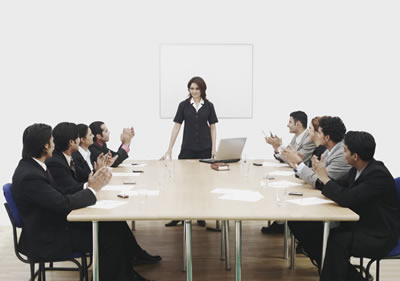
 
Not all meetings need a facilitator.  For example, a meeting that has a designated "leader" who is responsible for all the decisions and just needs to give information in a group setting does not need a facilitator.  But if a group is truly trying to achieve their goals as a unit versus being lead by an individual, a neutral facilitator is an essential tool to accomplishing this.
 
Beware the group member that offers to facilitate the group in addition to being a participant.  Even the most well intentioned person will find it difficult to be a neutral guide to the group.  The result can be meetings where participants feel increasingly superfluous and frustrated, the group has trouble moving forward, and meetings start getting longer yet less efficient.  If this describes the meetings that you are attending, the lack of a neutral facilitator may be the reason.
 
--KarenInstructor Karen Bolda
Comments?  Need training on this topic?  Contact me at:
 
Forward this email to a Friend


Instructor Karen BoldaNOW AVAILABLE:
Karen's Book,
"Ace the Interview" 
 
There is still the illusion that the interview is just a formality where they will ask more detailed questions about your work history.  This is definately NOT the case, and this workbook will help you prepare for the type of interviews that you are more likely to encounter.  This book not only tells you how to prepare; there are worksheets for you to take action in preparing for your interview. 

Shipping FREE thru July, 2009


Sign up for bi-weekly professional development tips!
Join Our Mailing List