|
|
|
Dear Friends,
How will we be able to recognize a Maine Real Estate recovery? Has it started already? What market dynamics are at work? Can we ever get back to the all time highs in the terms of price and/or unit volume? If so, When? If not, Why Not? What is the impact of low interest rates? Are we insulated from the US real estate market in general? We have been mulling through a 3-year period of mixed market signals. The more relevant value comes from identifying sustainable trends. We will present our thoughts below, but I would strongly encourage you to subscribe to our facebook page at www.facebook.com/legacysir to get daily updates on our market activity.
The Maine real estate market dynamics can be best described by the following observations:
- Markets will improve geographically starting in the southern part of the state moving north and east. This is already under way.
- Markets will improve first in the eastern coastal communities moving west to the lakes and the mountains. We are in the early stages of a a westward movement.
- Markets will improve first in the more populated cities and towns followed by the more rural. Again, we are already underway.
- Prices will move from lower priced inventory to mid-range to higher priced inventory. Sales of homes $500,000 and higher up more than 10% since 2009.
- Regardless of the marketplace, properties which are priced consistent with the condition of the property, location, competing inventory and sold comparables will be the first to sell. There are currently not enough buyers in any market segment to clear the inventory.
It is our opinion that Maine is recovering in all segments of the real estate market. Official July data will show that Sold Unit Volume has evidenced a year over year improvement every month for the last 13 months. Sold Unit Volume is critical to a recovery in pricing power. It is interesting to note that Sold Unit Volume peaked in June of 2004 and was relatively strong through June of 2006. The Median Home Sale Price peaked April of 2007 and rode the pricing crest through July of 2008. Despite the current steady improvements in Unit Volume, the market activity is consistent with monthly single family home sales in 1999 and 2000. In general, Unit Sales Volume is down approximately 40% from the all time highs. It will take time to rebuild the market on firm footing which is hampered by strict lending controls and firm credit conditions.
|
|
Historical Perspective
|
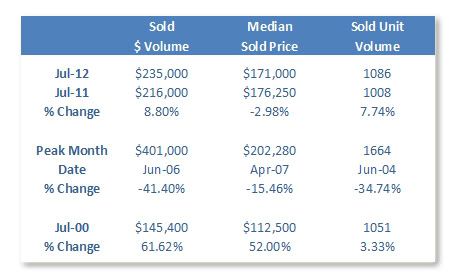
The Median Single Family Home Sale Price is unofficially $171,000 for July 2012. This reflects a 3% decline from July 2011. A median sold price of $171,000 is consistent with pricing conditions in 2004. Nonetheless, it is one of the stronger months we have recorded since the beginning of 2009. This statistic is particularly volatile month to month as demonstrated by nearly 15% increase since the February 2012 price of $149,950. One should also note in the table above, the Median Sale Price is actually 52% higher than it was in 2000. Lack of new home construction and continued high single digit Unit Volume growth will bring mounting pressure on pricing in the coming months.
We will likely see total Sales Dollar Volume of $234.7 million for the month of July. Again this is consistent with market conditions in 2002 on the way up and 2009 on the way down. The good news is it also highlights a 30% improvement from $179.9 million in July of 2010. Again, the evidence points to the early-mid stages of a broad real estate recovery that began in early 2011 and gained steam since then.
We are clearly rebounding and the pace seems to be moderate and relatively steady. We have felt positive impact in terms of buyer liquidity and confidence associated with the overall recovery in the US markets. Maine tends to be most influenced by market conditions in Massachusetts, Connecticut, New York, New Jersey, Washington DC, Florida, Texas and California. These markets tend to have both summer vacation property buyers as well as primary home relocation buyers. There is little doubt that low interest rates are helpful in terms of stabilizing pricing. I have seen ARM mortgages quoted in the high 2% range this week, but generally tight lending conditions affecting retirees, self-employed and lower credit score borrowers has kept a lid on availability.
There is little doubt in my mind that we can get back to the all time highs for median home sale prices. We are only about 15% off the mark. And, with a long term view, we should be able to return to volumes that are nearly double the Unit Volume today. Maine is a very small market with only 10,000 -12,000 homes per year selling statewide. A small change in the net inflow of people into the state can have a significant impact on this data. It only seems logical that more and more people will recognize the great property values and the incredible quality of life offered here in Maine. I am hard pressed not to be quite optimistic that over the next 5 years, we will see a healthy, vibrant, steadily improving Maine Real Estate Market!
Don't forget to follow us on facebook at: www.facebook.com/legacysir.
|
|

|
|
|
|
Maine Listings is the source of data, its accuracy cannot be guaranteed.
|
|
|
 | |
Maine Real Estate - 152 Merry Island Road, Edgecomb, Maine
|
|
|
|
|
F E A T U R E D C U R R E N T L I S T I N G S
|
|

NEW TO OUR CAMDEN OFFICE
|
|

NEW TO OUR PORTLAND OFFICE
|
|

|
|

|
|

|
|
Consequences
There are consequences to every action. A positive consequence of pricing a property competitively is that the property sells. Buyers have access to current information on what listings have sold, what are available, and what have expired. Their estimate of "current fair market value" may even be more accurate than last quarter's bank appraisal.
A pyramid is often used to demonstrate the percentage of buyers who will look at properties above and below market value, with far fewer people looking at properties the higher above market value they are. The pyramid can also be used to show how long a property remains on the market according to how competitively it is priced. The most competitively priced properties will sell in the shortest time. The higher above market value the property is priced, the greater the time it will remain on the market. The greater the time on market the lower the likelihood of obtaining the best price.
The Best Strategy
Authors Roger Fisher and William Ury provide a great analogy of approaching a negotiation with a predetermined strategy. You have a strategy to knock their socks off, but they arrive wearing sandals. ("Getting to Yes: Negotiating Agreement Without Giving In" (Penguin Group, 2011).
No one strategy works in all negotiations, and the strategy changes throughout the negotiation. If you are well prepared, you have the flexibility of moving between strategies.
Unless it is a simple transaction, few residential negotiations follow a straight line. New information is discovered and the previous strategy becomes ineffective.
If you have done your homework, you will go into the negotiation knowing the pivotal issues. Then you can decide what issues to address in the initial offer or counteroffer, and what issues are best addressed after both parties have reached agreement on minor points. It is easier to make progress if both parties are invested in the negotiation.
A useful exercise is to map out a strategy based on three or four different strategies that may be advanced by the other party. This approach promotes flexibility in thinking. While the other party may not actually use one of those strategies, you will be accustomed to thinking through alternative strategies.
George Ballantyne is a Senior Vice President with Legacy Properties Sotheby's International Realty specializing is High Value and Hard to Value Maine Real Estate
|

|
 |
 |
|

|
 |
|

|
| Unless otherwise specified, all Maine real estate statistics were compiled using Maine Listings data. There is no guarantee of the accuracy and completeness of the data.
|
|
|