Biased about Bias
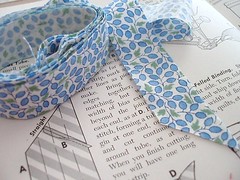
Bias Cutting Tutorial a la April 1930's
We're not biased or anything, but one little April 1930's tip takes Mary Brooks Picken's idea one step further and it makes all the difference in cutting bias tape in one continuous strip!
What is a Bias?
Bias indicates the direction of a piece of woven fabric, usually referred to simply as "the bias" or "the cross-grain" (UK term). The bias cut is 45 degrees to the warp and weft threads. Every piece of woven fabric has two biases, perpendicular to each other. Non-woven fabrics such as felt or interfacing do not have a bias.
Woven fabric is more elastic as well as more fluid in the bias direction, compared to the on-grain direction. This property facilitates garments and garment details that require extra elasticity, drapability or flexibility, such as bias-cut skirts and dresses, neckties, piping trims and decorations, bound seams, etc.
The "bias-cut" is a technique used by designers for cutting clothing to utilize the greater stretch in the bias or diagonal direction of the fabric, thereby causing it to accentuate body lines and curves and drape softly. For example, a full-skirted dress cut on the bias will hang more gracefully or a narrow dress will cling to the figure. Bias-cut garments were an important feature of the designs of Madeleine Vionnet in 1920s and 1930s and bias-cut styles are revived periodically. In the Middle Ages, before the development of knitting, hose were cut on the bias in order to make them fit better. The old spelling was byesse.
A garment made of woven fabric is said to be "cut on the bias" when the fabric's warp and weft threads are at 45 degrees to its major seam lines.

Note: The term "cross-grain" in the US refers to the direction perpendicular to the length-of-grain (selvage edges), not the diagonal.
Further Bias-Cutting Information
can be found here.
~~~~~~~~~~~~~~~~

Recently, we made a short narrative video-tutorial illustrating the correct use of the Singer Tucker Attachment. For the remainder of the month of February all Tucker attachments will be on sale for $27.95. As with all original Singer Attachments and Accessories from April 1930's, each Tucker will include instructions and a little sample with purchase - guaranteed ready-to-use upon arrival to you.
~~~~~~~~~~~~~~~~
New Items to the Shoppe!

ORIGINAL Singer Attachments Fashion Aids Case
Pristine Black Case with Red Interior Tray
$295.00
Hurry! Last time we made one available on the website, it lasted 8 minutes!

Fashion Aids Case ~ Perfect for porting all of your Sewing Machine Attachments!
~ ~ ~ ~ ~ ~ ~ ~ ~ ~ ~ ~

Rare! Singer Walking Presser Foot "Penguin"
On sale for $565.00 until the end of February
~ ~ ~ ~ ~ ~ ~ ~ ~ ~ ~ ~

Singer Featherweight 221 & 222
Servicing Class
If you are in the Pacific Northwest (particularly Idaho) next weekend, then you might consider joining us for a Featherweight Servicing Class!
When: Saturday, February 26th, 2011
Time: 9:30am - 4:00pm
Where: Bluebird Quilt Studio, Nampa, Idaho
Cost: $59.95*
* Previous Bluebird Quilt Studio FW Servicing Class Attendees can come for a refresher course for 1/2 price!
Optional ATTACHMENTS CLASS: Friday, February 25th, 2011
Time: 4:00pm-6:00pm
Cost: FREE with Saturday's Servicing Class Registration
To register or for more information call Marilyn at Bluebird Quilt Studio:
(208)467-4148
Space is limited!
Look forward to meeting some of you there!
~ ~ ~ ~ ~ ~ ~ ~ ~ ~ ~ ~
I told you last month that I was making some little cloth Valentine's Day cards for my daughter's classroom exchange. SweetPea picked out the fabric, wrote the message in her handwriting and I followed up with sewing and a bit of hand embroidery. It was special to individualize each one and the kids and teachers all loved them!
Here are a couple of our favorites I thought you might enjoy seeing....





