|
|
|
May 2011
Venice, Verona, Ravenna and the Po Valley
Part 2 of 3, Bologna, Ferrara, Ravenna, Padua
|
|
Greetings!
As promised, Part II.
Our stay during this part of our journey will be at the Hotel Corona d'Oro
(Telephone 05 17 45 7611)
"The world recognizes in Italy an essential beauty; beauty of landscape, beauty of learning, beauty of art, beauty of human romance and affection." Jan Morris
|
|
|
|
|
Bologna
 | |
Torri Pendenti
|
La Dotta, La Grassa, La Rossa
The learned, the fat, the red city. Learned for its university (Dante, Petrarch, Erasmus studied here); fat for its cuisine, and red? For its red brick buildings, its red sauce and its politics. Bologna was the hub of German resistance in World War II.The Other Italy:The Italian Resistance during WWII It was then it became a stronghold of the communist party.
Bologna is one of most beautiful, best preserved, sophisticated cities in Europe. Bustling with activity within its graceful porticos and in the lovely piazze, Bologna has earned the name of the Cultural Capital of Europe, though, mercifully, few foreign tourists seem to know it.
Sights include the Basilica di San Petronio, where we will see the work of Jacopo della Quericia and the frescoes by Giovanni da Modena; the medieval Torre degli Asinelli, built in 1109 and still affording a breathtaking view of the city.
Other sights include the Chiesa di San Domenico which houses the beautiful tomb with the sarcophagus by Nicola Pisano (1267). Work on the tomb was complete by Michelangelo in 1494.
 | |
Detail Sarcophagus
Chiesa San Domenico
|
During our visit, we will also get an insider's view from a
native Bolognese. There will be plenty of time to indulge in the exquisite cuisine the city is famous for and maybe leavea little more grosso/a then when we arrived.
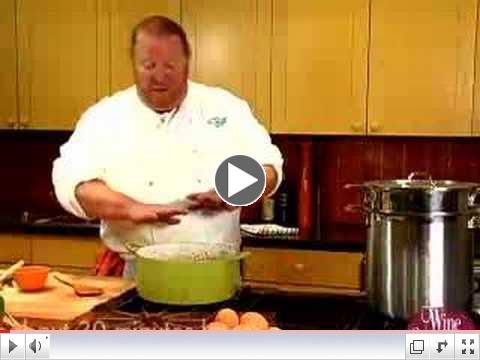 | |
Mario Batali
|
Here's Mario Batali and his excellent version of Ragu Bolognese.
Check out this slide show from The New York Times: Bologna Weekend
 Memorial to the Bolognese who died in the Resistance. Rome, Open City (1945) by Roberto Rossellini is an excellent film about the Italian resistance. Memorial to the Bolognese who died in the Resistance. Rome, Open City (1945) by Roberto Rossellini is an excellent film about the Italian resistance.
|
Ferrara
 | |
Lucrezia Borgia, wife of Alfonso I, Duke of Ferrara
|
The powerful d'Este family ruled Ferrara from 1208 to 1598. Despite the dramas, blood feuds and infidelities the family were great patrons of art and letters. Mantegna, Vicino da Ferrara, Bellini, Alberti, Pisanello, Piero della Francesco, Tura, Titian and other stars of the age were at the d'Este court. From this robust patronage the Ferrarese School of Painting was born. The splendid buildings and embellishments of D'Este and the many Renaissance palaces remaining here are now the back drop for a lovely, vibrant town.
 | | Castello Estense. |
Ferrara continues to be a great art and culture center and an inspiration to contemporary artists.
Through the 15th and 16th centuries, the d'Este welcomed Jews to the city and for centuries there has been a robust Jewish community here. In 1627 the ghetto was instituted by papal rule. It was dissolved in 1859.
The Garden of the Finzi Contini
by Giorgio Bassani (adapted to film by De Sica) is set in Ferrara in the late 1930's. "The  Finzi-Contini are one of the leading families, wealthy, aristocratic, urbane; they are also Jewish." Finzi-Contini are one of the leading families, wealthy, aristocratic, urbane; they are also Jewish."
Michelangelo Antonioni's Beyond the Clouds in (1995) and Ermanno Olmi's The Profession of Arms in (2001), a film about the last days of Giovanni dalle Bande Nere, were also shot in Ferrara.
|
|
Ravenna
Ravenna was the capital of the Roman Empire from 402 - 406 and then of Byzantine Italy until the 8th C. The town is synonymous with the breath taking mosiacs of the early Christian monuments.The Mausoleum of Galla Placidia, the Neonian Baptistery, the Basilica of Sant'Apollinare Nuovo, the Arian Baptistery, the Archiepiscopal Chapel, the Mausoleum of Theodoric, the Church of San Vitale and the Basilica of Sant'Apollinare in Classe - were constructed in the 5th and 6th centuries.
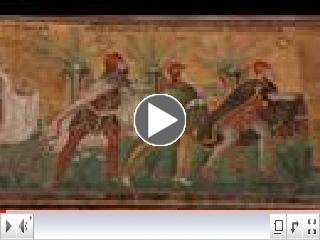 | |
Ravenna mosaics
|
[You may want to turn the sound off on this video. It was only one I could find where the gold didn't look brown. The only professional one I could find was in Spanish - and still the gold looked umber. ]

Of course, we cannot forget that Ravenna is also the burial site of Dante. Dante died here while in exile from Florence. This seems as good time to introduce you Frank's website developed over the last ten years in conjunction with dante.georgetown.edu
|
|
Padua
A pilgrimage city for both art lovers and Catholics. The Scrovegni Chapel (sometimes known as the Arena Chapel) Giotto's spectacular masterpiece. The Chapel holds the most complete, and best preserved, fresco cycle executed by Giotto. Recently restored, Giotto's use of color, the naturalism, and human pathos expressed in his mature work are brilliantly displayed.
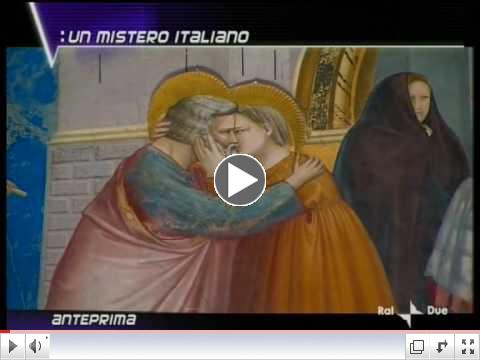
Standing beneath the barrel vault fully surrounded and embraced by this masterpiece of the 14th C is an absolutely unforgettable experience.
The video below is produced by the Italian bureau of tourism and while narrated in Italian, the frescoes are nicely photographed. The still shots in the Scrovegni website gallery are also lovely.
Capelladegliscrovegni
The Basilica of Saint Anthony of Padua
Inside Il Santo with its magnificent nave, is the Capella dell' Arco del Santo,the chapel of the tomb of St Anthony by Tiziano Aspetti. On the high altar, the dramatic bronze statues and reliefs by Donatello.
Outside the church is the famous equestrian statue of the Venetian leader Gattamelata, a masterpiece by Donatello (1453) and the first Renaissance bronze equestrian monument.

Saint Anthony, known for his miracles, continues to be one of the most revered Saints in the Catholic Church. His tomb is visited by pilgrims from throughout the world. The sanctuary has a centuries old mystique of all of the appeals and prayers of the devoted to al Santo. Still, he is a modern figure of devotion. He even has its own Facebook page. St Anthony of Padova Facebook pages
|
|
|
Next Venezia! A presto!
Deborah Ross Warin & Frank Ambrosio The Renaissance Company
|
|
|
|
|
|
|
|
|
|


