|
Martedi
Dante's Florence
Our visit begins with a stroll through Dante's Florence. You can get a head start at Frank's website: MyDante
The Uffizi
One of the most f amous museums in the world, the Uffizi gallery holds masterpieces too numerous to even highlight but surely one the most famous is Botticelli's Primavera. From BBC's The Private Life of a Masterpiece here's a Short Clip on Botticelli's Primavera amous museums in the world, the Uffizi gallery holds masterpieces too numerous to even highlight but surely one the most famous is Botticelli's Primavera. From BBC's The Private Life of a Masterpiece here's a Short Clip on Botticelli's Primavera
(The full program is available at Netflix.)
While it's impossible to see the whole museum in a single day, our visit will trace the development of medieval and Renaissance art through the works of the master painters of the transition.
|
|
Mercoledi
Today we visit the Bargello and the Opera del Duomo which house great sculptural works by Michelangelo, Donatello, and the Della Robbia.
 | | David by Donatello |
Il Bargello
Built in 1255, the Palazzo del Popolo is the site of the oldest seat of government in Florence. Today it is home to perhaps the greatest collection of Renaissance sculpture in Europe with its rooms of Michelangelo, Donatello, Della Robbia, Giambologna, Cellini and more.
Bargello Website
The Opera del Duomo The works of the cathedral, Baptistry and campanile. While these masterpieces are beautifully displayed in this sleek, modern building, the space has been the location for projects and maintenance of the Duomo for 600 years. Here Michelangelo created his David. The Opera holds Michelangelo's Florentine Pieta, Donatello's Mary Magdelene, the choir lofts of Luca della Robbia and Donatello, the original panels from the Baptistry doors and a reconstruction of Brunelleschi work site when constructing the dome. Opera del Duomo

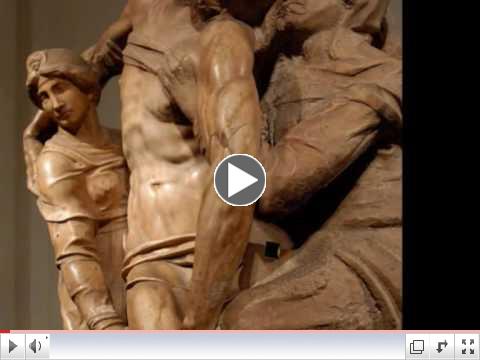 | |
Michelangelo, Pieta Opera del Duomo
|
|
|
Giovedi
Master painters Fra Angelico, Benozzo Gozzoli, Masolino (Little Tommaso) and Masaccio (Big Tommaso) each had a very distinctive style. Their contribution to western art exceeds the masterpieces they executed. Each painter's own particular sensibility, his own recognizable articulation of meaning and resonance, profoundly influenced Renaissance painting in Florence and beyond.
 | |
Fra Angelico, The Annunciation.
|
Convento San Marco
The Dominican Convent of San Marco contains the Museo di San Marco with its beautiful masterpieces of Fra Angelico. The pervasive tranquility of the Convent allows for a full appreciation of the works of the Beato. Two particularly moving frescoes are here in situ of place and spirit: The Crucifixion and The Annunciation.
The Annunciation and frescoes on the original cells of the friars resonant with a compelling serenity so different from the altarpieces meant to inspire public worship.
Gozzoli Chapel
 | |
Gozzoli Self Portrait
|
In this tiny chapel of the Palazzo Medici is one of the most familiar fresco cycles of the Renaissance: Gozzoli's Procession of the Magi ...or procession of the Medici, Medici amici, and amici d' amici. Glorious in its lush colors and scenery, exotic animals and characters the fresco has come to represent the rich character of the Renaissance itself.

Santa Maria del Carmine, The Brancacci Chapel
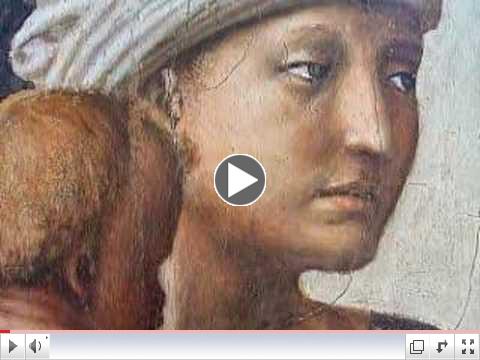
Executed in 1428, this fresco cycle became a textbook on perspective and chiaroscuro for virtually every artist in the Quattrocento. The cycle was begun by Masolino but soon after was taken over by his pupil Masaccio whose work was instantly recognized as a breakthrough in naturalism in both technique and expression.
 | | Masaccio |
|
|
Venerdi

A Michelangelo Morning
The Accademia
David, and the Bound Slaves
The Accademia
The Church of San Lorenzo

& The New Sacristy
Michelangelo's funerary chapel for the Medici with his evocative figures of
Dusk and Dawn, Day and Night.
Church of San Lorenzo
The New Sacristy
The Laurentian Library with Michelangelo's uniquely designed vestibule and sculptural swooping standing staircase. Biblioteca Laurenziana A Giotto, Ghirlandaio and Masaccio Afternoon
Santa Maria Novella Giotto's Crucifix (1290) in the nave, proximate to Masaccio's Holy Trinity (1427) - it's simply breathtaking! The master who transformed icons into human beings and the young man who more than a century later made another leap forward by placing them in a human world. Here too are beautifully frescoed chapels including the Cappella Strozzi by Filippino Lippi and the Sanctuary frescoes by Ghirlandaio. These frescoes were Ghirlandaio's masterpiece. Fascinating in their beauty and in their vivid view into Florentine life and its characters.  | |
The Birth of Mary, Domenico Ghirlandaio
|
. |
Sabato
Palazzo Pitti 
The Palatine Gallery with 500 Renaissance paintings including Botticelli, Lippi, Raphael, Titian, Caravaggio, Rubens and baroque interiors evokes the grandeur of the Medici Grand Duchy. "An embarrassment of riches" could have been coined here. Our focus will be on its splendid collection of paintings as well as the history of the building itself.
Palazzo Pitti
Santa Croce
 | |
Santa Croce & Pazzi Chapel
|
The burial place of so many famous Italians - Galileo, Michelangelo, Machiavelli, Ghiberti, Leonardo Bruni - it's been called The Westminister Abbey(without the weddings) of Florence . But with Giotto's frescoes in the Bardi and Peruzzi Chapels, especially those of the Bardi The Life of St. Francis; Gaddi's fresco cycle The Life of the Virgin (1332-38); a Crucifix and a limestone Annunciation by Donatello; Rossellino's Madonna del Latte...there are more masters outside the tombs than in them.
Next to the church there's Brunelleschi's jewel, the Pazzi Chapel and in the small museo, Cimabue's great Crucifix - so badly damaged in the flood of 1966.
|
Domenica

A day of rest, a stroll in the Boboli Gardens, a walk across
the Ponte Vecchio, a visit to the Baptistry, or a climb of the Giotto bell tower...or a mad dash to do everything you haven't done or want to do again. In the evening, we gather for our Cena Adio before we say a final "Arrivederci" to Florence and to one another.
Here's a link that will take you around the block on more time.
Florence 360
|


