Bad Engineering Endangers Foot Trafic on 17th Street Bridge
|
If you walk or bike between Atlantic Station and Midtown, take care. What you can't see might injure or kill you.
To accomodate increased car traffic on the 17th Street Bridge that occurred after shutting down the 14th Street Bridge in June, the Georgia Department of Transportation recently converted an eastbound through lane at the intersection of 17th Street and Spring Street to a combined through lane and turn lane, in effect creating a double right turn lane. GDOT also eliminated the prohibition on right turns on red that existed since the bridge's opening in 2004.
The bike lane is now sandwiched between
two right turn lanes, and not surprisingly, a cyclist was injured here last week by a turning motorist. Bad engineering breeds bad
driving,
 Double right turn lanes are a set up for the "multiple threat" crash scenario where a pedestrian steps into the crosswalk, the lead vehicle in the outside lane stops halfway around the corner to let the pedestrian proceed and blocks the view of a driver in the inside lane who plans to turn. Double right turn lanes are a set up for the "multiple threat" crash scenario where a pedestrian steps into the crosswalk, the lead vehicle in the outside lane stops halfway around the corner to let the pedestrian proceed and blocks the view of a driver in the inside lane who plans to turn.
The large turning radius at this corner, designed to accomodate the bridge's heavy bus use, exacerbates visibility problems and encourages high speed turns, further endangering pedestrians who cross Spring Street with the walk light. Making eye contact with drivers in the inside turn lane is not a possibility, so pedestrians who step off the curb take their life in their hands.
Double right turn lanes + pedestrians = recipe for disaster.
Conversations between PEDS and GDOT engineers this week suggest that current volumes of turning cars do not justify allowing turns from the inside lane. Responding to concerns expressed by PEDS and the Atlanta Bicycle Campaign, District Engineer Bryant Poole offered to prohibit turns from the inside lane if traffic volumes do not confirm the need for it after school starts on August 11. Meanwhile, we are asking Atlanta police officers to conduct a sting at this corner, targeting motorists who fail to stop for pedestrians before turning. |
Eliminating Wire Hazards from Atlanta's Sidewalks
|
Volunteers who participated in the John Lamb Memorial Wire Hunt in March submitted reports and photos of over 210 wire hazards on Atlanta's sidewalks. Together with a photo collage, a highly visual 92-page report we prepared consolidates this information, documenting the need for better maintenance of utility wires.
Georgia Power owns most wooden utility poles. As
pole owner, Georgia Power has a legal responsibility to monitor the safety of any
wires attached to it, even if they belong to other companies.
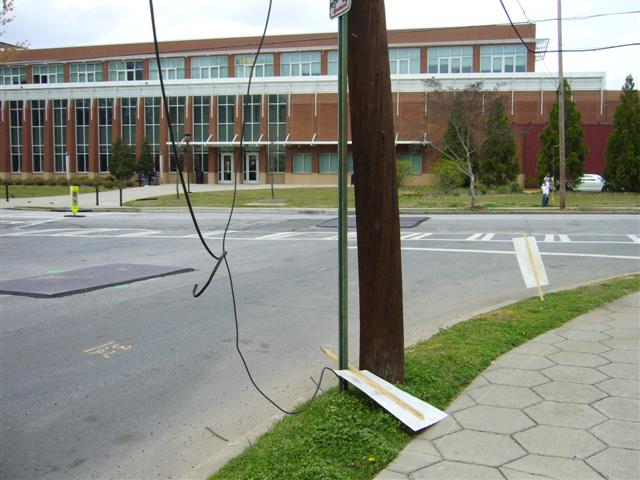
In June, we met with Atlanta Public Works Commissioner Joe Basista and Deputy Commissioner Sandra Jennings to discuss strategies for holding Georgia Power accountable for monitoring and repairing utility wires. Since then, Jennings and others have met twice with representatives from Georgia Power, who agreed to eliminate the hazards documented in the report and to conduct proactive maintenance to prevent similar hazards from occurring in the future.
We encourage volunteers who participated in the Wire Hunt to revisit the streets they monitored, check out whether hazards have been eliminated, and let us know. If you see new wire hazards report them to Deputy Commissioner Sandra Jennings.
|




