|
BrightStar Partners and BSP Software have launched a monthly webinar series tackling a variety of subjects, including the new features of IBM Cognos 10; Cognos Security Best Practices; and many more.
The next Webinar Wednesday session will be held on Wednesday, December 28th, covering 12 Tips and Tricks for 2012: Making the Most of IBM Cognos and BSP Software in the New Year.

|
|
A man went in to work one day to find that he could not log in to his computer. Then he remembered that the passwords are reset every month for security purposes. So he went to his boss and they had this conversation:
Man: "Hey boss, my password is out of date."
Boss: "Yes, that's right. The password is different, but if you listen carefully you should be able to figure out the new one: It has the same amount of letters as your old password, but only four of the letters are the same."
Man: "Thanks boss." With that, he went and correctly logged into his station. What was the new password?
BONUS: What was his old password?
Click here to find out. |
Join COGNOiSe.com, the largest independent, worldwide FREE IBM Cognos Support Community.
Access our
IBM Cognos 10
Download our Mobile App
|
|
| Greetings!
Welcome to our final newsletter for 2011. As we reflect on the year, so many exciting things have happened in the world of Business Analytics and in the world of BSP! We hope you have enjoyed the content in each month's newsletter, and remember, you can view all of our newsletters on our website.
As always, we have a lot of educational content, our latest webinar invite, along with some great tips and tricks and other IBM Cognos related information!
And remember, we enjoy hearing your suggestions regarding the content you'd like to see. Please e-mail us at Newsletter@brightstarpartners.com if you have a topic you'd like to see discussed in future newsletters. |
VENTANA RESEARCH RECOGNIZES CINCINNATI ZOO AND BSP'S JOHN LUCAS WITH 2011 LEADERSHIP AWARD |
|
Ventana Research has announced the results of the 6th annual Leadership Awards for 2011. The Leadership Awards recognize the technology vendors and their customers that have most effectively achieved success through using people, processes, information and technology and applying best practices within specific business and technology categories.
The Leadership Awards distinguishes pioneers and leaders - organizations and individuals that exemplify the understanding that the successful management of their performance requires a clear vision, understanding, determination, and a team effort. The awards are designed to highlight exemplary individuals and organizations that have demonstrated business leadership.
The Business Analytics winner this year was Cincinnati Zoo & Botanical Garden, led by former Director of Operations John Lucas along with BSP's Ted Reilly on the implementation.
Congratulations to John, Ted and the Cincinnati Zoo!
To find out more about the Cincinnati Zoo success story, click here.
|
|
|
PODCAST 3.20: A TECHNIQUE FOR DOCUMENTING A REPORT STUDIO REPORT |
This technique demonstrates how to use rendering variables to provide a report documentation page on a report that is visible to authors but hidden when the report is run. This type of documentation is useful for recording the changes that a report goes through over time as well provides a check list area for testing a report when a new author is working on it.
Click here to watch the podcast. |
|
|
AUTHORING MULTIPLE MUTUALLY EXCLUSIVE PROMPTS |
|
By Vinay Gupta, Implementation Specialist
It is sometimes a requirement that users have the flexibility to decide what they want to filter a report on. This requirement can be met by providing optional prompts, which allow the users to decide which prompts they want to use. The requirement becomes more complex if the prompts have to be optional while also being mutually exclusive. Though this requirement can also be met by authoring prompts which are placed in conditional blocks and are displayed depending on the user choice, the authoring of such prompts becomes complex.
It is intended to present, through this article, a way to achieve that end result without making the report very complex. Some complexity will be inevitable as the requirement itself is fairly complex. This paper assumes that the reader is able to create reports and prompt pages and prompts. The details and steps for creating the initial report and prompt pages will therefore be omitted.
For detailed steps on how to author multiple mutually exclusive prompts, click here to read the full article.
To get more information on the topic, e-mail us at Newsletter@brightstarpartners.com
|
|
MANIPULATING VALUE PROMPTS WITH JAVASCRIPT |
|
By Mike Vilhauer, Consultant
This script will allow you to specify text for the first line in a Value Prompt and remove the dashed line that displays on the second line. This has many benefits including allowing the drop down to automatically size to the length of the values available.
To learn how to manipulate value prompts with javascript, click here to read the full article.
To get more information on the topic, e-mail us at Newsletter@brightstarpartners.com
|
|
Extrasolar Planets
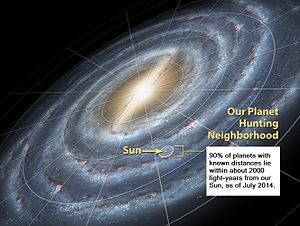
An extrasolar planet, or exoplanet, is a planet outside the Solar System. A total of 708 such planets have been identified as of December 5, 2011. It is now known that a substantial fraction of stars have planets, including perhaps half of all Sun-like stars. It follows that tens of billions of exoplanets must exist in the Milky Way Galaxy alone.
For centuries, many philosophers and scientists supposed that extrasolar planets existed. But there was no way of knowing how common they were or how similar they might be to the planets of our Solar System. Various detection claims made starting in the nineteenth century were all eventually rejected by astronomers. The first confirmed detection came in 1992, with the discovery of several terrestrial-mass planets orbiting the pulsar PSR B1257+12 The first confirmed detection of an exoplanet orbiting a main-sequence star was made in 1995, when a giant planet was found in a four-day orbit around the nearby star 51 Pegasi. Due to improved observational techniques, the rate of detections has increased rapidly since then. Some exoplanets have been directly imaged by telescopes, but the vast majority have been detected through indirect methods such as radial velocity measurements.
Most known exoplanets are giant planets believed to resemble Jupiter or Neptune. That reflects a sampling bias, since massive planets are easier to observe. Some relatively lightweight exoplanets, only a few times more massive than Earth, are known as well; statistical studies now indicate that they actually outnumber giant planets. Planetary-mass objects also exist that orbit brown dwarfs or that "float free" in space, although strictly speaking the term "planet" may not be applicable to them.
The discovery of extrasolar planets has intensified interest in the possibility of extraterrestrial life. Several giant planets are now known that orbit in their star's habitable zone. Among the candidates are Gliese 581 d and HD 85512 b. In December 2011, NASA confirmed that 600-light-year distant Kepler-22b, at 2.4 times the radius of Earth, is potentially the closest match to Earth in terms of both size and temperature.
- Wikipedia (2011) |
|
|