|
|
|
Greetings!
In recent months, many public safety agencies have been investigating broadband LTE and trying to determine its impact on traditional Land Mobile Radio (LMR). This discussion will become even more widespread as development progresses on the First Responder Network (FirstNet), the first nationwide public safety broadband network. After having thorough discussions with our clients and other industry leaders about the capabilities that are absolutely necessary to fulfill their missions, I believe that LMR and broadband technologies are complementary, but broadband cannot yet stand on its own as a substitute for LMR.
Recently, a report from the U.S. Government Accountability Office (GAO) confirmed my opinion. The report states that LMR remains necessary because it is the only technology that will support the mission-critical voice capabilities that meet high standards for reliability, redundancy, capacity and flexibility. Industry experts say that it will be at least a decade before broadband is able to provide users with these same mission-critical voice capabilities.
LMR also benefits from the ability to work on or off network, which is critical when responders are working outside of the network range. In addition, LMR systems can support a large number of users during an emergency, and LMR's infrastructures are durable enough to withstand most disasters.
Despite the benefits of LMR, there is something to be said for broadband's ability to greatly enhance incident response though high-speed video and data transmissions. After all, the ability for a crew of firefighters to pull up the blueprints of a burning building or for a police officer to transmit the video of a recent arrest can significantly impact the outcome of an incident. However, additional infrastructure may be required for users to access the broadband network when inside large buildings or underground, and broadband may have a limited capacity for users during an emergency. These issues are not insurmountable, but they must be considered when looking at the benefits and challenges of each system.
Some may argue that broadband devices are preferable because they are substantially less expensive. While this has been true in the past, there are now a number of ways to reduce the cost of LMR devices. The government has several grants available for the purchase of this equipment. In addition, the Department of Homeland Security recently agreed to help its partners identify joint procurement opportunities so that agencies can reduce costs by purchasing devices in larger quantities. As Project 25 standards become more integrated, interoperability will also reduce the higher cost of LMR since agencies will be able to cut ties with a single vendor's proprietary equipment and use an open bidding process to secure the most competitive price.
Without a doubt, broadband will provide users with unprecedented high-speed access to a wide range of information, and I am excited to watch the progression of this technology. But, for now, broadband systems can only complement LMR devices; broadband cannot entirely substitute for LMR. As a result, LMR remains a good investment.
As your one-stop resource for public-safety P25 solutions, EFJohnson is committed to evolving our architecture, products and solutions to deliver the highest-quality, cost-effective, mission-critical communications solutions for LMR and broadband systems. This includes the expansion of our ATLAS 8000-based interoperability and interworking gateway solutions, as well as the adaptation of our subscriber portfolio to maximize interoperability with LTE devices and applications through future P25-LTE interfaces and gateways.
I look forward to speaking with each of you about how EFJohnson's devices can meet your mission-critical voice communications needs.
Sincerely,
Andy Adams, CEO
EFJohnson Technologies |
 |
|
EFJohnson achieved a significant milestone this spring with the full deployment of the Wisconsin Interoperable System for Communications (WISCOM), a statewide system that allows emergency responders to seamlessly communicate across jurisdictions. The launch of WISCOM was celebrated during a commissioning ceremony hosted by the Wisconsin Office of Justice Assistance on April 30, 2012 at the Fond de Lac Police Department. Speakers included David Spenner, Statewide Interoperability Communications Manager for the Office of Justice Assistance; Matt Joski, Sheriff of KewauneeCounty and Chairman of the Statewide System Management Group; and Andy Adams, CEO of EFJohnson. Additional participants included representatives from the Wisconsin Department of Transportation, the State Interoperability Council and the Wisconsin Statewide System Management Group, a committee tasked with managing Wisconsin's statewide communications system.
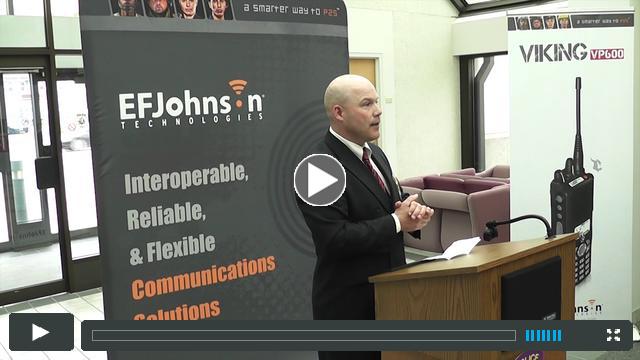 | | WISCOM is Live! |
WISCOM is an integrated, interoperable network that is shared by statewide law enforcement, fire services, EMS and emergency management agencies. It provides mobile coverage to 95 percent of the state. The flexible, robust system is P25-compliant and uses EFJohnson's unique, patented distributed architecture for maximum flexibility and scalability in network design and deployment. This allows users to plug and play new site additions as coverage needs change or as local agencies replace their legacy systems and join WISCOM. In addition, use of a switchless network instead of a centralized core network increases reliability and eliminates single points of failure.
Final acceptance of the system was awarded in March to EFJohnson by the Wisconsin Statewide System Management Group after comprehensive regional and statewide testing by the State Patrol Bureau and L.R. Kimball, the architecture, engineering and communications firm that developed the initial WISCOM concept. This acceptance cleared the way for full deployment.
With the WISCOM backbone now in place, several Wisconsin counties and public safety agencies are already working with EFJohnson to build out systems that leverage the state network. These counties and agencies are receiving unprecedented long-term cost savings by sharing the infrastructure and avoiding equipment duplication.
In partnership with Two-Way Communications and Pointon Communications, EFJohnson is working with Iowa County, Sawyer County, Taylor County, Kewaunee County, the City of Fond du Lac and the Wisconsin State Patrol to build new P25-compliant systems that leverage the WISCOM backbone. Deployments will begin by the end of 2012.
|
 |
|
The U.S. Department of Homeland Security (DHS) has named EFJohnson as part of an elite group of suppliers eligible to provide DHS agencies and certain non-DHS agencies with mission critical communications equipment through a $3 billion Tactical Communications (TacCom) contract. The company was identified as one of only three qualified small business track suppliers for subscriber and infrastructure equipment, which includes Project 25-compliant, digital two-way portable and mobile radios, base stations and software. The company was also identified as an approved vendor of equipment complementing the communications system infrastructure, such as dispatch consoles and mobile radio control stations.
TacCom is a multiple award, Indefinite-Delivery, Indefinite-Quantity contract established in 2012 to help DHS purchase a wide array of tactical communications products, infrastructure and services for mission critical, public safety communications. The total funds spent on equipment through the contract may not exceed $3 billion, inclusive of options.
EFJohnson will be a TacCom supplier for two years, from 2012 - 2014, with options for additional extensions that could extend the contract through 2017.
Agencies purchasing equipment through the TacCom contract include the U.S. Coast Guard, the Transportation Security Administration, the Federal Emergency Management Agency and U.S. Customs and Border Protection. Non-DHS agencies, such as the U.S. Department of Justice, Department of State and the White House Communications Agency, may also procure tactical communications equipment from selected vendors through the TacCom contract.
|
 |
If you're attending the APCO International Conference and Expo in Minneapolis, MN, be sure to join EFJohnson for a special presentation on August 20, 2012 at 1:30 p.m. in the APCO Presentation Theater. Participants will learn how smarter system design and engineering can decrease costs while enhancing reliability, functionality and durability.
During the presentation, we will provide more details about our ATLAS P25 Systems Solution, the most reliable, cost-efficient system currently available in the communications marketplace. Participants will also be introduced to the new Viking VP600 portable radio, which was designed based on feedback from end users. The Viking VP600 features P25 Phase 2 capabilities, superior audio quality and advanced visual features.
Be sure to stop by Booth #1713 to see our latest public safety communications solutions.
|
|
|
|
 |
|
Land Mobile Radio Devices vs. Broadband Networks
As plans progress to develop the First Responder Network (FirstNet), a nationwide public safety network, many agencies are trying to understand broadband systems and how they relate to traditional Land Mobile Radio (LMR).
According to a report recently released by the U.S. Government Accountability Office (GAO), LMR devices will remain a good investment for at least the next decade or longer. This is primarily because LMR networks are a vital source of mission critical voice communications - the voice capabilities that meet a high standard for reliability, redundancy, capacity and flexibility. In addition, its durable, reliable infrastructure can withstand most environmental extremes. Long Term Evolution (LTE) systems, the technical standard for the nationwide broadband system, cannot currently provide the mission critical voice communications that are necessary for emergency responders to perform their duties (push-to-talk instantaneous call set up, group talk one-to-many and direct talk around with no infrastructure). LTE may also have issues during emergencies. Emergencies tend to be localized, forcing many first responders to a small area. With all the users demanding large data transmissions, it may overwhelm the local LTE tower, resulting in denial of service.
See Full Article...
|
Upcoming Events
You can learn more about EFJohnson products at these upcoming trade shows:
TechNet Land Forces - South
July 10-12, 2012
Tampa, FL
North Carolina Police Executives Annual Conference
July 15-18, 2012
Concord, NC
Louisiana Association of Chiefs of Police Annual Conference
July 17-19, 2012
Shreveport, LA
Sheriffs' Association of Texas Annual Conference
July 22-23, 2012
Dallas, TX
Virginia Association of Chiefs of Police Annual Conference
August 12-15,2012
Roanoke, VA
Association of Public Safety Communications Officials (APCO) International Conference & Expo
August 19-22, 2012
Minneapolis, MN
National Guard Association of the United States (NGAUS) General Conference & Exhibition
September 10-12, 2012
Reno, NV
International Association of Chiefs of Police (IACP) Conference
Sept. 29 - Oct. 3, 2012
San Diego, CA
|
|