 |
|
|
|
|
|
Corn has finally arrived at the markets. I like corn. Last year Bob Munson handed me a fresh ear of corn and told me to eat it raw right then. I did. That changed my opinion on corn forever. I've tried to take it home and eat it the next day raw but it just wasn't the same. Our farmers pick their corn the same day as they bring it to the market, often bringing more from the farm to the market during the day.
I have more information on corn than you will want to read in the newsletter today. It is a very important crop for our farmers in Colorado, and the nation. What the industry does with corn is far from those tasty sweet ears of corn that you find at the market. Be sure to eat the corn immediately after you buy it at least once this year. Nothing feels more like summer than eating roasted corn with butter and salt.
Mark Menagh |
|
Understanding CORN
Eating cooked sweet corn significantly boosts the grain's health-giving antioxidant activity, which can substantially reduce the chance of heart disease and cancer. "There is a notion that processed fruits and vegetables have a lower nutritional value than fresh produce. Those original notions seem to be false, as cooked sweet corn retains its antioxidant activity, despite the loss of vitamin C," says Rui Hai Liu assistant professor of food science at Cornell University. The researchers found cooked sweet corn increases levels of antioxidants. The scientists measured the antioxidants' ability to quench free radicals, which cause damage to the body from oxidation. Cooked sweet corn also releases increased levels of ferulic acid, which provides health benefits, such as battling cancer."When you cook it, you release it, and what you are losing in vitamin C, you are gaining in ferulic acid and total antioxidant activity.
Corn Math
- An ear of corn averages 800 kernels in 16 rows.
- A pound of corn consists of approximately 1,300 kernels.
- 100 bushels of corn produces approximately 7,280,000 kernels.
Ever notice that every ear of corn has an even number of rows? And that there's one filament of silk for every kernel of corn?
FDA statement of what is natural about High Fructose Corn Syrup
corn.org
Corn is the most widely produced feed grain in the United States, accounting for more than 90 percent of total value and production of feed grains. Around 80 million acres of land are planted to corn, with the majority of the crop grown in the Heartland region. Most of the crop is used as the main energy ingredient in livestock feed. Corn is also processed into a multitude of food and industrial products including starch, sweeteners, corn oil, beverage and industrial alcohol, and fuel ethanol. The United States is a major player in the world corn trade market, with approximately 20 percent of the corn crop exported to other countries. ERS analyzes events in the domestic and global corn markets that influence supply, demand, trade, and prices. ers.usda.gov/- Corn
Colorado is a corn-deficit state, which means we use more corn than we grow. This is due to the fact that Colorado ranks 4th in the U.S. for cattle on feed and 10th overall for cattle numbers; not to mention the increased need for corn in the many ethanol plants that are being built around the state. Currently Colorado plants approximately 1.2 million acres of corn. In other words, 1 out of every 4 acres of Colorado's farm ground is devoted to the production of corn. The majority is grown for grain and 10% is raised for silage. In 2006, Colorado corn production ranked 18th for silage and 15th for grain in the United States. The combined value of corn for grain and corn for silage was estimated at $480.3 million. While cash receipts accounted for 5.2% of the total agriculture receipts in Colorado, corn is often fed to cattle on the same farm without changing hands. Corn remains first among field crops and behind the leaders beef and dairy, which the Colorado corn industry helps support. www.colorado.gov
USDA research Global Agricultural Supply and Demand: Factors Contributing to the Recent Increase in Food Commodity Pricesers.usda.gov/Publications The Effects of Ethanol on Texas Food and Feed AFPC Agricultural and Food Policy Center Texas A&M University ncga.com/ethanol
National Corn Growers Association
National Corn Growers Association view of sustainability and pesticides. It is interesting to understand the use of pesticides and fertilizers in corn production, they compare it to other crops tomatoes to potatoes, penuts and cotton. ncga.com Sustainability
History,
Corn probably originated as a type of gigantic grass growing on slopes of the Andes. Pueblo Elders in Southwest America, however, take it straight back to the beginning of Time: they say that in the beginning, when People were just about ready to step upon Mother Earth, their Creator gave them one last gift--corn, 4 kinds of corn. Yellow corn, associated with the South, the home of the grandmothers and grandfathers who give spring and new life. Red corn, from the West, that gives long life as our spirits travel westward with the sun. White corn, from the North, which gives strength. And Blue corn, from the East and the rising sun, that brings wisdom and understanding. He told the People to be corn's caretakers and showed them how to plant, harvest, and use the corn for food, medicine, and prayer.
Columbus, on returning home, crammed this wonderful treasure into the cargo hold of his ship and presented it to his king and queen. It was placed on the level of the great spices from the Orient because of its nutty sweet taste. In Central America, corn grew like forests across the valleys and hills. The stalks were so dense with cobs that, to the explorers and missionaries, they became like an unpenetratable stone wall. If there had been an opening to get through, you didn't enter. It was considered suicide to walk through an Aztec field of corn because they were protected like gold.  Link - Bt corn - all about it.
Article in Front range living on corn
With lobster and corn recipe. I wonder if it works on crayfish?
Less than 10 percent of Colorado's corn has traditionally gone to ethanol production, said Colorado Corn Growers executive director Mark Sponsler, with the remaining 90 percent going to livestock feed. That should hold true again this year. To fulfill the 9 billion gallon mandate for 2008, however, almost one third of the national corn crop will go to ethanol production. The USDA estimates that between 30 percent and 32 percent of the national corn crop will go to ethanol production this year, Colorado Farm Bureau spokesman Shawn Martini said. This is up from about 18 percent in 2007. reporterherald.com |
Tis the Season for Sweet Corn
by Carol Ann Kates
There's nothing quite like a good ear of corn-it's sweet and satisfying. Following is my husband's favorite preparation for corn on the cob. I love to roast it over hot coals, and leaving the husks on makes corn on the cob more festive.
Fiery Roasted Corn on the Cob
Serves 6
½ cup butter, softened
1 teaspoon salt
2 tablespoons green onions, minced
1 teaspoon chili powder
½ teaspoon dried oregano, crushed
Freshly ground black pepper to taste
Cayenne pepper to taste
6 ears corn
In a small bowl, cream together butter and salt until fluffy. Add green onions, chili powder, oregano, and black and cayenne pepper and mix thoroughly. Keep mixture at room temperature for 1 hour to blend flavors. Turn back husks of corn, leaving husks attached at the bottom of cob, and remove silks with stiff brush. Place each ear of corn on two pieces of heavy-duty foil. Spread corn with 1 tablespoon of the butter mixture. Lay husks back into position, covering cob. Wrap corn securely with foil. Repeat until all 6 ears have been spread with butter and wrapped with foil.
Prepare grill. Place ears on an elevated rack over medium coals and roast until corn is tender, turning frequently with tongs, about 30 minutes.
Cooking tip: The secret to preparing good roasted corn is to be diligent in turning it while roasting. Frequent turning roasts the corn evenly and prevents one side from getting overdone.
Selecting corn: Look at the husks first. Husks should be tightly closed, bright green in color, and look full and fat. The ear should feel plump through its husk. My father taught me to pull back enough of the husks to expose the kernels. To judge the quality of corn by its kernels, look for evenly spaced rows that are plump and milky all the way to the ear. The silks should be dry and deep gold in color. Avoid corn with soggy silks.
Storing corn: As soon as corn is picked, its sugars start to convert to starch, causing corn to lose some of its sweetness. Therefore, corn is best when cooked and served the day it is picked. It will keep for a day, possibly two, when wrapped in plastic bags and placed in the vegetable crisper of your refrigerator. Newer corn varieties are bred to retain their sugars longer. When buying corn at the market, ask the farmer what variety he grows and how long it will stay sweet once picked.
Carol Ann Kates is the author of award-winning cookbook, Secret Recipes from the Corner Market, selected as one of the top ten favorites of the Denver Post Food Staff.
For more information, visit www.cornermarketsecrets.com.
|
|
Dr Audrey says "Eat Your Veggies"
A just-published study conducted by the NIH and AARP evaluated the impact of diet on the risk of colorectal cancer in men and women. Those who ate a larger percentage of fruits and vegetables, and those who consumed a lower-fat diet, had a significantly lower risk of colorectal cancer; those who consumed a "meat and potatoes" diet had a higher risk. This increase in risk was particularly noticeable in women, who had a nearly 50% increase in risk. (American Journal of Clinical Nutrition, July 2008).
|
Who's Your Farmer - Longmont Farmers' Market
By Dr Audrey
Arrowhead Dahlias
If you've been waiting for cut flowers to be available at the Longmont Market, come visit the tent of Arrowhead Dahlias, run by Calvin and Julie Cook. They've been growing dahlias for 8 years in the Fort Lupton area. Early in the season they sell dahlia tubers for home planting (you can also purchase them on line); now they've got a beautifully colorful table full of flower bouquets. You can find incredibly gorgeous mixed bouquets containing some unusual flowers (the pink and purple Clary Sage caught my eye).
Channel 3, The Longmont Channel
is the community television station for Longmont, Colorado
|
|
Zucchini Pancakes with Basil Chive Cream
We are excited to share our favorite summer market recipes. Come out to the Boulder County Farmers' Market to visit our Market Chef every Wednesday evening and Saturday morning. Watch demonstrations, pick up complimentary recipes, and gather advice for cooking with seasonal ingredients fresh from the market.
Ingredients:
4 cups coarsely grated zucchini (1 lb)
2 tsp. salt
½ cup all-purpose flour
¼ tsp. black pepper
2 large egg whites
4 Tbsp. canola oil
Basil Chive Cream
¾ cup sour cream or yogurt
2 Tbsp. water
¼ cup fresh basil, chopped
2 Tbsp. fresh chives, chopped
½ tsp. salt or to taste
Method:
Put zucchini in a colander and toss with salt. Let stand at room temperature for 20 minutes then wrap zucchini in a kitchen towel and twist towel to wring out as much liquid as possible. Transfer zucchini to a large bowl and stir in flour, salt, and pepper.
Beat egg whites with a pinch of salt until they just hold stiff peaks, then gently fold into zucchini mixture.
Heat 2 tablespoons oil in a 10-inch non-stick skilled over moderately high heat until hot but not smoking. Working in batches of 5, spoon 2 tablespoons batter per pancake into skillet, flattening slightly with back of spoon. Cook pancakes turning once, until golden brown, about 3 minutes total. Transfer pancakes as cooked to paper towels adding more oil to skillet as necessary.
Mix all ingredients together for basil chive cream.
Serve immediately with basil chive cream. |
| Fresh, Flavorful and Colorful
Oh Yes, and Also Nutritious
By Liz Marr, MS, RD
Flavor plays a key role in people's food choices. But here's another reason to go for flavor with fruits and veggies - nutrition. Research has shown that flavor can predict the nutritional content of produce: In general, the more flavorful, the higher the nutrients. And the same is true, in general, with color intensity and nutritional content; typically, the richer the color, the higher the nutrient content. Plus, produce picked at ripeness is higher in certain nutrients, such as vitamin C. (That's not so with all nutrients, for example, antioxidant phenol compounds tend to be higher in less ripe fruits and vegetables.)
Fruits and vegetables are packed with numerous nutrients, including fiber, a variety of vitamins and minerals such as folate, iron, magnesium, potassium, beta-carotene (plant form of vitamin A) and vitamin C as well as phytochemicals. And eating plenty of fruits and veggies may help reduce the risk of many diseases, including heart disease, high blood pressure, and some cancers.
Yet studies show only 10% of Americans eat enough fruits and vegetables. Wonder how you're doing? Here's the general recommendation: Nine ½ cup servings of fruits and vegetables daily for an average 2,000-calorie diet - two cups of fruit and 2½ cups of vegetables. In the fruit group, focus on whole fruits rather than fruit juice for the majority of your fruit intake to ensure adequate fiber intake. When it comes to veggies, different vegetables are rich in different nutrients. So vary your intake of dark green, orange, legumes (dry beans), starchy, and other vegetables.
The Boulder and Longmont Farmers' Markets are loaded with great tasting and unique varieties of fruits and vegetables, often harvested the same day they're sold. No wonder people rave about the great taste of farmers' market produce.
So if you're going to buy great tasting, nutritious, fresh produce, be sure to protect those fruits and vegetables. Here are a few tips for maximizing flavor and nutrition:
- With fresh vegetables, buy only what you can consume within a week.
- If you buy fresh fruits, plan to eat within 1-3 days.
- Corn - Refrigerate with husks on for use as soon as possible or within 1-2 days.
- Leaf lettuce - Rinse well, dry with paper towels. Refrigerate in plastic bag up to 1 week.
- Mushrooms - Refrigerate in original container or paper bag up to 1 week.
- Tomatoes - Store at room temperature away from direct sunlight, for use within 1 week after ripe. Tomatoes taste best if not refrigerated; refrigerate only if you can't use them before they spoil.
- If you use fresh fruits in vegetables as ingredients in recipes, minimize cooking as certain vitamins can be destroyed with heat.
- Cook with a minimum of water to reduce the amount of vitamins leaching into the water; try steaming or stir frying with a bit of oil.
An award winning registered dietitian, Liz is found and principal of Liz Marr and Associates, LLC, Longmont, CO, an independent, strategic communications consultancy, specializing in food, nutrition, health, wellness and sustainability. Liz serves on the Boulder County Food and Ag Policy Council.
|
|
Farmers market etiquette
How to ask hard questions of the people who grow your food
Dear Checkout Line,
Any suggestions on how to ask local farmers (or the person selling the goods at the farmers' market who might not be the actual grower) if the produce was treated with Sevin or some other noxious but commonly used poison?
A question about asking questions! How delightfully meta!
As you probably know, many small, local growers have neither the time nor money for organic certification. The good news is that they might very well be using sustainable, organic growing methods anyway. The bad news is that they might not, so we really do have to pipe up and ask questions. This is where things can get uncomfortable. In essence what we are asking is "Are you poisoning me?" And while food questions are not quite as loaded as "Are you still beating your wife?," the mere inference of wrongdoing might make a farmer a bit defensive.
Read the rest of the answer on Gristmill |
Every week we take a look at what is for sale at the market. We create an extensive crop calendar with all of this data. We are looking for ways to make this information more interactive for seeing when and what is available. One of the great things about the farmers' markets is the ability of farmers to sell items that are not available at supermarkets. The total number of varieties that the farmers sell is huge. This is a partial list of what we found at the Boulder Farmers' Market last week. This list of course changes every week. For a fairly detailed crop calendar visit our website:
ONIONS Egyptian Walking Onions
Green Onions/Scallions
Purple/Red
Sweet Spanish Red Onions
Sweet Spanish White Onions
Walla Walla Sweet Onions
White
Yellow (sweet)
Shallots
GARLIC
Elephant
Inchelliuma Red Garlic
Mariand
Tzan
Leeks
CUCUMBERS
Gherkins
Lemon
Mini English (greenhouse)
Pickling Cucumbers
Striped Armenian Cucumbers
TOMATOES
Beefsteak (greenhouse)
Grape
Green
Heirloom
Yellow Cherry
SUMMER SQUASH
Baby Zucchini
Baby Yellow Squash
Butterstead
Gazukes
Pattypan
Round Zucchini
Sweet Gourmet Zucchini
Yellow
Yellow Crookneck
CORN
Sweet
Peaches & Cream
Dried - Hopi Blue
EGGPLANT
Apple Green
Calliope
Italian Purple (reg)
Japanese
Neon
Orient Express
Turkish Orange
White
LEAFY GREENS
Mixes
Braising Mix
Lettuce Mix
Spicy Salad Mix
Lettuce
Baby Romaine Lettuce
Oak Leaf
Red Leaf Lettuce
Chard
Baby Chard
Golden Chard
Green Chard
Rainbow Chard
Red Chard/Ruby Red
Swiss Chard
Spicy Greens
Arugula
Mizuna
Mustard Greens
Kale
Dinosaur Kale (Lacinato)
Red Bor Kale
Red Russian Kale
Winter Bor Kale
Spinach
Other Greens
Baby Bok Choy
Beet greens
Bok Choy
Brocolli Raab
Collards
Red Amaranth
Squash Leaf/Vine
Zaub iab
PEPPERS
Anaheim
Bell Peppers
Green Bell Peppers
Orange Bell Peppers
Purple Bell Peppers
Red Bell Peppers
White Bell Peppers
Yellow Bell Peppers
Roasted
Roasted Poblano Peppers
BEETS
Chioggia Beets
Gold Beets
White Chioggia Beets
Turnips
Hakuri Turnips
Purple Top White Globe
CARROTS
Rainbow Carrots
Red
RADISHES
Easter Egg
Red Cherry
Other Roots
Horseradish
Beans, Green
Fava Beans
Green Beans
Haricot Verts
Purple Beans
Romano Beans
Yellow Roma Beans
Yellow Wax Beans
CRUCIFEROUS (non-greens)
Brocolli
Purple Kohlrabi
White Cauliflower
Cabbage
HERBS
Shiso
Sorrel
Spearmint
Tarragon
Thyme
Basil
Cinnamon
Genovese
Lemon
Magical Michael
Opal
Spicy Globe
Sweet
Thai
Tulsi (holy basil)
EDIBLE FLOWERS
Borage
Calendula
Squash
Violas
OTHER
Okra
Rhubarb
BERRIES
Strawberries
Gooseberries
CHERRIES
Bing Cherries
Rainier Cherries
Sour Pie Cherries
MELONS
Cantaloupe
French
Honeydew
Muskmelon
Sweet Tropical Mellons
STONE FRUIT
Apricots
Peaches
These are at every market:
MICROGREENS
Adzuki Beans
Arugula
Broccoli
Clover
Corn
Cress
Garbanzo Beans
Kale
Kohlrabi
Lentils
Mixed 9 Grains
Mixed Beans
Mung Beans
Mustard
Orach
Pea Greens
Radish
Sorrel
Sunflower
Swiss Chard
Turnip
Wheatgrass
MUSHROOMS
Button
Clamshell
Crimini
King Oyster
Lion's Mane
Oyster
Portabello
Shitake
Wheat
Berries
Flour
Honey
Popcorn
|
|
On eating raw corn - eating corn raw
I instinctively took a bite of the cool, raw, plain corn. And then another. Soon I had greedily gobbled down the whole ear. It was the best tasting corn I have ever had. Right there in the parking lot I tore through six ears. There was a mild breeze and corn silk was flying all over the place. I was wearing it, it was in my hair, and the car was full of the stuff. But I just didn't care. The corn was soooo good!
Here is a raw food eaters opinion on eating raw corn:
Raw corn is a convenient filling meal, free from dirty dishes and the need to cook on a hot summer day. It also saves on the cost of butter.
|
RAS Farms Polenta Pie
1C RAS Farms blue cornmeal
3C water
Tamari to taste
Cook 20 min. on low heat, stirring often
1 onion, diced
3 cloves garlic, minced
2C RAS Farms leafy greens, chopped fine
2C fire roasted diced tomatoes
2C cooked black beans
1t. Oregano
1t. Cumin
2t. Chili Powder
Saute onion and garlic, add remaining ingredients
and simmer until greens are wilted
Grated cheese (optional)
Oil an 8x8 casserole dish, put half the cornmeal in the
bottom, pour the veggie mixture over this then top with the
rest of the cornmeal and cheese if using. Bake covered
at 400F for 35 min., remove foil and bake another 10 min.until
top is brown
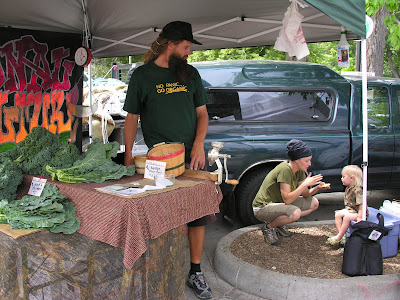
RAS can be found at the Boulder Farmers' Market on Saturdays. They currently have blue corn and will have Hopi purple corn this fall. See how easy it is to grind corn and make your own fresh cornmeal at their stand. Cornmeal is a great gluten free local flour that can be substituted for other flours in your favorite recipes. Find out more about RAS Farm at: www.rasfarms.com or stop by their stand on Saturday!
know your food...know your farmer
| |
|
|
"I expand and live in the warm day like corn and melons"
--Ralph Waldo Emerson
13th street Downtown Boulder
Boulder County Fairgrounds
|
|
Boulder Farmers' Market
is open Saturday
8am to 2pm
Longmont Farmers' Market
is open Saturday
8am to 1pm
Boulder Wednesday
Farmers' Market is open
4pm to 8pm
Market bucks - When given as a gift help farmers and the recipient.
Mark Menagh
Executive Director
Boulder County Farmers' Markets |
|
|
|
 |


