|
|
|
|
|
|
Perfect week at the markets
The weather has been fantastic for the Farmers' Markets this week. If you were at last night's farmers' market in Boulder you know just what I mean. It is so wonderful to see so many families enjoying the market. There are so many beets at the markets I thought we would focus on them today. I am guilty of not eating them often enough and Carol Ann helps me get back into the habit with a tantalizing recipe. The Longmont Farmers' Market enjoys the company of Rhythm on the River this weekend and I am looking forward to picking up my veggies in Longmont and enjoying the entertainment in Longmont on Saturday. As we wait for the peaches don't forget how good the apricots are, they too can never be sold in a supermarket as perfect as you will find them at the farmers market, picked ripe amd sold the same day. Right when you want to eat them. Be sure to ask the farmers about how to tell ripe fruit, many of us judge fruit as if it came from the supermarket, it is different when picked ripe instead picked green. See you at the market!
|
|
|
If you haven't had any of the cherries yet this season HURRY UP, they won't be here much longer!

|

The Beet Goes On
by Carol Ann Kates
The beet is a descendant of the sea beet, a wild seashore plant that grows in southern Europe. As charred beet roots were found in the Neolithic site of Aartswoud in the Netherlands, historians believe our ancestors have been eating beets since prehistoric times.
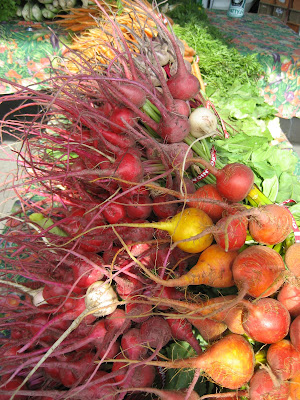
We are accustomed to seeing the common beet in supermarkets. It is round with slightly flattened ends, a dusty red exterior, and deep red flesh. But at our farmers' market you can find other varieties. Baby beets are considered the most tender and possess a delicate flavor. The Italian chioggia beet, also called candy cane, is bright red on the outside but on the inside has red and white concentric stripes. Golden beets are more orange than gold and tend to be sweeter than red beets. White beets are sweet with a less earthy taste than the deeper colored varieties. And, of course, you will find rainbow beets, whose multitude of colors make an interesting and unusual presentation. One of the advantages of purchasing golden or white beets is that they will not bleed like beets with deep red flesh.
When you buy beets with the greens attached, you are actually getting two veggies for the price of one. Beetroots can be simmered in stews, roasted, steamed, boiled or braised. They can also be used uncooked and shredded for salads or squeezed into juice. Beet greens have a wonderful earthy flavor. If the greens are small, add them to salads. Larger greens should be sautéed or cooked like any other hearty green.
I just started cooking with golden beets. I found them sweet and delicious, and they didn't leave any messy red stains. Following is a recipe for a salad with golden beets and roasted asparagus. My family loved this one.
Roasted Golden Beets and Asparagus
over a Bed of Greens
Serves 6
I made a dressing for this salad using my vanilla-fig balsamic vinegar. It was heavenly. I've included this recipe. I've also inserted a recipe using plain balsamic in case you don't have this flavor.
For a balsamic vinegar dressing:
3 tablespoons balsamic vinegar
1 teaspoon Dijon mustard
1 teaspoon minced garlic
½ teaspoon salt
½ teaspoon large grind black pepper
3 tablespoons olive oil
In a small bowl, combine balsamic vinegar, mustard, garlic, salt and pepper. Whisk to blend. While continuing to whisk, slowly add olive oil. Set aside.
For a vanilla-fig balsamic dressing:
3 tablespoons Corner Market Secret Recipe Vanilla-fig Balsamic Vinegar
3 tablespoons olive oil
In a small bowl, place balsamic vinegar. Slowly add olive oil, whisking to blend. Set aside.
For the beets:
12 small golden beets
3 tablespoons olive oil
½ teaspoon salt
½ teaspoon large grind black pepper
Preheat the oven to 350 degrees F. Remove greens and reserve for cooking later. Wash beets well, peeling off any bad spots and leaving skins on. In a medium baking dish, toss beets with olive oil, salt, and pepper. Bake beets at 350 degrees F for 45 to 55 minutes or until beets are tender when pierced with a knife. Remove from the oven, cool, and peel.
For the asparagus:
½ pound asparagus spears, tough ends snapped off and thick spears peeled
Extra virgin olive oil for drizzling
Salt to taste
Large grind black pepper to taste
Arrange spears in a single layer on a rimmed baking sheet. If spears vary in size, separate them into piles of thick and thin spears and keep them divided on the baking sheet. Thin spears will cook faster, and this makes it easy to remove them when they are cooked.
Drizzle with olive oil and season to taste with salt and pepper. Roast until ends are tender when pierced with a knife, about 7 minutes for thin spears and 10 minutes for thick ones. Transfer to a cutting board and cool.
For the salad:
12 small golden beets, roasted, peeled, and cut in quarters
½ pound asparagus, roasted and cut into 2-inch pieces
½ cup scallions, thinly sliced
¾ cup crumbled feta cheese
6 cups Spring mix or your favorite greens
Using 6 salad plates, cover plates with greens. Top greens with golden beets, asparagus, scallions, and feta cheese. Drizzle with dressing and serve immediately.
Selecting beets: Choose small, firm beets with bright green leaves that show no signs of wilting. The taproot should still be attached. Avoid large beets that have a hairy taproot. This is an indication of age and toughness. If beets are larger than 1½ to 2 inches in diameter, they will likely have a tough, woody center. Smaller beets are more tender and sweeter. Pass up beets that have scales or spots. To ensure even cooking, select beets that are uniform in size.
Storing beets: Upon arriving home, trim the leaves 2 inches from the root. The leaves will suck moisture from the beets. Do not trim the tail. If you like, you can store the leaves in a separate plastic bag in the vegetable crisper of your refrigerator. Use these leaves within 2 days. When placed in plastic bags and stored in the crisper of your refrigerator, beetroot bulbs will keep up to 3 weeks if dry.
Washing and cooking: Wash beets gently as their skin is fragile. If the skin is not broken during the washing process or removed for cooking, beets will retain more nutrition and color. The skin of beets will easily rub off under cold running water or when rubbed gently with a paper towel. Leave at least an inch of the leaf stem when you cook beets. Remove the leaf stem before serving.
Carol Ann Kates is the author of award-winning Secret Recipes from the Corner Market selected as one of the top ten favorite cookbooks by the Denver Post Food Staff.
For more information visit www.cornermarketsecrets.com.
|
 Rhythm on the River Rhythm on the River
Join the Longmont Farmers' Market in welcoming LiveWell Longmont and Rhythm on the River this Saturday at the Longmont Fairgrounds North lot.
LiveWell Longmont is a movement designed to ensure that healthy lifestyle choices are always available and convenient for all who work, live, play, and learn in our community. Longmont is a community that has a long history of working together. From our Focus on Longmont Strategic Plan to our Multicultural Action Committee, Longmont's citizens, businesses and nonprofits are known for collaborating for positive change. As a result, Longmont was named an All-America City by the National Civic League in 2006.

It is the Longmont Farmers' Market's goal to build partnerships in our community "to make healthy choices easier choices for all people in Longmont."
|
The G8 Summit leaders tackle Global Food Crisis
The Group of Eight (G8) Summit is an annual meeting attended by the leaders of the eight countries, namely, Canada, France, Germany, Italy, Japan, Russia, the United Kingdom, and the United States of America, and the President of the European Commission.
"Summit meeting" in its strict sense means a leaders meeting, but it usually refers to a series of meetings which include those of foreign ministers and finance ministers that are held prior to the leaders' meeting.
As Sheryl Gay Stolberg reported in The New York Times, world leaders attending the G-8 summit declared today that they were "deeply concerned that the steep rise in food prices" could push "millions more back into poverty."
"Everyone realizes that it's a crazy idea to use valuable land to grow crops for cars and not people," Adrian Bebb of Friends of the Earth told The Christian Science Monitor.
Grain prices have more than doubled since January 2006 with 60 percent of the rise occurring this year. More than 30 countries have experienced rioting over food shortages. Overall, the world"s poorest countries like Bangladesh, Ethiopia and Haiti, which import most of their food, stand to suffer the most."
While G8 leaders discuss the global solutions, the UN World Food Program has developed some of their own. "The plan includes local purchase of food, spending to strengthen smallholder farming, local transport and communication networks, as well as school meals and support for mother-and-child health and nutrition programmes."
Interesting that the flow of solutions always returns to the obvious. We have developed our global food systems at the expense of our local economies, personal health, and social infrastructures. It appears that supporting local food systems like farmer's markets supports global health.
See you at the Longmont Farmers' Market this Saturday from 8am-1pm!
Cindy Torres - Longmont Farmers' Market Manager |
|
July 19 - August 24, 2008
In the modern world of agribusiness and factory farms, some family farms survive, and even thrive. Photographer Jane Gabrilove has spent the last two years photographing Zweck's Farm, a Centennial Farm on the western edge of Longmont. An exhibit of her photographs, On Zweck's Farm, opens July 19 and runs through August 24, 2008.
Longmont Farmers' Markets is proud to be a sponsor of this show.
|
| Edible flowers
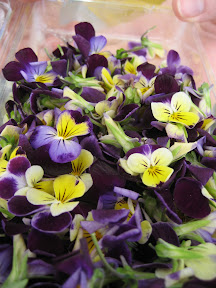
violas (available most of the year, purple or blue and yellow)
 borage (available Aug - Oct, cucumber flavor, light blue or white) borage (available Aug - Oct, cucumber flavor, light blue or white)
naturtiums (available Sept, spicy flavor, many colors)
sage (available now, purple flower)
 chives (available now, purple flower) chives (available now, purple flower)
 arugula (available spring and fall, spicy, ivory flower) arugula (available spring and fall, spicy, ivory flower)
lavender (available July or Aug, purple flower)
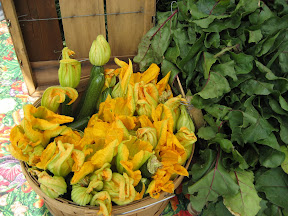
squash blossoms (available July - Sept, yellow flower, good for stuffing and frying)
|
Longmont Farmers' Market
Farmer Spotlight:
Lladyhawk Llamas, LLC is 37 picturesque acres overlooking Long's Peak in Longmont, Colorado. Our well-maintained farm is home to a small, llovingly cared for herd of llamas, numbering about 50 after this year's crop of new babies (called "crias."). We know and appreciate the individual personality of each one. The llamas are used for their fiber and some are sold as guards to folks that own sheep, goats, alpacas, even fowl. They do exceptionally well when their job is as a deterrent to canine predators. We have several pack llamas, and "PR" llamas who regularly appear in parades, at retirement centers, and an assortment of other community events. We also show them and have a show string with a large percentage of our animals being breeding stock for show quality offspring.

We also raise lavender. In comparison to the fields in France and even here in Washington State and Texas, our crop is small. But it is generally a hobby, and not a profession, and the passion is merely to be shared with others that are not so fortunate as to have the space to grow it in quantity. It is all fertilized with llama manure, is not sprayed with any pesticide, and is harvested lovingly by hand when it blooms in July (and sometimes in September.) We have about 300 plants, mostly of the English varieties, and a small quantity of hybrids are grown as well.
We also grow gourds. This started as a "side venture" to the hundred or so pumpkins we grew each year for our private family/friends harvest festival. They grew well and were fun and funky. And there were LOTS of them. So - upon figuring out what to do with all of them, I bought a few books, and learned the art form. It's become an obsession, as the possibilities are endless.
We both work "day jobs" so farm tours and visits are not possible, unfortunately. We need to spend our evenings and weekends devoted to taking care of the animals and plants. We make occasional exceptions for groups such as the Y, and retirement centers, so please call and ask if you have a special request.
Lladyhawk Llamas - Ladyhawkllamas.com |
100 mile diet based in Boulder County |
|
Interesting facts about beets:
- According to John Heinerman Ph.D. in Encyclopedia on Healing Juices, beets (& beet juice) are blood-building herb that detoxifies blood & renews it with minerals & natural sugars. This encyclopedia goes on to note that there may be substances in beets that aid circulation.
- Dr. H.C.A. Vogel, in The Nature Doctor, states that beet juice contains betaine, which stimulates function of liver cells & protects our liver & bile ducts.
- Norman Walker, D.Sc. in Fresh Vegetables and Fruit Juices, claims that beets build red corpuscles & add tone to blood.
- An article in February 25,1996, issue of Cancer Letters report on an animal study that shows that beetroot has a significant tumor-inhibiting effect. The abstract for the study says, "The combined findings suggest that beet root ingestion can be one of the useful means to prevent cancer."
|
Band on the Bricks is on Wendesday evenings right after the Boulder Farmers' Market on Wendesday.
Bands on the Bricks features the best dance bands in the Front Range and appeals to music lovers of all ages. The concerts are held in the 1300 block of Pearl on the bricks in front of the Boulder County Courthouse.
July 16th- Freddi Henchi
July 23rd- Wendy Woo
July 30th- Fab 4
Aug 6th- Home Slice Band
Aug 13th- Erica Brown Band
Aug 20th- Chris Daniels & The Kings
|
Letter to the editor, re: Kohlrabi
Mark,
Hi - just got your latest market newsletter, which is wonderful as usual. However, there is an error in regard to kohlrabi. Kohlrabi is a member of the cabbage family (brassica), not the turnip family. Just thought you'd like to know!
Vicky.
Vicky,
Although Kohlrabi is a cultivar of the cabbage, it is in the same order and family as the radish -Brassicales. Its origin in nature is the same as that of cabbage, broccoli, cauliflower, kale, collard greens, and brussels sprouts: They are all bred from, and are the same species as, the wild cabbage plant (Brassica oleracea).
Brassicaceae family contains well-known species such as Brassica oleracea (cabbage, cauliflower...), Brassica rapa (turnip, Chinese cabbage...), Brassica napus (rapeseed...), Raphanus sativus (common radish), Armoracia rusticana (horseradish), Matthiola (stock) and many others. So yes I would say cabbage is the most correct, but to say a member of the radish family is not incorrect. As cabbage is described as a leaf vegetable. If we look at the "meat" we would be more likely to "liken" it to the radish. So if we look up cabbage you will see it is related to the tunip, and turnip to radish, and radish to mustards.
Mark
Mark,
Yes, I had noticed that turnips, cabbages, and their ilk, all were from the Brassica family. Probably the biggest distinction is the edible parts of the cabbage family grow above ground, while the turnip folks produce a root crop (even though turnip greens are delicious).
One thing I have noticed as a grower is that the tops of the turnip family (turnips, radishes, rutabagas) are terrific attractants of those pesky flea beetles. The flea beetles will turn turnip tops into frail, lacy remnants of the nice greens they once were.
On the other hand, the cabbage family, including my kohlrabi, is of little or no interest to the flea beetle. The pest of concern here is the white cabbage butterfly who lays her little eggs on the underside of the leaves. These in turn hatch into those voracious little green cabbage worms. Case in point, my kohlrabi is growing next to radishes & turnips. The radishes & turnips have been mercilessly attacked by flea beetles, but the only pest on the kohlrabi has been the little green cabbage worm.
Vicky
| |
|
|
In 1960, Americans spent 17.5 percent of their income on food and 5.2 percent on health care. Today, they spend 9.9 percent on food and 16 percent on health care.
13th street Downtown Boulder
Boulder County Fairgrounds
|
|
Boulder Farmers' Market
is open Saturday
8am to 2pm
Longmont Farmers' Market
is open Saturday
8am to 1pm
Boulder Wednesday
Farmers' Market is open
4pm to 8pm
Share what you find good - with others. Purchase market bucks as gifts for your best friends.
Mark Menagh
Executive Director
Boulder County Farmers' Markets |
|
|
|
 |