 |
|
|
|
|
|
Happy Independence Day
The July 4th weekends are usually slow markets for us. This is an opportunity to have a picnic in the park with the absolutely freshest food possible. Let the crowds be somewhere else. This is your chance to bring the family down to the farmers' market to talk to the farmers about where food really comes from and fill the reusable shopping bags you brought with you with the freshest food available anywhere. So let's have the party on Friday night and visit the farmers' market on Saturday. Even though the crowds won't visit us on this weekend our farmers are at the market. See you at the market!
|
|
From Dr Audrey:
In case you needed another reason to eat cherries:
A study published in the Journal of the American College of Nutrition looked at the impact of eating a variety of fruits on antioxidant levels. Eating a meal was found to lower antioxidant levels in the blood; however eating cherries (or blueberries or grape powder) resulted in increased antioxidant levels. Eating antioxidant-rich foods with the meal helps to provide the tools the body needs to compensate for the stress caused by digesting the meal. What a great excuse to have cherries for dessert.
|
|
What In The World is Kohlrabi?
by Carol Ann Kates
A member of the turnip family, kohlrabi looks a bit like a turnip but has protruding stalks that are topped with broccoli-like leaves. It is the vegetable you see in the market and wonder, "What in the world is that and how would I prepare it?" Looking a bit like a visiting veggie from another planet, kohlrabi has the appearance of something dug up from the earth, but it is actually a swollen stem.
The word kohlrabi is German and translates to mean "cabbage turnip". The Italian word for this veggie is cavolorapa. Kohlrabi can have a deep violet or light green skin; but underneath, its flesh is ivory. Both the root and leaves are edible but completely different in flavor and texture. Kohlrabi root tastes a bit like celery root, broccoli stem and cabbage with the hotness of radishes and the sweetness of turnips. The leaves, however, have a cabbage-like flavor.
I've spent the majority of my life working in grocery stores, yet I've never seen this one in the produce department. While there may be some specialty markets that stock it, you'll find kohlrabi in farmers' markets. It flourishes in Colorado and is in season from late June through September.
If you buy it, what can you do with it? Cut kohlrabi into slices or wedges and add it to Chinese stir-fry or Indian curry. Slice it thinly like you do potatoes and add it to scalloped potatoes. Shredded kohlrabi makes a crunchy addition to coleslaw, and you can add it to your favorite combination of vegetables for roasting. Kohlrabi can be used in stews and soups and is even made into pickles or relish.
Kohlrabi can be boiled or steamed. To boil it, cook it in boiling salted water for 30 to 60 minutes, depending on the size of the bulb. If you boil it in its skin, drain and peel it before using. To steam kohlrabi, season it with salt and place it in a vegetable steamer over boiling water for 45 to 60 minutes, depending on the size of its bulb.
If you want to give this one a try, it pairs nicely with curry, Dijon mustard, garlic, ginger, potatoes, rice wine, roasted meats, sesame oil, and soy sauce.
Chinese Chicken Salad
with Crunchy Kohlrabi and Spicy Toasted Almonds
Serves 4
For the chicken:
4 boneless, skinless chicken breasts (about 1 ½ pounds)
½ cup Corner Market Secret Recipe Honey Ginger Teriyaki Sauce
or your favorite teriyaki sauce
In a large bowl, place chicken breasts and drizzle with teriyaki sauce. Cover with plastic wrap and marinate in the refrigerator for 2 to 4 hours, turning occasionally to coat evenly. Remove chicken from marinade. Grill over hot coals 4 to 5 minutes per side or until chicken is cooked through but not dry. Cool and cut into ½-inch strips.
For the almonds:
1 tablespoon olive oil
¼ cup slivered almonds
½ teaspoon crushed red pepper flakes
In a small skillet, place olive oil over medium heat. Add almonds and red pepper flakes and sauté for 5 to 7 minutes. Watch closely as nuts turn from golden brown to black very quickly.
For the salad:
4 medium kohlrabi
1 cup carrots, julienned (about 8)
1 cup radishes, julienned (about 6)
1 cup pea shoots, chopped
4 green onions, sliced thin
1 cup canned sliced water chestnuts (optional)
2 tablespoons cilantro, chopped
Remove kohlrabi leaves. Cut off the stems and any tough center ribs. Using a vegetable peeler, peel kohlrabi. Using a mandoline, cut kohlrabi bulbs into 1/8-inch slices. If you don't have a mandoline, cut kohlrabi into 1/8-inch slices. Stake them and cut the slices into julienne, or 1/8-inch slices. In a large salad bowl, place kohlrabi, carrots, radishes, pea shoots, green onions, water chestnuts, and cilantro.
To serve:
Sliced chicken strips
Toasted almonds
Salad fixings
Additional teriyaki sauce for tossing
Add sliced chicken and toasted almonds to the salad bowl. Drizzle with additional teriyaki sauce to taste and toss gently. Serve immediately.
Preparing kohlrabi: Remove the leaves. Discard the stems and any tough center ribs. The leaves can be cooked like greens. You can steam the bulb to loosen its skin. Then peel the outer fibrous skin of the globe. If preparing kohlrabi raw, use a potato peeler or a sharp paring knife to remove the outer fibrous skin.
Selecting kohlrabi: Do not buy extremely large kohlrabi. They are tough and have a strong taste. Choose small to medium specimens with small, smooth bulb-stems and firm, green leaves. Kohlrabi less than 3 inches in diameter will be the most tender. Choose ones that seem heavy for their size with firm, deeply colored green leaves. Avoid this veggie if it has soft spots on the bulb or signs of yellowing on the tips of its leaves.
Storing kohlrabi: The leaves will only keep for a few days. Remove the leaves and store them separately. The root, however, will keep for several weeks in the refrigerator.
 Carol Ann Kates is the author of award winning cookbook, Secret Recipes from the Corner Market. For more information visit: www.cornermarketsecrets.com. |
|
Book review:
By Dr Audry
This Organic Life
Confessions of a Suburban Homesteader, by Joan Dye Gussow
(Chelsea Green Publishing Company, 2001).
This book is where I first read the shocking statistic that it requires 435 calories of fuel to fly a 5-calorie strawberry from California to New York. It was one of the early books to promote the idea that a locally-based diet, especially one based on food you grow yourself, is more ecologically sound than our current system of long-distance imports. After being convinced of the importance of decreasing the reliance of our food system on fossil fuels, the author sets out to prove that it is actually possible. She describes the process of beginning a large garden at her home outside of New York City, adding recipes to match the season (her Tomato Glut Sauce has become my staple for freezing). She thoughtfully explores local items that can be substituted for produce transported long distances, and trials of growing produce that "can't be grown" in her region. As a nutritionist and journalist, she also reviews the studies available about all aspects of eating-for example, she discusses whether home cooking is economically advantageous-as well as adding her intermittent journal entries about restoring her old house, starting a community garden in her town, and her nutrition classes at Columbia University. Her story provided inspiration for Michael Pollan and Barbara Kingsolver in their experiments with eating locally. An entertaining story of this woman's quest for "vegetal self-sufficiency".
|
|
A question posed to Anne Zander at the CSU extension services:
Q: Are there any new food safety guidelines, especially in light of the recent salmonella outbreak on tomatoes?
A: Yes, here is some fresh advice for consumers.
First, store produce in the refrigerator (except for potatoes, tomatoes and bananas, which don't need refrigeration) just as they come from the farmers market, CSA or store until you are ready to eat them.
At that point, thoroughly rinse fresh fruits and vegetables under running water. Cut away any bruised or damaged areas before eating, and use a clean vegetable brush to scrub produce with firm skin, such as melons and cucumbers.
Be sure to prepare only the amount of fresh produce you plan to eat right away. Don't store wet fruits and vegetables -- wash just before preparation. If necessary, dry produce thoroughly before placing it back in the refrigerator.
The reason for these precautions? It's simple. Bacteria need three things to multiply: nutrients, moisture and time. Bacteria tend to grow on bruised and cut edges of fruits and vegetables -- those sites are rich sources of nutrients. Don't add more such sites by cutting into the produce long before eating it. When you wash produce, you're adding moisture. If you then store the produce, even in the refrigerator, that allows bacteria time to multiply, possibly to a point where it could cause illness.
 Although cold temperatures retard most bacterial growth, some organisms can multiply even in the refrigerator, especially if the temperature is above 40 degrees F. You can reduce the risk of all these factors by not preparing or washing produce until just before eating it. Also, check the temperature of your refrigerator with a thermometer to be sure it is cold enough. This advice is particularly important for children, the elderly, and persons with weakened immune systems, all of whom are at high risk of developing serious illness from foodborne disease. Of course, also follow standard food safety guidelines, including: Wash your hands often, especially after using the bathroom or changing diapers, before and after eating or preparing food, and after touching animals. Cook ground beef to 160 degrees F. Use a thermometer to test it. Keep raw meat away from other foods. Wash your hands, cutting board, counter, dishes and silverware with hot soapy water after they touch raw meat or produce. Avoid eating raw sprouts. The conditions under which seeds are sprouted also are ideal growth conditions for microbes, which means a few bacteria that could be present on seeds can grow to high numbers on sprouts. Learn the difference between micro-greens and sprouts. For more information please contact Ann Zander at the CSU Extension office 303-678-6238 or azander@bouldercounty.org |
|
"All natural" is researched and described on this serious site that uses comics to help us see their point.
|
|
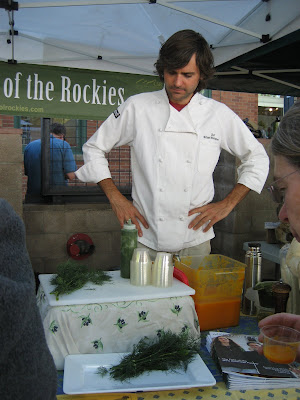 
Sesame Sugar Snap Peas
Serves 6
Ingredients:
1 pound sugar snap peas, stringed
1 teaspoon toasted sesame seeds (black and white)
1 tablespoon sesame oil
Salt and freshly ground black pepper, to taste
Method:
In a large saute pan over medium high heat, heat sesame oil and quickly saute sugar snaps until crisp tender and bright green.
Lightly season with salt and pepper and transfer to a bowl. Sprinkle with toasted sesame seeds and serve.
Visit the CSR Chef at the Market every Wednesday evening and every Saturday morning at the Boulder Farmers' Market.
|
Longmont Vendor Spotlights:
Frfroney's
"Frfroney's is a new and exciting mobile food vending business, aiming to change the way business is done in the industry. Frfroney's stands for fruit fritters & honey and has developed a new healthful street snack. We take local & organic pears, apples, strawberries, & fair trade bananas, dip them in our delicous Frfroney vegan or gluten-free batters, fry them up and serve them with honey, a local vanilla ice cream, chocolate, or agave! We also offer other fruit products such as frfroney-sicles, fresh fruit fondue, and fruit bowls. On the operations side Frfroney's is trying to be as eco-friendly as possible by recycling all of our cooking oil into biodiesel, composting all of our waste, and sourcing as much local and organic produce as possible from Colorado farmers. On the social side Frfroney's aims to become an employee-owned business that helps its employees hold ownership in the company and eventually own their own Frfroney's stand! Supporting Frfroney's supports other local businesses, and a company that is committed to doing better business. Come visit us at the Longmont Farmers Market Saturdays 8-1!"
|
|
Around and About
A tale of two tomatoes
Or - How and why, in a centralized food system, a little bacteria can go a long way. rodaleinstitute.org
Grist on the organic summit that was held here in Boulder grist.org
Mark Morford SF Gate Columnist on eco-green stuff
(Caution Mark Morford can offend some sensibilities)
We are doomed! Sort of!/Earth in crisis, food and water increasingly scarce, people freaking out. Should you join them? By Mark Morford, SF Gate Columnist sfgate.com
I wonder if enough people have read my previous posting about Monsanto genetic modification to be able to read between the lines of this news article.
Dow & Monsanto Move To Grow Crop Businesses forbes.com
The second annual state-wide Permaculture Convergence will be held near Boulder, Colorado on the first weekend of August. livingearthcenter.org
Prices are going up, this is the governments Consumer Price Index Summary page www.bls.gov
How much of flood impact is man-madeExtensive monocropping, tile drainage, reduction of riparian areas and development of wetlands all damage the land's ability to hold water. In extraordinary weather events such as the rainfall to hit Iowa & the Midwest. washingtonpost.com When someone asks me about getting into agriculture the first place I send them is the CSU extension service. Lots of help. coopext.colostate.edu
The Organic Trade Association (OTA) filed a legal complaint against Ohio's Department of Agriculture.
For those farmers who have chosen to not use rBST on their cows, and who were finding new and growing markets by marketing their milk as no-rBST or organic, Ohio has passed an "emergency" rule which will hurt the farmers' ability to convey to consumers how they produce their milk. Monsanto was the driving force behind getting FDA approval for rBST and then turned its substantial resources towards lobbying the Ohio Department of Agriculture for this new "emergency" rule.The Ohio rule violates the U.S. Constitution in three distinct ways: First, the Ohio rule violates the OTA members' free speech rights. Second, the OFPA already provides substantial regulation of the organic products industry and preempts enforcement of the Ohio rule with respect to labeling protocols followed by organic dairy farmers. The USDA's National Organic Program already has clear labeling requirements for certified organic labels. Third, the Ohio rule violates the Commerce Clause of the U.S. Constitution which gives Congress sole authority to regulate interstate commerce. Ohio has violated that prohibition by regulating dairy products outside of Ohio that are shipped into the state and controlling the labeling of dairy products in Ohio that are shipped outside of the state. organicnewsroom.com
To help understand why it is important to talk about "food systems" and "food security" in a local context Cornell University has put together "A Primer on Community Food Systems" Linking Food, Nutrition and Agriculture The term "food system" is used frequently in discussions about nutrition, food, health, community economic development and agriculture. The food system includes all processes involved in keeping us fed: growing, harvesting, processing (or transforming or changing), packaging, transporting, marketing, consuming and disposing of food and food packages. It also includes the inputs needed and outputs generated at each step. The food system operates within and is influenced by social, political, economic and natural environments. Each step is also dependent on human resources that provide labor, research and education.
A Global Crisis Canary In the 1990s, North Korea was the world's canary. The famine that killed as much as 10 percent of the North Korean population in those years was, it turns out, a harbinger of the crisis that now grips the globe - though few saw it that way at the time. truthout.org
They give a reason to travel to Boulder
Under Organic Veggie the top pick:
Boulder: The 70 organic artisanal farms in and around Boulder bring Colorado's organic acreage the second-largest in the country (after California). "Local," "seasonal" and "sustainable" are the founding principles of the local ag industry, and the Slow Food movement is gaining strength every day.
| |
|
|
By volume, the highest levels of foods imported into the U.S. are fish and shellfish, 79 percent; fruit and nuts, 32 percent; and wine and beer, 16 percent.
13th street Downtown Boulder
Boulder County Fairgrounds
|
|
Boulder Farmers' Market
is open Saturday
8am to 2pm
Longmont Farmers' Market
is open Saturday
8am to 1pm
Boulder Wednesday
Farmers' Market is open
4pm to 8pm
Mark Menagh
Executive Director
Boulder County Farmers' Markets |
|
|
|
 |


