|
Healthy Tradition:
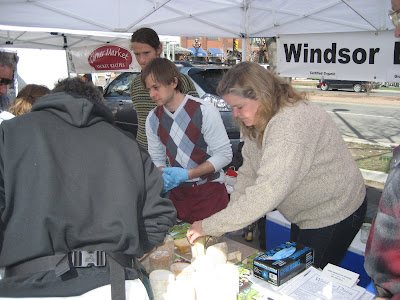
Windsor Dairy's Line of Raw Milk CheesesNot long ago you had to travel to Europe or Amish country to purchase handmade raw-milk cheeses, crafted from grass fed organic cow's milk. Now that Windsor Dairy has introduced its own line of artisan cheeses, you only have to travel as far as the Boulder or Longmont farmer's markets to enjoy these delicious traditionally made cheeses. These farmstead cheeses have evolved out of the dairy's mission to become a local raw-milk micro-creamery that is committed to producing delicious and nutritious dairy products in an environmentally sustainable and traditional manner. The cheeses are made on the farm where the dairy's owners manage all aspects of the cheese making process, from managing the variety of wildflowers in the organic pastures to making certain the cheeses are aged at the right temperature.
The owners of the dairy, married dairy veterinarians, Drs. Meg Cattell and Arden Nelson have a unique background for making cheese at a raw milk dairy. Respected dairy veterinarians, they also hold degrees in environmental health, nutrition and anthropology. Meg has studied indigenous cultures' ancient relationships with cattle on research grants to Nepal and the Orkney Islands and to India on a Fulbright scholarship. She and Arden have also traveled the world lecturing and consulting with dairy farmers. When they purchased Windsor Dairy in 1999, they began to transform the farm into a dairy where they could put their unique expertise into practice and raise a family.
Meg and Arden have discovered that allowing cows to live like cows have lived for centuries results in the best animals husbandry and a creamy, sweet, nutritious milk. Windsor Dairy's cows are a mix of European mountain dairy breeds famed for cheese making, like Brown Swiss and Tarentaise. Like their ancestors, the cows spend most of the day grazing fields full of grasses, herbs and wildflowers. The cows' all grass diet results in a milk that is high in omega 3's, the kind of fatty acid found in salmon and walnut oil, and high in CLA (conjugated linoleic acid), a fatty acid that has high cancer fighting properties. Because the milk is un-pasteurized the milk's enzymes and vitamins remain intact when the milk enters the cheese-making vat.
The dairy's small batch cheese making vat is housed in a room adjacent to the milking parlor. In the traditional manner, cheese-making begins when the cows are milked, so the culture and the rennet can be added while the milk is still the body temperature of the cows. The curds are hand pressed into twenty pound or two pound cheese molds and then placed in aging rooms where they are aged a minimum of sixty days. After sixty days, by federal law, raw milk cheeses are available to the general public without a raw milk share.
Delicious cheese is the happy result of the careful attention to nuances of cow health and cheese making. Currently Windsor Dairy has nine varieties of cheese in production. Though some of the cheeses are made in "Swiss," "cheddar," and "jack" styles, the cheeses are named for geographic features along the dairy's watersheds, names like Glendevey, Buckhorn, and Nakhu, and reflect the dairy's commitment to environmental stewardship, local food and tradition. (Historically cheeses are named after the region they are made in. For example, Emmental from Switzerland and Stilton from England.) Many of the cheeses are true Colorado creations, like Buckhorn which has both jack and yogurt cultures and a natural or "mold" rind, Glendevey, a gruyere cheese aged with a natural rind, and Melville is a gouda-like cheese with a natural rind washed in organic apple cider from Meg's organic heirloom apple orchard.
These unique and delicious cheeses are only available from Windsor Dairy. 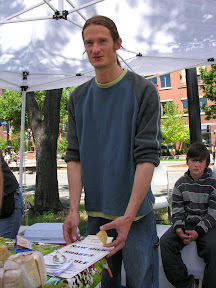 |
|
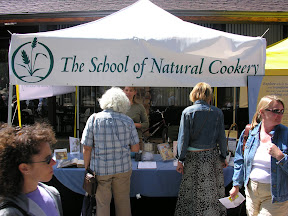
Join the School of Natural Cookery will offer cooking demonstrations at 10am every Saturday morning.
Join them this Saturday at the North side of the Boulder Farmers Market.
June 21st Demonstration
They will be creating a bright summer salad with whole grains, plenty of early summer vegetable and fresh herbs from the local farmers. View their presentation, or just stop by for a sample.
naturalcookery.com |
|

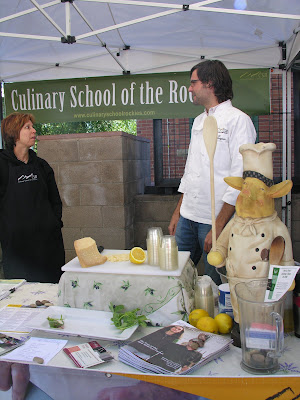
Culinary School of the Rockies
Recipe: Grilled Salmon with Strawberry Salsa
Visit the Chef at the Market every Wednesday evening and every Saturday morning at the Boulder Farmers' Market. Watch demonstrations, pick up free recipes, and gather advice for cooking with seasonal ingredients fresh from the market.
Serves 6
Ingredients:
For the salsa:
1 seedless cucumber, finely chopped
1 scallion, thinly sliced
1 tablespoon fresh mint, cut into thin strips
3 to 4 tablespoons rice wine vinegar
2 cups fresh strawberries, hulled and diced
For the sauce and fish:
1 stick butter
1 clove garlic, finely chopped
1 tablespoons honey
2 tablespoons soy sauce
1 tablespoon lemon juice
6 four-ounce salmon fillets
 Method: Method:
In a bowl, mix the cucumber, scallion, mint and vinegar. Cover with plastic wrap and chill for 1 hour. Just before serving, stir in the strawberries.
For the grilling sauce, melt butter with the garlic in a small saucepan. Stir in the honey, soy sauce and lemon juice. Cook for 2 minutes over low heat.
Brush the salmon with the sauce and place on the grill, cook for approximately 4 to 5 minutes. Turn the salmon and brush with the sauce on the other side. Cook for another 4 to 5 minutes. Brush the salmon again with the sauce just before it finishes cooking.
When fish is done, place on a large platter and top with the salsa. We post new recipes on our website every week.
For more recipes, visit the recipe section of thier website!
|
| Kids Activity Tent tonight:
Shining Mountain Waldorf School
will be working onfelt gnomes
Our beer or wine garden is open!
Tonight Boulder Beer and Bookcliff wine.
Music
tonight June 18th, our own regular... Gary Shackelford
Saturday
June 21th, Jill Pillon
|
OTHER THINGS
This is an article Newsweek about the problem with salmonella in our tomato supply. In this article you can see how the big agriculture tries to say that local may not be the answer. Their key solution is to allow tractability back to the farmer, with a whole new set of regulations, and make it a requirement, a cost that would be unrealistic for a small grower. Do you would think they would include selling direct to be outside of the requirement? Or do they mention anywhere that the best way to know where it is grown is to buy directly from the farmer? Where is it that you can buy directly from the farmer? A real Farmers' Market.
http://www.newsweek.com/id/141342/page/1
U.S. food prices will rise a stiff 9 percent a year through 2012, the largest increase since 1979 and the result of record-high crop prices, the head of an economic consulting company said on Thursday."When I do that analysis and look at the relationship between that and food prices, I get a 2008-12 average annual rate of increase in the consumer price index for food of 9.0 percent," he said.
That will make $1.00 of food costs $1.41 in 2012.
If you would like a real fresh, well prepared meal at one of our farms. You must check out this group.
Farm Dinners.com
Such hard-core opponents of regulation were once part of the political fringe, but with the rise of modern movement conservatism they moved into the corridors of power. They never had enough votes to abolish the F.D.A. or eliminate meat inspections, but they could and did set about making the agencies charged with ensuring food safety ineffective.
FDA and Republicans
Boulder Farmers' Market and 2r's Farm on the news last Wednesday night.
We all know that fruits and vegetables are good for us, providing important vitamins, minerals and fiber, but a new study by Agricultural Research Service (ARS) found that plant foods also may help preserve muscle mass in older men and women. The article asserts that the typical American diet contains foods that result in acidosis, a condition that can trigger a muscle-wasting response. The solution to acidosis is to eat foods that produce alkaline-residues, such as most fruits and vegetables.
USDA/ARS
Interested in learning more about growing your food and sustainalbility? Start here
The amazing part is not just the 2310 Calories, but the 73 ingredients!
|
Longmont Vendor Spotlights:
Taylor's Tinys - For a special Saturday morning treat, come to Longmont to check out Taylor's miniature organic donuts, "As Good As Bad Gets!". Taylor uses all natural ingredients (organic whenever possible) and cooks up the golf ball-sized donuts while you watch; he'll hand them to you hot and you can then eat them plain, or add a sprinkle of powdered sugar or cinnamon. Taylor's also promising apple cider donuts in the fall. For now, you can only find these little cuties at the Longmont Farmers' Market, but we expect them to be taking the Denver Metro area by storm soon. Taylor is also available to set up his "lazy river" donut maker at your next party--see www.taylorstinys.com or call 970-485-1084 for details! New this weekend: Arturo at La Esmeralda tortilleria tells us he'll be bringing a variety of 100% authentic Mexican burritos, "no Tex-Mex, this is the real thing!". Also watch for Mexican BBQ at the tortilla stand, coming soon. As for produce, in addition to the spring greens and plant starts, Longmont farmers have strawberries, asparagus, walking onions, beets, turnips, and sugar snap peas.
Come by early to check out the irises at the Stevens Farm stand.
Windsor Dairy has recently joined us, selling their cheeses, which are made from raw milk from their grass-fed cows.
Altan Alma is another new grower for Longmont, with microgreens and fruit trees.
And of course the tomatoes from Honeyacre Farms are salmonella-free and delicious as always!
For Longmont market goers who need a source of fresh produce mid-week, and don't want to go into Boulder stop by the Ollin Farm Stand on 95th Street, ½ mile south of Highway 119. They're open for produce sales on Wednesdays from 10-6. or visit them at the Longmont Farmers' Market on Saturdays. |
| Walk & Bike Month information booth at Boulder Farmer's Market
As part of Walk & Bike Month in June, GO Boulder will host an informational booth at the Boulder Farmer's Market, 13th and Arapahoe, on Saturdays from 10 a.m. to 2 p.m., and on Wednesdays from 4 to 8 p.m. Stop by to pick up your free leg band, bike bell, and burrito coupons when you register for Bike to Work Day, which takes place on Wednesday, June 25. Please register first Online at www.drcog.org.
|
|
Boulder Museum of Contemporary Art - BMoCA
 Summer Saturdays at BMoCA: Weekly fun for all! Summer Saturdays at BMoCA: Weekly fun for all!
FREE TOUR: 11am every Saturday, meets at the front desk
BMoCA offers in-depth weekly tours of current exhibits.
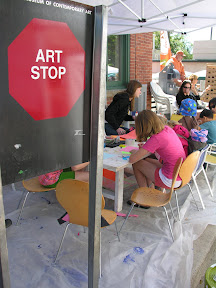
ART STOP: 9am-1pm every Saturday, on the museum's front porch
Art Stop is an activity-based program that gives children of all ages hands-on experience making artwork. Visitors are provided with materials and encouraged to creatively explore ideas related to current BMoCA exhibits and the color and textures of the Boulder County Farmers' Market. Free and open to the public.
Art Stop is generously supported by the Kevin Luff Family Fund and Community Foundation Serving Boulder County.
FREE ADMISSION: 9am-4pm every Saturday and 4pm-8pm every Wednesday
BMoCA proudly offers free admission to the public during the Boulder County Farmers' Market.
Every cup of coffee you purchase at the BMoCA booth is a donation to BMoCA also.
|
|
Even More Local:
Several of our farmers are collecting donations to help their neighbors. Please look around at our markets for ways to donate to victims of the Windsor tornados.
Farmaid.org is trying to find the local Farmers who are heroes, not a bad idea. All the farmers I know are heroes!
|
Book Review: Stuffed and Starved, by Raj Patel (Melville House, 2007).
Review by Dr. Audrey Sheridan
The book begins: "Today, when we produce more food than ever before, more than one in ten people on Earth are hungry. The hunger of 800 million happens at the same time as another historical first: that they are outnumbered by the one billion people on this planet who are overweight." A former policy analyst for Food First, and now at UC Berkeley, Mr. Patel explores the problems in the worldwide food production system in order to explain how we have arrived at this contradictory state. He traces the journey of our foods from farms around the globe to our markets, through the hands of powerful corporate distributors and marketers; we may think that we're making individual choices about food when we shop, but can't see that our choices have been limited for us by these companies that stand between the farm and our plates. Ultimately hopeful, he discusses the means to achieve a healthier world population by supporting an ecologically sustainable and socially just food system. To hear a brief interview with Mr. Patel prior to his testimony before Congress on the current food crisis, go to NPR.org
| |