|
Your Link to Timber Frame News & Information | |
|
Need help finding a timber frame professional? |
|
| |
|
| Heating and Cooling Your Timber Frame | |
A timber frame home should be as energy efficient as it is beautiful. Your choices on heating and cooling a new timber frame home are very important. Below we focus on some of the options availalbe to you. Any combination of these solutions will provide you with years of energy efficient comfort.
Heating and Cooling Your Timber Frame
The first order of business in assuring year-round comfort in your new timber frame home is to make certain that it is as energy efficient as it is beautiful.
Energy efficiency means savings for the homeowner not only in the long run with lower fuel bills, but also in the purchase and installation of heating and cooling systems. In many locations, a cooling system needs to be nothing more than strategically placed ceiling fans and windows. As for heating the structure, many homeowners will utilize solar energy (active or passive) while others may want to install a wood burning, or pellet, stove. These are excellent options that can save money and be environmentally friendly, however, local building codes (as well as the homeowner's lending institution) will almost certainly require a back up heat source.
A forced air furnace, located in the lowest level, with properly placed registers let into the floor of the main level, should handle the heating requirements for the entire house. The heat simply rises to the upper levels of the timber frame home. Building codes will often require heat registers or a wired heat source in all rooms, even on upper floors. A zoned heating system will make it easy to regulate heat upstairs and will meet these requirements.
Radiant floor heating is a popular system for heating timber frames. Radiant floor heat provides heat by convection, heating the floor and furniture first. This is a very efficient way to heat a timber frame home.
|
| Great Read for Timber Frame Enthusiasts | |
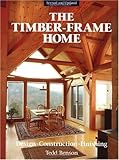
The Timber-Frame Home: Design, Construction, Finishing
by Tedd Benson by Taunton Press
Hardcover ~ Release Date: 1997-03-20 
List Price: $34.95
Our Price: $20.00 Buy Now |
| Timber Frame of the Month: Breathtaking Barn and Home | |
 This month's Timber Frame comes from Sweet Timber Frames in Mount Desert, ME. This month's Timber Frame comes from Sweet Timber Frames in Mount Desert, ME.
Below is a copy of a press release sent out about the features of this home:
"Mt. Desert, Maine -- Premier timber frame manufacturer, Sweet Timber Frames ( www.SweetTimberFrames.com), of Mt. Desert, Maine has completed the raising of an exceptional barn frame in Sorrento, ME, just outside Bar Harbor, and is now cutting the frame for the main home. Situated on an idyllic property high on a cliff overlooking Sullivan Harbor and Mt. Desert Island, these two Sweet Timber Frames structures are breathtaking. These traditionally joined timber frames will showcase the purity of the handcrafted frame - the raising of such a structure is truly a sight to behold. John Sweet, owner of Sweet Timber Frames says, "The use of timber framing was essential for this family - the property is breathtaking in every way, and they needed a barn and home to match. We are more than happy to oblige." The frame that they've just completed erecting is an impressive two story 36' x 60' barn structure, which is built solely from traditional mortise and tenon-joined hemlock frames, and like all Sweet frames, there are no metal supports or nails used whatsoever. Each frame is a unique wooden sculpture composed of large beams that lock together with wooden pegs to form the visible interior. The pegs act as a locking mechanism with the joints of the timbers, so that when the frame of the house is assembled on-site, the only element holding the entire structure together is wood."
|
|
|
| The ABC's of SEV's |
|
By: Jack Costantino, President, Timber Frames Unlimited
As a Freshman High School architecture/engineering student going back almost 55 years, I remember my instructor and early mentor Professor Harry Fleischer's knowing smile as we unfolded our leather bound pencil and pen holders on our first day in his class. The pencils were blue plastic with a shiny knurled metal spot at the bottom for better grip and had a button on top for dispensing graduated lengths of lead from a 3" stick inserted in the shaft.
I had been practicing for weeks before school started with various hardness leads from B's to 6H which produced different line qualities, and used my soap eraser and brush incessantly to keep my velum drawing paper free of smudges. I was ready to draw. Or at least I thought so. Professor Harry (which is what we called him) smiled knowingly at the four bright and eager young faces staring up in anticipation of our first assignment. Yup...its' true our class only had four students in the specialized Engineering, Architecture and Strength of Materials class we were enrolled in at our Vo-Tech...which was very heavy on the Vo and very light on the Tech.
Many of the enrollee's in our school were climbing around on old cars in a permanent state of partial repair and disassembly or welding pipes, running machine lathes or learning electrical wiring. But not me...I wanted to be an architect and an engineer and build things I designed so they would be truly my own. Little did I know what I would be doing in real life for the 50+ years which followed graduation in 1959? I wonder if any of us ever do at that age.
Professor Harry suggested we put our drawing tools away and said we were going on a field trip. We visited a nearby empty lot which sloped gently to a distant view of the Staten Island to NY Ferry Terminal. There were several large boulders on the site.
|
| Go Green: 101 Ways to Save Green and Live Green | |
 Each month we will be including ways to go green in our newsletter, courtesy of Pennywiseguides.com, in hope that it will help our readers live happier and healthier lifestyles. Below is a continuation of the 101 ways to save Green and live Green. Check back each month for the more of the 101 ways, and feel free to send us your suggestions.
Leisure & Vacation Green Tips
56. Rent hybrid cars: Try a hybrid or more fuel-efficient car. A hybrid rental can go three times as far as a standard sedan on a single tank of gas.
57. Refill water bottles: Use a refillable bottle or thermos or canteen when you travel.
58. Give small gifts: Gift cards, concert tickets, restaurant certificates and movie vouchers are great alternatives to holiday presents heavily packaged and wrapped in expensive and hard-to-recycle paper. You'll also reduce the time, stress and energy associated with traffic, crowds and long checkout lines. How many gifts do you give a year? If you average $2 for wrapping paper, ribbon and labels for each, think of how much you can save, not to mention the recycling costs.
59. Get the holiday LED Lights: Next time you replace your holiday lights, save both money and energy by choosing LED types. What's more, with a 100,000-hour life span, your LED lights could last until the next century.
60. Go for glass Instead of Cans: The energy required to produce a single 12-ounce aluminum can from virgin ore is enough to produce nearly two 12-ounce glass bottles. So the next time you buy a six-pack of beer, opt for glass bottles over aluminum cans.
61. Reduce sports gear: Consider renting or leasing sports equipment on a per-use basis as opposed to wasting money and cluttering up your garage with stuff you likely won't use more than once or twice a year. Or purchase used equipment. You'll reduce the energy needed to produce an additional piece of equipment and decrease the amount of waste eventually sent to the landfill.
Green Health and Beauty Tips
62. Use bars of soap versus liquid wash: It's less expensive, and it saves packaging waste. Not to mention that body wash is primarily water, so the fuel costs for transporting it are higher because it weighs more.
63. Skip the treadmill: If the weather's right, consider giving the treadmill a rest and taking your walking or jogging routine outdoors.
64. Slash trash: Cut waste by selecting products with less packaging. Three ways to do it: Choose products that come with minimal packaging, buy larger sizes, or buy refills or in bulk which typically have less packaging.
65. Get two for one: Consider using a two-in-one shampoo and conditioner instead of buying each separately. If one in seven U.S. households replaced its shampoo and conditioner purchase with a single two-in-one bottle, the amount of plastic saved per year could fill a football field 27 stories high.
66. Avoid pore pluggers: When you buy deodorant, try to avoid antiperspirants, which use aluminum salts to seal up your pores. In addition to being a potential health toxin, aluminum takes a tremendous amount of energy to mine. If you buy one stick of aluminum-free deodorant, the energy saved could power your laptop for 30 minutes. |
| Ask the Expert |
|
|
Do you have a question about your home or building project? Please forward your questions to pam@timberframe.org and the answer may be found in the next edition of "In Touch." |
| Tell Us Your Story |
|
|
If you have built a timber frame home and you'd like to share your story with our readers, please pass along your story (and any photos) -- we'd like to highlight your project! Send your story to info@timberframe.org! |
| About the Timber Frame Business Council |
|
|
Established in October 1995, the Timber Frame Business Council (TFBC) was created as a not-for-profit organization dedicated to enhancing the quality, integrity and marketability of the timber frame industry. TFBC is committed to strengthening and advancing the business, communications and research capabilities within the timber frame industry.
Using its most traditional definition, timber framing is a specific type of post and beam construction in which a frame is created from solid wood timbers that are connected by several types of interlocking wood joinery including mortise and tenon, dovetails or scarfs secured with hardwood pegs.
Timber frames are enclosed using several methods. While traditional timber frames were typically in-filled (between the posts and beams) with various mixtures of clay, straw, lime and other regionally available materials, contemporary frames use several methods that effectively enclose the timber frame and allow the timbers to remain exposed to the interior of the building. Timber framing is a building system which lends itself well to both residential and commercial construction over a broad spectrum of architectural styles such as; traditional, rustic, modern, southwestern, oriental and colonial to name a few. Timber framing integrates well with many other building systems and materials, such as; structural insulated panels, log systems, engineered wood products, concrete and conventional stud framing. |
|
|
|
| The Timber Frame Business Council is a non-profit trade association dedicated to putting you in touch with North America's best timber framing professionals. Please consider hiring a TFBC member for your next building project! And, remember, to stay "In Touch"!
Sincerely,
Pam Hinton, Executive Director
Timber Frame Business Council |
|
|
Visit Us!!!
|
Timber Frame Business Council
Your Link to Timber Frame Professionals, Resources & Information
104 Carlisle St.
Gettysburg, PA 17325 USA
888-560-9251
www.timberframe.org
|
We'd like to hear from you! Email to info@timberframe.org or pam@timberframe.org
|
|
|


