
For your gear bag, I would suggest buying a plain, non-descript bag. No need to advertise what's inside. Many, if not most, scuba gear bags these days come in plain,
unmarked (or very small label) black bags.
Now, I have no idea if the theft rate is any higher with a brightly colored scuba bag than with other bags. I haven't been able to find any statistics on the issue. I just feel more comfortable with a plain bag. It's a personal choice.
What we use when packing our scuba gear for flying is a big, black non-descript rolling duffel bag. The wheels are key since all that gear can get heavy.
And you'll only look like you overpacked, not like you have hundreds of dollars worth of equipment with you. The bag is big enough for packing all our scuba gear for flying in the one bag.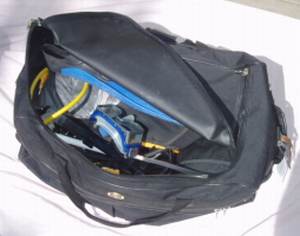
A little GREEN goes along way in helping you load that gear at your desination.
We fit our scuba diving mask,scuba diving fins,scuba diving wetsuits, BC's and alot of other stuff in the bag with no problem.
Scuba Regulator
While our regulator could easily fit in this bag, we usually pack them in our carryon. I don't like the idea of the regulator being thrown around, or worse, getting lost.
We pad the regulator with clothes and have never had a problem. Of course, remember it's in there before you throw that bag up in the overhead compartment. They sell special bags just for regulators if that makes you more comfortable.
A couple of times we did check our regulators for the return home trip in the big bag. We wrapped them in our skins/clothes and put them in the middle of the bag so they would have some cushion. It worked out fine but I'm more comfortable carrying it with me. My suggestion is to do the same.
Scuba Diving Computer
Besides being your best friend on a dive trip, your dive computer
is probably expensive too. This should always go on in your carry-on. This is one thing you don't want thrown around.
Our scuba diving computer has a plastic covering around it. We usually just put it in a Beer Can Koosy to cushion it and prevent scratches. I know, very high tech. But very economical keeps my beer cold after and dive and it works fine. The Beer Can (or bottle) neoprene covers work well on dive light heads as well.
If you can remove your dive battery, travel with the dive computer battery out of the computer. This way if there is a problem with the battery it doesn't ruin the computer. Plus there is no way the computer can turn on accidentally and waste the battery.
Scuba diving masks
Masks are durable and can take alot of beating. Sometimes if we need the room we'll wrap the mask in our wetsuit, or other piece of clothing to prevent scratches. My mask has a prescription lens so it ALWAYS travels in my carry-on. If the dive gear gets lost, I can rent gear. But my prescription mask is too important.
BC's BC's take up alot of room when you are packing scuba gear for flying. There is not much you can do with them. Just make sure all the air is out before packing it. We then fold the sides fairly tightly so it as small as possible.
We put the BC's in the bag first when packing our scuba gear for flying. It helps to cushion the other equipment.
Scuba Diving Fins Most dive bags have pockets on the sides for the fins. You can even put them in your carry on if you want to bend the tips a little. They straight out quickly.
Miscellaneous All the other things you may want to when packing your scuba gear for flying should fit easily into the nooks and crannies of your dive gear bag. We add slates, flashlights, extra batteries, dive knives, gloves, defogger, etc. with no problem. Camera Gear is another topic and we use separate baggage (sometimes even a cooler - which comes in handy during the trip for keeping your beer cold).
There you have it. One method of packing scuba gear for flying. We hope it helps you. When it seems like a chore, just think of all the fun ahead of you. It's bound to put a smile on your face.
So start packing your scuba gear for flying, get on the plane and go!






