Learn how to SUCCESSFULLY plan and write grants!
|  | Buy NOW
|
| The more you know... |  | Check out the classes and workshops offered by Janet at
Janet Levine Consulting |
|
| Greetings!
I turned 65 last month. Part of me is in denial-so much so that I still haven't registered for Medicare. The other part of me is defiant. Sixty-five-pshaw! So I announce my age and wait until I'm told that I certainly don't look 65. Which brings up other feelings: pride, distrust, and I channel Gloria Steinem and think, "But this is what 65 looks like." And then I wonder why it matters at all. registered for Medicare. The other part of me is defiant. Sixty-five-pshaw! So I announce my age and wait until I'm told that I certainly don't look 65. Which brings up other feelings: pride, distrust, and I channel Gloria Steinem and think, "But this is what 65 looks like." And then I wonder why it matters at all.
All of which makes me appear more insecure about my age than I think I am. I actually like this age. I really like that I have experiences on which to draw so that most situations-at least most situations involving fundraising, boards, and such-don't find me flatfooted. I have been there before.
I also hope that at the same time I am flexible and secure enough to continue looking at the world with eyes of wonder-always seeking to discover new things and different ways of approaching things.
Discovering new things and approaching old things in different ways, of course, is what nonprofits really need to do-especially as it relates to raising money.
What are the ways you've been fundraising? How can you build upon what you've been doing? What things should you be doing differently? What new things should you be adding? What things perhaps have grown stale and need to be retired or completely retrofitted?
Take a look at your donors. Who are your regular supporters? How and when do they give? Can you move them in new ways and-perhaps-excite them so much they make new, additional gifts or increase the amounts they have been giving? Who don't you have on your donor list? How can you involve them? What kinds of outreach do you need to do?
At 65 I see that the world is a very different place than it was when I was in my twenties, thirties. Heck, it is different this year than it was last. Despite change, some things remain. A few deservedly so, and those are the ones that should be nurtured. But embracing the new things-that's what makes 65 feel young. Learning new skills, doing things in new ways, seeing things in new light are all daunting. But they are what keeps us fresh and gives us the energy to go on. And it works at all ages.
So as somebody somewhere must have said: Honor your past, live in your present, embrace your future. And think what all this has to do with raising funds.
***************
Fundraising capacity not where you want it to be?
Need help in making Board members comfortable with fundraising?
Contact Janet Levine Consulting for a
free 30-minute meeting
|
|
Pressing Matters
5 Tips for getting media attention in an increasingly crowded NGO Marketplace
By Matthew King
Getting coverage in the mainstream press remains the best tool for raising awareness of your organization with the general public. Facebook posts and timely tweets are helpful, but a hit in the Los Angeles Times or "Eyewitness News" is the best way to validate the relevancy of your organization with the widest audience possible. It's called mass media for a reason. tool for raising awareness of your organization with the general public. Facebook posts and timely tweets are helpful, but a hit in the Los Angeles Times or "Eyewitness News" is the best way to validate the relevancy of your organization with the widest audience possible. It's called mass media for a reason.
However, traditional media outlets are shrinking -staffs, budgets, news holes, attention spans, you name it. Because there are fewer reporters to cover the growing number of worthy NGOs, the simple laws of supply and demand mean that it's harder to get noticed by the press. Having served for years as a newspaper editor and then later as the communications director for one of Southern California's most effective environmental nonprofits, I've developed some basic strategies you can employ to significantly increase your chances for media attention. Here are five of them:
Follow the money. Given the fragile state of the economy, people are understandably focused on money. Editors love stories  about the bottom line. Frame your programs and services in a way that shows you are having a positive fiscal impact. If you work to reduce high-school dropout rates, for example, show how your programs save taxpayer funds over the long term by reducing welfare rates. Do your homework and be able to provide specific dollar amounts. about the bottom line. Frame your programs and services in a way that shows you are having a positive fiscal impact. If you work to reduce high-school dropout rates, for example, show how your programs save taxpayer funds over the long term by reducing welfare rates. Do your homework and be able to provide specific dollar amounts.
Wear a white hat. Media outlets naturally gravitate to stories about conflicts, with clear winners and losers. Finding the villain worked for Shakespeare and it can work for you. Position your organization as the good guys doing noble deeds, locked in mortal combat against the guys in dark hats. Personify those individuals who stand in the way of your group achieving its mission - it could be indifferent watchdogs, industrial polluters or complacent school administrators. Readers need someone to cheer for, but it's just as important for them to have someone to root against.
Onward! Viewers are overwhelmed with so much bad news - social decay, bloodshed, corporate greed. We all feel better when we meet people who are working to improve our quality of life, and even better yet, succeeding. NGOs do a great job of spelling out problems and painting doom-and-gloom scenarios for the media, but many fail to show a clear path forward. Demonstrate to a reporter that you are making measurable progress in tackling the fundamental issues driving your mission. Celebrate one individual that is making a positive impact. Remember: Media like stories about people, not process.
Be specific. The press is still driven by the 5Ws: who, what, where, when and why. Media outlets generally aren't interested in doing a generic profile of your organization. They want news - something new and different that happens in a particular moment of time - the results of a study you commissioned, a call for volunteers to man an innovative, just-launched program, major financial support from a new and noteworthy donor, e.g. the Gates Foundation. Root your work in cinematic terms - invite reporters to come to a living, breathing event that embodies the spirit of your organization and exemplifies your work throughout the year.
Let others tell your story. Editors can smell "spin" a million miles away. No matter how effective you are framing your value proposition to media, it's ultimately more effective to let others do it for you. Connect media directly to those you are helping and to your partners. Their voices will ring more authentic to a reporter, more than any press release you prepare. miles away. No matter how effective you are framing your value proposition to media, it's ultimately more effective to let others do it for you. Connect media directly to those you are helping and to your partners. Their voices will ring more authentic to a reporter, more than any press release you prepare.
Since 1985, Heal the Bay has worked to make Southern California coastal waters and watersheds, including Santa Monica Bay, safe, healthy and clean. Learn how you can get involved at http://www.healthebay.org/get-involved
|
|
Oh No! Not Another Meeting
By Mitch Dorger
If the title of this article is how you and your board members feel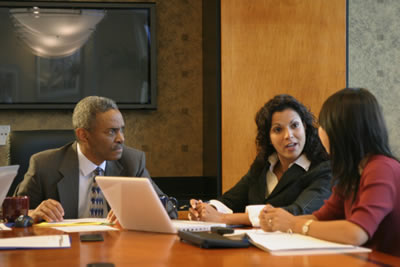 about meetings, then things are not being done well in the organization. Let's face it. Because the authority of the board is a collective one, boards have to have meetings. And in these meetings, they need to effectively interact with one another to make things happen for the organization. Unfortunately, I find that board meetings are often one of the biggest sore points for board members. Why is this? about meetings, then things are not being done well in the organization. Let's face it. Because the authority of the board is a collective one, boards have to have meetings. And in these meetings, they need to effectively interact with one another to make things happen for the organization. Unfortunately, I find that board meetings are often one of the biggest sore points for board members. Why is this?
Among the biggest reasons for poor board meetings are:
- Poor attendance by board members
- Lack of interest and engagement
- Inappropriate human relations in the meeting
- Lack of preparation
- Breaches of confidentiality
- Poor meeting control and management
- Wasted time
- Parliamentary foolishness
- Agonizing length
- Addressing unimportant topics
If any of these problems (or others) plague your board meetings, I want to recommend a simple model for thinking about future board meetings. For simplicity, I call it the "PME" system.
In the PME system, the "P" stands for plan. All board meetings should be well planned. This seems rather obvious, but what does this actually entail?
- Attendance. The first step in planning any meeting is determining the right people to be in the room. For a board meeting, this obviously includes all board members as well as the supporting staff necessary to properly inform the board or execute their decisions. To the extent possible, meetings should be planned well in advance. Scheduling in advance significantly increases the prospect that board members can adjust their other commitments to enable their attendance. You may also want to consider having a board attendance policy that makes it clear to board members the importance of meetings and their attendance. The repeated failure of a member to attend meetings may warrant removal from the board for that individual. Continued absence on the part of several board members is in indicative of much larger issues than just meeting management, and a thorough evaluation of causation should be undertaken.
- Time. The planned time for each meeting should be thought about in advance. This requires an understanding of the goal(s) of the meeting and the complexity of the topics. As a general practice, I like to use a 90-minute rule. My own personal experience is that you can hold people's attention for 90 to 120 minutes. After that, minds seem to numb a bit, and restlessness begins to develop in the group. That is not to say that in unusual circumstances meetings cannot be scheduled for longer, or run longer, I just find that group interactions are not as crisp and effective after the meeting has been going too long. If meeting are going to run beyond 90 minutes, plan breaks in the schedule to allow the members to refresh their minds.
- Topics. Effective planning involves the proper selection of topics. This task should not be left to staff assistants. This is something the board chair and the chief executive need to work on together. The board needs to address the right topics at the right time. An annual board work plan helps in this regard. The board should know what it plans to accomplish during a year and then periodically check to see that the right things are getting on the agenda. But agenda setting should not just be rote. The board chair and chief executive need to make sure that critical emerging issues for the organization are getting in front of the board. This requires thought and reflection on the part of those assembling the agenda. Another step in ensuring the right agenda topics is polling the board members to ensure that their issues are receiving appropriate attention. Don't let them feel disenfranchised by excluding their issues. If there are too many issues on the table -- as may well be the case for some meetings -- there needs to be a screening of topics. The board chair and chief executive should work together to ensure that the list of agenda topics contains the issues that are the most crucial for the board to address. Try not to let minor issues or issues not related to governance (read operational issues) intrude on the precious time of the board.
- Information. The final element of planning is assembling, in advance, the information that the board members need to make informed and rational decisions. Too many times boards will consider pop-up topics and then proceed to pool their ignorance on the matter before reaching a decision that may or may not be a good one. The effective board demands and receives the information it needs to consider the issues surrounding any upcoming decision. Pop-up issues may still happen but more often than not they can be avoided by good planning and preparation. As a matter of policy, board chairs should try to refer any pop-up matters to staff or a board committee for further consideration outside of the meeting rather than trying to decide a matter with insufficient background. (READ MORE)
|
Perfection

For years I've tried to no avail to learn another language. It isn't so much that I can't master the grammar or learn the vocabulary (though none of that comes easily to me) but rather because I wouldn't use what I knew. I wouldn't speak the language because I couldn't speak it well.
That was dumb. And I knew-know-it was (is) dumb. And yet I could not make myself speak it because everyone would know I wasn't perfect.
Perfection. Sigh. When I was a little girl I thought perfectionists were people who did things perfectly and I wanted desperately to do be perfect at something. I haven't completely outgrown that desperation-or the desire to do things without error. But I have learned that perfection is a pain-and it can also be a barrier to doing anything at all. Hence my mono-linguism, and perhaps, your organization's inability to actually fundraise.
Over the years, I've heard boards and staff tell me that they can't possibly fundraise yet because:
* We don't have an elevator speech.
* Our database is messed up.
* We don't actually have a database.
* No one knows who we are.
* Our website is embarrassing.
* We don't have any brochures.
* Name your favorite non-fundraising excuse.
In short, things aren't perfect so we can't possibly move forward and ask anyone to help us move our mission forward. And speaking of mission, have you noticed that no one ever says, "We can't ask anyone for money because we aren't doing good work"?
It seems to me, that if your mission is good and you are doing good work, you are perfectly situated to raise funds. Yes, you do need to let people know about you-but you really don't need fancy brochures. Databases are built over time and by themselves, don't actually fundraise for you. And an "elevator speech" is nothing more than a statement of your passion about your organization.
Good fundraising does rely on a strong database and great communications. But-to coin a cliché-every journey starts with a single step. Begin by identifying five people who you have reason to believe would support your organization. Find out if anyone on your board knows any of those five-and what size gift they think is reasonable as a first gift.
If you can convince your (fellow) board members to set up meetings with these five, you will probably get three to five meetings. If you can't, count on one. And each time someone is willing to join with you in supporting your organization, add that person to your database. More importantly, ask that person who else you could call on and, by the way, would they be willing to introduce you? Next, add another 5 potential prospects to your list.
Slowly, surely, you will develop that elevator speech. The more you tell others about your organization, the more you will understand what catches their attention and fans their flames of passion.
Your database will get filled with premier prospects and more and more people will know who you are. If you actually start fundraising, you will start to raise funds. And I ask you, what could be more perfect?
|

Have Your Say
Inquiring minds do want to know--what is on your mind?
Send me your article (200-2,000 words) on any topic of interest to those who work for or with nonprofit organizations. |
|
Are your fundraising results down? Board members bored? Or are thinking about a campaign? Whatever your capacity building needs, Janet Levine Consulting can help. Email or give me a call at 310-990-9151 to schedule a free 30-minute consultation.
|
|
|