| Greetings!
Hello, everyone!
I imagine you are all anxious for spring to arrive! We have daffodil sprouts in our front yard. A bit early, but we'll take it.
If your students are getting restless in your classroom, a sure-fire cure is to add more games and active-learning activities and lessons to your day. This ALWAYS worked for me! Keep your students so busy and engaged in your material that they don't have the time or the inclination to misbehave! My rule-of-thumb for this time of year is: Play at least one game per day!
Don't know how to set up games in your classroom so your students don't erupt into a herd of misbehavers? Keep reading for hints and even a Podcast on how to successfully set up games in the classroom!
|
Question from a Teacher: Grading Bellwork
|
Hi Marcia,
I have bought several of your units and LOVE them; so do my students! How do you grade bellwork? I am struggling with some ideas and wondering your thoughts!
ANSWER FROM MARCIA: I hand out a bellwork page on Monday and collect on Friday. Each day's bell is worth two points! Easy to grade 'cause it's a quick eye scan. I also hand out the Objectives page for each unit and they have to put the day's date by the ones we are covering that day. PLUS, I hand out the Homework page and collect each on Friday as well so each is worth two points per day, so 30 points total for Obj, Homework, and Bellwork. Works really well! When I had last period off, I would get them all done before I left Friday afternoon. Really keeps them alert at the beginning of each class! I tell them that it's the 30 easiest points they get all week!
|
Setting Up Classroom Games
|

I am here to tell you that playing a game a day in the science classroom is EASY and FUN! It doesn't have to be chaotic or out-of-control at all! This took me years to figure out, I will say. But once I had it figured out, I wished I'd known how for more years than I did. This is why I try to pass it forward!
So here's the skinny: You need to TRAIN your students in how to set up and take down for games. Each part (set-up and take-down) takes only one minute and I figured out a way to guarantee every class will do it perfectly every time! This means you can do a vocab review with partners or a team game with up to six students per team, and go back to a regular classroom activity with order and real learning taking place!
Email me to access a special Team Games Podcast download that talks about training students to play classroom team games. The download contains the Podcast with an actual training session with one of my classes and also a Team Game Directions and a Team Game Rewards.
I've also included two Transparencies with the "Rules" for Team and Pair Games. I recommend putting the appropriate one up for students to go over before you start.
The TRICK to a QUICK set-up and take-down in this:
Give them ONE MINUTE for each and take points away from any team not meeting your standard. If you do it in a friendly way, they will be fine with the penalty. I would always say something like, "Oh, golly, Red Team, you took a bit too long get back to your desks just now and I'll have to take one point off your Team Score for this unit. But don't worry! You can make that up next game, I'll just bet!" Works like a charm!

GET A TIMER! I used my timer every day. Giving kids a one-minute timed-task like getting set up for a game works every time if you've trained your students well. When it beeps be sure to notice aloud that everyone is where they need to be. If they all are, they KNOW they've done it right but it doesn't hurt to hear a quick acknowledgment from you!
Happy Team Games! (Click here for my Games web page.)
|
Making Scientific Instruments!
|
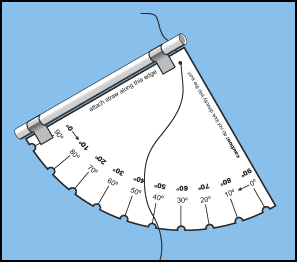 | |
Make Astrolabes
in your Classroom!
|
I believe in having your students make scientific instruments! I would always make sure at least one unit per year had an instrument-making activity. In fact, my students usually made several over the course of a year. My favorites are the Astrolabe and the Star Wheel. Check out my Astronomy page for great links and/or downloads for making and teaching both the Astrolabe and the Star Wheel. |




