| Featured Article |  | |
Tips for Improving Your Child's Speech - See article below! |
Join Our List

|
|
|
| April/May, 2011 | January/2011 |
Dear WPC Families,
Summer has finally arrived. School schedules are winding down and everyone is looking forward to enjoying the great outdoors. Call now to schedule you kindergarten/school physical! Avoid the rush! Once that's done, get out and enjoy the sun!
Your friends at Williamsville Peds |
| Fun in the Sun - Safely! |
Before you head to the beach or the pool, review these tips from the American Academy of Pediatrics (AAP) on sun exposure.
Babies under 6 months:
- The two main recommendations from the AAP to prevent sunburn are to avoid sun exposure, and to dress infants in lightweight long pants, long-sleeved shirts, and brimmed hats that shade the neck to prevent sunburn. However, when adequate clothing and shade are not available, parents can apply a minimal amount of suncreen with at least 15 SPF (sun protection factor) to small areas, such as the infant's face and the back of the hands. If an infant gets sunburn, apply cold compresses to the affected area.
For All Other Children:
- The first, and best, line of defense against harmful ultraviolet radiation (UVR) exposure is covering up. Wear a hat with a three-inch brim or a bill facing
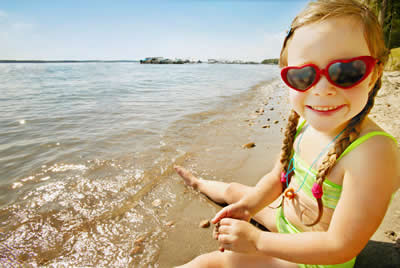 forward, sunglasses (look for sunglasses that provide 97% -100% protection against both UVA and UVB rays), and cotton clothing with a tight weave. forward, sunglasses (look for sunglasses that provide 97% -100% protection against both UVA and UVB rays), and cotton clothing with a tight weave. - Stay in the shade whenever possible, and limit sun exposure during the peak intensity hours - between 10 a.m. and 4 p.m.
- On both sunny and cloudy days use a sunscreen with an SPF of 15 or greater that protects against UVA and UVB rays.
- Be sure to apply enough sunscreen - about one ounce per sitting for a young adult.
- Reapply sunscreen every two hours, or after swimming or sweating.
- Use extra caution near water and sand (and even snow!) as they reflect UV rays and may result in sunburn more quickly.
|
| Summer Safety |
Summer is a time filled with fun, but also some unique dangers. On our website, we have information on the following topics:
Sun Safety
Pool Safety
Boating Safety
Open Water Swimming
Fireworks
Playground Safety
Bicycle Safety
ATV's
Scooter/Skateboard Safety
Lawnmower Safety |
| Tips for improving your childs speech this summer |
As the warm weather approaches we hope that you have many opportunities to have fun playing with your child outside. These informal play times are a great time to reinforce language skills. Some strategies you may want to try include:
Expanding your child's remarks:
Child: "swing" Parent: "do you want to swing?"
Adding to your child's remarks:
Child: "Truck there" Parent: "Yes, there's a big red truck"
Another good strategy is to talk about the here and now. It helps children to understand when you talk about things that can be seen. Talk out loud about what you are doing. Putting your thoughts and actions into words teaches your child about language. Using everyday events and routines helps reinforce language on a daily basis.
If you have any concerns regarding your child's speech or are looking for additional services to be provided for your child over the summer, please give us a call. We would be glad to talk with you about your concerns and possible services we could provide for your family.
For more information contact:
- Speech-language development - Cindy Stando, SLP 631-7503
- Hearing/Audiology - Anne Orsene, AuD 633-3344
|
| Car Seat Guidelines 2011 | |
One of the most important jobs you have as a parent is keeping your child safe when riding in a vehicle. Each year thousands of young children are killed or injured in car crashes. Proper use of car safety seats helps keep children safe. But with so many different car safety seats on the market, it's no wonder many parents find this overwhelming. You can find a summary of the guidelines on our website.
|
| Insect Repellents | |
There are so many insect repellents out there. What kind is best for my children?
Insect repellents come in many forms including aerosols, sprays, liquids, creams, and sticks. Some are made from chemicals and some have natural ingredients.
Keep in mind that insect repellents prevent bites from biting insects but not stinging insects. Biting insects include mosquitoes, ticks, fleas, chiggers, and biting flies. Stinging insects include bees, hornets, and wasps.
You can find a summary of the lastest recommendations on our website. |
| Meet Our Staff | |
Nancy Panzica, PNP

Nancy joined Williamsville Pediatric Center in January of 1994. She graduated from SUNY @ Buffalo with her Bachelor of Science in Nursing (Summa Cum Laude) in 1986. She then completed her Masters of Science in 1990. Nancy is board certified in pediatrics by the American Nursing Credentialing Committee.
Nancy lives in the Town of Tonawanda with her husband and two children. |
|
At Williamsville Pediatrics, we are proud to be designated as a "Patient Centered Medical Home" and are NCQA certified.
Our team of highly regarded Board-Certified Pediatricians and Nurse Practitioners are committed to providing exceptional health care for your children. Pediatrics is our passion - come grow with us! Located in Williamsville, a suburb of Buffalo, New York, Williamsville Pediatrics serves the Western New York pediatric needs of the communities of Williamsville, Clarence, East Amherst, Amherst, Depew, Lackawanna and beyond. It has been our pleasure to deliver acute and preventive pediatric care at the highest level since 1989. Nurse Practitioners are committed to providing exceptional health care for your children. Pediatrics is our passion - come grow with us! Located in Williamsville, a suburb of Buffalo, New York, Williamsville Pediatrics serves the Western New York pediatric needs of the communities of Williamsville, Clarence, East Amherst, Amherst, Depew, Lackawanna and beyond. It has been our pleasure to deliver acute and preventive pediatric care at the highest level since 1989.
Sincerely,
Williamsville Pediatric Center
|
|
|