|
Alkali-Silica Reaction Testing
and the Future
By: Lisa Mahr
Construction aggregate is the main ingredient in ready-mix concrete and asphalt concrete (AC). All aggregate used for construction purposes must be tested physically and chemically to verify its quality. In some cases, aggregates may be found to react with cement and be unsuitable for concrete uses unless additional measures are introduced to the concrete mixing process. Identifying reactive aggregates using the American Society for Testing Materials (ASTM) standards is one of the first steps in identifying a high-quality aggregate source for Portland cement concrete (PCC).
The ASTM International Committee meeting took place in San Diego in late June 2012. Professionals from all over the country convened to discuss currently accepted testing methods and new testing possibilities. I had the pleasure of attending this year. Alkali-silica reaction (ASR) testing was a hot topic.
Alkali-silica reaction (ASR) is caused by a response between the hydroxyl ions in the alkaline cement pore solution in concrete, and reactive forms of silica in the aggregate (e.g., chert, quartzite, opal, strained quartz crystals). This response creates a gel, which increases the volume of the materials in the blend and exerts expansive pressure. This reaction occurs over time (as the concrete is hardening) and results in the weakening of the bond between cement and aggregates. The reaction can be readily identified through 'map cracking' when the concrete has not been reinforced.
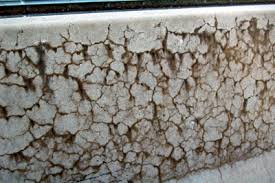
ASR is important because it can cause serious expansion and cracking in concrete. This results in major structural problems and sometimes necessitates demolition. Identifying ASR in a rock deposit is a vital step in identifying Portland Cement Concrete (PCC) grade aggregate. PCC aggregates have the highest value due to their suitability for use with concrete mixes, as well as a variety of other aggregate end products (e.g., asphaltic concrete, base materials, etc.).
Although ASR is a major concern with aggregate suitability for PCC applications, there are a number of methods to reduce or eliminate its damaging effects. A number of pozolanic cement substitutes can be used to counteract the reactive qualities of some aggregates. Some examples include fly ash, slag, silica fume, and pumice. These admixtures can be added to the concrete blend and may add to the cementitious qualities of the blend. The majority of these admixtures can also be used to reduce the overall cost of the concrete because the cost of production for fly ash (as an example) is less than the cost of cement.
Fly ash is the most common ASR treatment admixture found in use around the country. It is a concrete admixture that inhibits alkali-aggregate reaction, and enhances sulfate resistance. However, the use of fly ash is not without problems. Fly ash is one of the residues generated in the combustion of coal, and is classified by ASTM C618 as Class N, Class F, or Class C. Class N fly ash is considered raw or calcined natural pozzolans and generally contains more impurities that are considered health hazards which restrict its use. Class F is created through the burning of harder,older anthracite and bituminous coal. Class F usually contains less than 10% lime. Class C is created through the burning of younger lignite or subbituminous coal and contains up to 30% lime. Due to environmental, health, and safety concerns fly ash as a partial replacement for portland cement is generally limited to Class F fly ashes. With environmental concerns rising, coal is being replaced by other forms of energy. These restraints make fly ash more challenging to obtain.
ASR has become noticeably more problematic due to the stringent concrete requirements for transportation projects and the reduction of fly ash availability. The currently accepted ASTM tests for ASR are questioned by industry due to inaccurate results and pressing time limits.
ASTM C1260 and ASTM C1293 are among the most widely used methods to test for ASR. ASTM C1260 is the standard test method for potential alkali reactivity of aggregates, otherwise known as the "Mortar-Bar Method". This test is used because it can be performed in as little as 16 days but, it does not evaluate combinations of aggregates with cementitious materials, and the test conditions are not representative of those encountered by concrete in the field.
ASTM C1293 is the standard test method for determination of length change of concrete due to alkali-silica reaction, otherwise known as the "Concrete Prism Test". This test is the preferred method; however, it does not address the general suitability of pozzolans or slag for use in concrete, and it takes an entire year to get the results.
Although these tests are in standard use, problems with inaccuracies of the results have made these methods questionable and more difficult to rely on. Due to time constraints, many operators will use the 16 day (C1260) method over C1293, which takes an entire year. The problem with C1260 is that it does not accurately demonstrate how the concrete will react in the field. As a result many deposits are listed reactive when, in reality, they are not. This is a huge problem because these deposits cannot be used for PCC, and the only other test method that can dispute those results takes an entire year to perform.
Research conducted at the University of Texas is directed at the development of a testing procedure that reduce the time required to identify ASR with greater accuracy over current methods. This improved testing method uses concrete prisms similar to those used in ASTM C1293. These prisms are subjected to a saturated steam environment for 24 hours using commercially-available equipment. The test takes a total of four days from mixing of the concrete to the final expansion measurement. Not only is this test faster, but it also provides results that are similar to current ASR testing standards.
The first phase of testing included two non-reactive and three benchmark highly reactive aggregates from the southwestern United States. The two non-reactive aggregates consistently exhibited a minimal amount of expansion, while the three reactive aggregates exhibited expansions similar to those produced in ASTM C1293. The second phase of the project consisted of six additional aggregates of varying reactivity and mineralogy from across North America, some of which are incorrectly classified by ASTM C1260 or ASTM C1293.
Although this testing method is still in its beginning stages of development, the results appear to be positive. Within the next 5 years, the construction industry may have a more accurate and rapid way to test for ASR.
|