|
|
|
|
| Delaware Humanities Forum | June 2010 Newsletter |
|
|
|
|
Greetings!
As we approach the 4th of July (colloquially, what Americans call Independence Day) all things red, white and blue spring to mind. The humanities scholar is prone to analyzing and interpreting everything, so DHF is pleased to peel away the surface of a few American traditions: the Pledge of Allegiance, patriotic songs and Independence Day celebrations. We hope to give you something to think about as the last firecracker fades away, the last slice of apple pie is eaten and the hand-held flag is stored away for another year.
COMING UP: Mark your calendars! DHF's next Grant Application Writing Workshop will take place at a New Castle County location on Thursday, July 29th from 2-4pm. More details to follow in our next issue.
ALSO: School's out for the summer, but we have some homework for you to do in preparation for next month's e-newsletter. Take a visit to your grandmother's sewing box, your mother's attic or your nearest flea market; while you're there, see if you can find any mother-of-pearl shell buttons. We will be talking about them next month.
Marilyn P. Whittington
Executive Director |
|
Pentagon on September 11, 2002 by Johnny Bivera USN (DOD Photo 020911-N-2383B-604) | Hapax Legomenon
Linguistic Obfuscation and Patriotism
Flag Day just passed, and Independence Day beckons. Patriotism is a timely subject for this reason, and it's also timely because DHF has turned its focus this year on "civic discourse." Shining a humanities spotlight on patriotism allows discourse on the subject to be civil (and the subject can surely get heated in these politically-turbulent times), and DHF is more than happy to get readers' cogs turning on the subject.
It can be said that the most basic display of patriotism is the recitation of the Pledge of Allegiance. Following is a linguistic analysis of the Pledge of Allegiance that may shed light on a new interpretation of this tradition.
On March 30, 2010, NPR printed an article by linguist Geoff Nunberg called, "I Pledge Allegiance To Linguistic Obfuscation." In the article, Nunberg said, "Obscurity has been built into the [P]ledge [of Allegiance] since Francis Bellamy created it in 1892...to rouse the patriotic attachments of schoolchildren, particularly the recent immigrants who might need extra encouragement." He goes on to theorize that Americans have managed to keep the words contained within the Pledge of Allegiance from meaning anything at all.
This statement is not a judgment of people's patriotism or complacency; it is an observation that several words and phrases within the Pledge run the gamut from arcane to mystifying. He adds: "In fact, 'pledge allegiance' is what linguists call a hapax legomenon, or hapax for short -- an expression that only occurs in a single place in the language, like wardrobe malfunction, Corinthian leather or satisfactual. Or let's not leave out my favorite, ginchiest. People don't pledge allegiance to Hadassah or the U.S. Marines or Kappa Kappa Gamma, much less to other inanimate objects. We only use the words when we're either quoting the flag pledge or riffing on it. So there's no independent reference point, no way to know what you've just signed on for that you weren't down for already."
It is fascinating to hear that the phrase "one nation under God" is said to have been inserted by Congress into the Pledge of Allegiance at the height of the Cold War in 1954, ostensibly "to underscore the difference between American values and those of the atheistic Communists." Nunberg proposes that its actual meaning is unclear. He asks, "Does it affirm our faith in God or assert that we have his special protection? Is it a ceremonial deist formula with no especial religious character? Or is it merely a historical nod to the beliefs of the founders?" He says that "one nation under God" is a hapax legomenon that doesn't occur anywhere else in modern English. It is said that the words were taken from the Gettysburg Address ("this nation, under God, shall have a new birth of freedom"), but Nunberg points out that "under God" did not modify "this nation" but instead modified the latter part of the phrase. He adds that in Lincoln's time, "under God" was a euphemism for "with God's help" or "the Lord willing" that circumvented the incidence of taking the name in vain.
Nunberg makes some further suppositions, such as what Lincoln's attitude toward the phrase in question and the pledge might have been, and calls the whole pledge "just one big hapax legomenon, a string of syllables that only comes to life in classrooms and school assemblies." Ultimately, though, he contends that the meaning of the words is not as important as the bond the pledge creates between impressionable children and their flag and country -- and there's a difference between saying or analyzing the words and incanting them.
Follow this link to read the entire article.
|
|
...And Speaking of Hapax Legomenon
 Patriotic Songs Patriotic Songs
If a hapax legomenon is an expression that only occurs in a single place in the language, then the world of music may be ground zero for this marvelous incarnation of the English language. Syntax is easily set aside in favor of rhythm and poetic license, and nowhere is this more obvious than in "traditional" songs.
Check out the link below for a list of patriotic American songs. From "purple mountains majesty" to "Yankee Doodle," the hapax abounds.
|
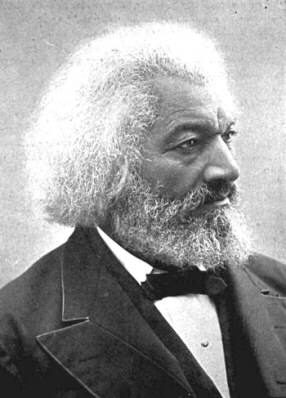 4th of July and American Slavery 4th of July and American Slavery
Frederick Douglass' Famous 1852 Speech
Frederick Douglass, a former slave himself who became a leader in the 19th Century Abolitionist Movement, gave in 1852 a now-famous Independence Day speech known as either "What to the Slave Is the 4th of July?" or "The Meaning of July Fourth for the Negro." The speech, given in Rochester at an event commemorating the signing of the Declaration of Independence, consisted of 16 paragraphs, concluding with a poem. It is unapologetically biting, and bridges a strong connection between the 21st Century reader and the 19th Century speaker.
Following are some highlights; click the link at the bottom to see the entire speech.
"This Fourth of July is yours, not mine. You may rejoice, I must mourn." "Do you mean, citizens, to mock me, by asking me to speak to-day?" "What, to the American slave, is your 4th of July? I answer; a day that reveals to him, more than all other days in the year, the gross injustice and cruelty to which he is the constant victim. To him, your celebration is a sham; your boasted liberty, an unholy license; your national greatness, swelling vanity; your sound of rejoicing are empty and heartless; your denunciation of tyrants brass fronted impudence; your shout of liberty and equality, hollow mockery; your prayers and hymns, your sermons and thanks-givings, with all your religious parade and solemnity, are to him, mere bombast, fraud, deception, impiety, and hypocrisy -- a thin veil to cover up crimes which would disgrace a nation of savages. There is not a nation on the earth guilty of practices more shocking and bloody than are the people of the United States, at this very hour."
DHF encourages you to visit the links below for more information and for the full speech.
|
|
|
Cinco de Mayo is not Mexico's Independence Day, which is actually September 16th. |
|
The Delaware Humanities Forum has offered programs that connect people, cultures and ideas for over 35 years. Through literature, art history, material culture, philosophy, civic discourse and other humanities disciplines, DHF helps citizens, scholars and nonprofit organizations accumulate a balanced body of knowledge about Delaware, making it available to the public now and in perpetuity. In 2010 we are pleased to turn the focus on Delaware's industrial history, to safeguard the history of the workers, structures and products that are critical to understanding the culture of the First State.
Please consider becoming a Friend of the Forum today by contributing to our Annual Fund. Friends of the Forum are the first to find out about opportunities, such as our Humanities Salons, and through the generous support of our Friends, the Forum offers nearly all of our programs free of charge to the citizens of Delaware.
Your donation in any amount will be most appreciated and wisely used. Click here to make a donation online today. | |
|
|
About the Delaware Humanities Forum
The humanities-subjects which include literature, ethics, political science and history-help people make a connection between their own lives and other people, cultures, and ideas. Through grants and public program offerings, the Delaware Humanities Forum builds bridges to connect the daily life and work of people to the universe of human experience, thought, and imagination. The Forum brings the public together with cultural, educational, and civic institutions statewide, and focuses on issues of public interest and concern.
As a state division of the National Endowment for the Humanities, the Delaware Humanities Forum supports organizations by awarding grants and implementing project initiatives such as lectures, symposia, exhibitions, classroom programs, and media projects. Your non-profit organization, school, library, or government agency may qualify for funding from the Forum and can obtain subject matter experts for lectures and presentations. To learn more about funding opportunities and the other resources available through the Delaware Humanities Forum, visit our website at http://www.dhf.org or call 302.657.0650 or toll free 800.752.2060. | |
|




