| International Peace & Security Institute |
|
PEACE & SECURITY REPORT
IPSI's Peace & Security Report (PSR) is a concise weekly e-publication intended to brief busy students, academics, advocates, and practitioners in the conflict management community on pertinent global news, events, and trends. Meticulously researched and written by IPSI, the PSR empowers us all to take a step back from our immediate deadlines each Friday and gain a greater understanding of the week's global events.
|
|
Featured Article
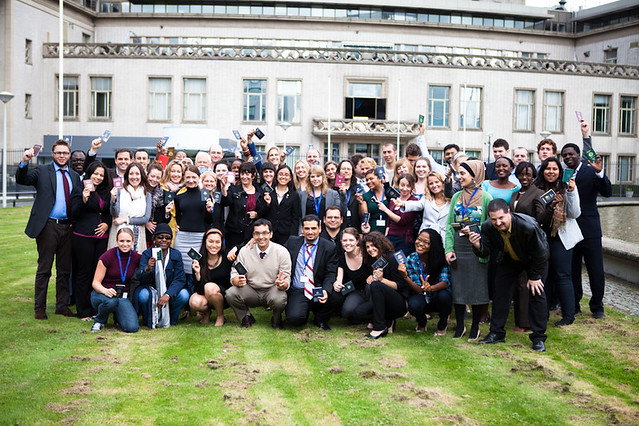
The Hague Symposium Week Two! IPSI Participants at the ICTY. Click on the photo above for a complete slideshow of Symposium photos. In the second week of the inaugural The Hague Symposium on Post-Conflict Transitions & International Justice, the participants used what they learned in week one to explore three case studies in-depth. Juan Mendez presented on Argentina, Charles Villa-Vicencio spoke about South Africa, and Bill Stuebner and Ambassador Jacques Paul Klein discussed the Former Yugoslavia. A week highlight was the site visit to the ICTY, where the group was briefed on outreach and witness/victim protection. Catch-up on this week's events:
As always, you can read all about The Hague Symposium by visiting the event webpage. |
Africa
ETHIOPIA: Ethnic clashes kill 18 in southern Ethiopia
Violent fighting between two communities in southern Ethiopia erupted last Thursday over a land dispute in an area about a mile from the Kenyan border. According to the Kenya Red Cross Society (KRCS), the battle resulted from the Ethiopian government's decision to settle the Garri community on land claimed by the Borana community. The clash resulted in at least 18 deaths and 20,000 refugees fleeing into Kenya. Comment: Millions of people are still reliant on food aid following the severe drought in the region in 2011. Heavily armed pastoralist communities regularly clash over land, water, and cattle in the remote borderlands. Earlier this year, more than 200,000 Kenyans fled into Ethiopia following deadly clashes between two warring tribes in northern Kenya. (AFP, Reuters, Sudan Tribune)
MALI: Interim president returns and outlines steps to end crisis
On Friday, Interim President Dioncounda Traore returned to Mali after a two-month medical treatment stay in Paris, recovering from injuries inflicted by protesters over the extension of his ruling mandate. He addressed the nation on Sunday and set the tone towards political transition in Mali. Traore said he will lead talks to form a unity government in Mali while creating a committee to open a dialogue with the Islamists in the north. Comment: Following the March coup of this year, the Tuareg rebel and Islamist militant groups capitalized from the chaos by forming a tentative alliance in the north, which has since collapsed. The Islamists now control Timbuktu, Gao and Kidal - all three of the region's major cities. (Al Jazeera, All Africa, BBC News, Daily Guide Ghana)
SOMALIA: Leaders back new constitution
On Wednesday, Somalia's National Constituent Assembly overwhelmingly backed a Provisional Constitution, paving the way for a new government to be elected later this month. The leaders passed the new constitution with a vote count of 621 in favor, 13 against, and 11 in abstention. Two suicide bombers attempted to enter the venue before the vote, and at least one detonated explosives during a clash with security forces injuring several officers. Comment: After decades of on-going warfare, Somalia is currently undergoing a peace and national reconciliation process, implementing the so-called Roadmap for the End of Transition in Somalia devised in September of last year. The constitution is integral to the process, as it is supposed to provide a legal framework to govern the new Somali Federal Institutions after August 20. (All Africa, BBC News, VOA News)
|
Americas
BELIZE/GUATEMALA: OAS hosts border dispute meeting
The Organization of American States (OAS) will host a meeting this week with Belizean and Guatemalan government officials in Washington, DC to find a solution to the border conflict. On July 20, the Belize Defense Forces and three Guatemalan citizens clashed on the border, resulting in the death of one Guatemalan. The other two Guatemalans were charged with illegal entry and logging in a protected national park. Comment: The OAS released a statement: "The events of the past week emphasize the urgency to finding a permanent and peaceful solution to the centuries-old territorial dispute between Belize and Guatemala and thus the importance of submitting the referendum to the International Court of Justice for final settlement." (Caribbean 360, Amandala, 7 News Belize)
BOLIVIA: Local protests and conflicts widespread
Various municipalities across Bolivia experienced more acts of protest this month, including the seizure of a gas plant, the blocking of major roadways, and the kidnapping of a government official. The gas plant in Caranda was paralyzed on Monday by 200 workers protesting in the region, losing an estimated USD 130,000 to USD 140,000 a day when not in operation. The protestors took the plant to negotiate the release of Ángel Nina Choque (a leader in jail), to gain more paved roads and electricity in the region, and to denounce Mayor René Vega. In Challapata, parked vehicles blocked major intersections for more than 24 hours on Monday to attract attention to their call for increased electricity and gas availability, the dredging of a dam, and other demands. Additionally, Julia Quisbert, the alternate deputy of the Movement Towards Socialism (MAS) was released after four days of confinement in the San Buenaventura municipality because of her role in freezing municipality accounts. The account funds were suspended in response to reported irregularities in the appointment of deputy mayor. MAS deputies presented criminal complaints in La Paz for crimes of kidnapping, harassment and political intimidation against the Buenaventura councilors. Comment: Although the context for each incident is unique, protest movements in Bolivia over natural resources and politics are common. A recent example of conflict over resources is the TIPNIS marches over the construction of a highway through indigenous lands. (Los Tiempos, Jornada Net, La Razon )
MEXICO: Attacks on journalists persist
On Sunday, the offices of El Notre newspaper in San Pedro Garza Garcia, Nuevo León, were lit on fire by three hooded men. The men brought guns and gasoline to light the offices on fire, but no major injuries were reported. This is the third attack on the newspaper offices in nineteen days. A security camera caught a police patrol passing in front of the burning offices while the criminals were still in sight, and although it slowed down at the sight of the fire, it did not pursue the men. The Inter-American Press Society condemned the violence and reiterated anger at the lack of even minimal protection and security for press members, and demanded an investigation of this crime along with the inaction of the present patrol officer. Comment: Mexico is considered a highly dangerous country to be a journalist due to the prevalence of assaults against journalists and media outlets. Organized gangs are linked to the killings of journalists covering drug-trafficking and human rights issues. Intimidation tactics are also used to promote self-censorship amongst journalists. (El Economista, Vanguardia, SDP Noticias, El Siglo de Torreon)
|
East Asia
PHILIPPINES: Government receives bids for oil exploration in disputed waters
The Philippine government received bids for oil and gas exploration in the South China Sea from several oil conglomerates on Tuesday, deepening the diplomatic rift between the Philippines and China. The decision prompted an official statement from Chinese authorities urging "the Philippine side to immediately withdraw the bidding offer in areas 3 and 4, [and] refrain from any action that infringes on China's sovereignty rights." Although several Philippine companies placed bids, the world's largest international energy companies were notably absent given the sensitive political nature of the territory in question. Energy Undersecretary Jose Layug Jr. dismissed the controversy, saying that "These areas are clearly within the sovereign rights of the Philippines," and noted that they lie over 800 kilometers from the nearest Chinese coast. Comment: Parts of the South China Sea are claimed by six different countries. The region is widely believed to contain large reserves of petroleum and natural gas, and is a major shipping route through which over half of maritime trade tonnage passes annually. (Jakarta Post, Reuters, Bloomberg, Business Week, People's Daily)
THAILAND: Insurgent attacks escalate in southern provinces
Suspected Islamic militants ambushed and killed four Thai soldiers patrolling the southern province of Pattani on Saturday. The soldiers, who were returning to their compound on motorbikes, were fired upon by men from the back of two moving pickup trucks. The attack comes on the heels of a bombing in the neighboring province of Yala, which killed five police officers on Wednesday, and the bombing of a Pattani hotel on Tuesday, which left an undisclosed number of people wounded. In response to the increasing violence, Prime Minister Yingluck Shinawatra announced the establishment of a new counter-insurgency intelligence command center which would oversee intelligence efforts to uproot the insurgency. Comment: Southern Thailand has been the site of a violent insurgency for over eight years, and continuing violence in the region has left an estimated 5,000 people dead. Despite the intensity of the conflict, the demands and leadership of the insurgency remain largely unclear. (Irrawaddy, Bangkok Post, Inquirer, Montreal Gazette)
FIJI: Diplomatic relations to be restored with Australia, New Zealand
Australia and New Zealand announced the restoration of diplomatic relations with Fiji following a meeting between government officials from the three countries in Sydney on Monday. Australian Foreign Minister Bob Carr and Australian Council of Trade Unions President Ged Kearney reiterated that while travel sanctions imposed on Fijian military personnel would remain in place, restrictions on civilians would be eased "to send a message to the military regime that Fiji's future rests in its civilian population, not the undemocratic military." Comment: Australia expelled Fiji's chief diplomat in 2009 after Fiji's military government similarly dismissed Australian high commissioner James Batley. The two countries have had strained diplomatic relations since a military coup led by Fijian Commodore Frank Bainmarama assumed control of the island's government in 2006. (Washington Post, Sydney Morning Herald, Australian)
|
| Europe & Central Asia
GREECE: Greece multiplies border patrols for anticipated Syrian immigrants
1,800 additional officers were ordered along the Greek border this week in response to the potential surge of Syrian refugees. Within the European Union, Greece is the most used entry point for illegal immigrants. This surge quadruples the number of guards in the area. The Grecian government is under pressure to crack down on illegal immigration, especially since the country is struggling economically and maintains a unemployment rate of 20 percent. The increased security is being criticized as new immigrant detention centers have not yet been built. General Secretary Constantine Arzoumanidis stated, "Without other parts of the program in place the presence of police along the border does not act as a deterrent. It acts as a magnet. Immigrants know they give themselves up to the police at the border, and because of the detention space, in a few days they will be free in Athens." Comment: Local police registered 8,800 migrants crossing the Evros in 2009; 47,000 in 2010; and 55,000 in 2011. Many Greeks blame high crime rates on illegal immigrants. (Huffington Post, AP, Digital Journal, Economist)
SPAIN: Al-Qaeda trio arrested in southern Spain
Spanish police arrested three alleged al-Qaeda members, suspected of planning attacks in Spain or Europe, in Andalusia on Thursday. The suspects were found with poison and enough explosives to blow up a bus. Two are Chechens and one is a Turk. The two Chechens were arrested while carrying documents about piloting light planes. One of the arrested suspects is reportedly a senior al-Qaeda operative, although the names of the detained are not yet released. Comment: Spanish Interior Minister Jorge Fernandez Diaz stated this was "one of the biggest terrorism investigations ever," with "international ramifications," and intelligence services from "Spain's allies" involved. (SBS, BBC, Aljazeera)
ROMANIA: President Basescu suspended from office
On Thursday, Romania's constitutional court suspended President Traian Basescu from office until the ruling on the validity of the referendum to impeach him takes place on September 12. The court needs to verify registered voter numbers with official census figures to determine if the referendum failed due to insufficient turnout. More than half of the electorate needed to vote, but according to election commission figures only 46.24 percent turned out. According to a motion filed against the referendum results, the number of Romanians decreased by two million since the last count. Comment: Leftist Prime Minister Victor Ponta's cabinet launched the impeachment campaign against President Basescu over allegations that he overstepped his power in the presidential office. The impeachment raises concerns over the strength of Romanian democratic institutions. (Euro News, Europe Online Magazine, Financial Times)
|
Middle East & North Africa
IRAQ: Suicide car bombs in Karradah
Two consecutive car suicide bomb explosions killed 21 and wounded at least 47 in the Shi'ite majority shopping district of Karradah neighborhood in Baghdad on Tuesday. The first bomb attack exploded outside the emergency police's headquarters, while the second followed minutes later outside an Iraqi passport office. Iraqi police stopped three assailants trying to attack the nearby Interior Ministry major crimes unit headquarters. The attackers attempted to free detained suspects being held there, according to AP news. Comment: While no group has claimed responsibility for the most recent attacks, the car bombings coincide with al-Qaeda's (AQ) previous announcement that they were commencing a new military campaign to retake territory. The twin car bombings came the same day Iraqi officials announced new safety measures within the country, which include an initiative to curb smuggling and drug trafficking between Iran and Iraq and warning the Iranian exile group Mujahedeen-e-Khalq to move from Camp Ashraf to a refugee camp in the outskirts of Baghdad. (AP, Al Jazeera, AFP)
SYRIA: Aleppo violence continues
Fighting over the critical city of Aleppo continues after 12 days, as the United Nations mission observers reported government fighter jets commencing in an aerial bombardment while opposition fighters claim that government fighters have been force to retreat from areas of the city. UN mission spokeswoman Sausan Ghosheh reported the UN had confirmation that rebels now have heavy weapons of their own, including tanks. On Wednesday, in a written messaged that did not give away his location, President Assad encouraged pro-government troops to continue fighting for the city that would determine the fate of his country and praised them for confronting "criminal terrorist gangs." Comment: According to a report from Amnesty International on Tuesday, many demonstrators and bystanders in Aleppo have been shot dead and hundreds have been injured by security forces and government militia. Arab League secretary-general Nabil Elaraby quoted on Wednesday, "The massacres that are happening in Aleppo and other places in Syira amount to war crimes that are punishable under international law." (Al Jazeera, Reuters, Al Jazeera, BBC)
YEMEN: 15 killed in Sanaa
On Tuesday, an estimated 15 were killed and 40 people wounded after clashes between armed tribesmen loyal to former president Ali Abdullah Saleh and police erupted near the Yemeni interior ministry in the capital. The assailants, who previously worked unofficially in the police department, started demanding they be enrolled in the police force and surrounding the ministry's headquarters on Sunday. The tribesmen reported that they were promised jobs by Mohammed Abdullah al-Qawsi in exchange for siding alongside Saleh, but Qawsi was removed from his position by President Abdrabuh Mansur Hadi in May. Comment: The confrontation highlights the continued instability five months after Saleh was replaced in order to end political upheaval that weakened government control in parts in the country.
(Al Jazeera, Reuters, Yemen Times)
|
| South Asia
AFGHANISTAN: Report challenges feasibility of US reconstruction projects
The Special Inspector General for Afghanistan Reconstruction (SIGAR) - a U.S government agency charged with the oversight of Afghan reconstruction projects - issued a report on Monday stating that many planned infrastructure projects have not begun, calling into question the possibility of a weak Afghan government capable of sustaining such projects. The U.S Embassy in Kabul issued a statement calling the report 'speculative,' while a military official called it 'premature.' Comment: Two years ago, the Pentagon and the State Department undertook an initiative to spend millions for infrastructure projects in Afghanistan in an effort to garner support from the Afghan people. The two agencies were able to secure $400 million USD from Congress to pursue this initiative, which was considered a vital military strategy against the Taliban insurgency. (Washington Post, New York Times, Sydney Morning Herald)
INDIA: Country suffers a blackout Power has been restored in India after a prolonged two-day blackout. Three of India's five transmission grids collapsed on Tuesday, leaving 670 million people, more than half the population, without power. It is not clear what sparked the massive failures; however, the central government has accused state governments of taking more than their allotted share of electricity from the grids, which disrupts the distribution of power. The government has been unable to deliver the high demand for electricity by a population that is quickly becoming energy hungry, thus, leading to calls for reform in the power sector. Comment: The Confederation of Indian Industry said the outages cost businesses hundreds of millions of dollars, although they did not affect the financial center of Mumbai and the powerhouse cities of Bangalore and Hyderabad. India relies on coal for more than half its power generation, and the coal supply is under a near state monopoly widely considered to be in shambles. The power deficit was worsened this year by a weak monsoon that lowered hydroelectric generation and kept temperatures in the region higher with many keeping air conditioners and fans running longer. (Reuters, Al-Jazeera, New York Times)
INDIA: Four blasts in the city of Pune On Wednesday, four low intensity blasts hit the city of Pune, injuring one person. The explosions occurred on the day of a scheduled visit by the newly appointed home minister Sushilkumar Shinde to the city, targeting a busy restaurant and shopping area. National security and forensic teams are investigating possible terror links to the blasts. Comment: This is the worst attack on Indian soil since the 2008 Mumbai attacks carried out by Pakistan-based militants that claimed 166 lives. In 2010, Pune was the site of a major bombing that led to 17 deaths and injured dozens. On Thursday, the Indian Mujahideen (IM), a homegrown terrorist group, emerged as the prime suspects. (BBC, Times of India, AFP, Hindustan Times)
|
|
|
|
|
IPSI News

The 2012 The Hague Symposium on Post-Conflict Transitions & International Justice is currently underway!
Learn more here >> ___________________ |
IPSI News

IPSI Advisor Gareth Evans writes the following Op-ed: "Calming the South China Sea" ___________________ |
IPSI Leadership
Cameron M. Chisholm Dr. I. William Zartman
Dr. P. Terrence Hopmann
Alexander Little
George Foote
Pamela Aall
Ahmedou Ould-Abdallah
Betty Bigombe Dr. Francis Deng
Jan Eliasson
Gareth Evans
Dr. Ted Robert Gurr
Amb. Jacques Paul Klein
Peter Kyle
Dr. Jean Paul Lederach
Jeffrey Mapendere
John Marks
Susan Collin Marks
Dr. Joyce Neu Dr. Valerie Rosoux
William Stuebner
Dr. Ruth Wedgwood Dr. Craig Zelizer About Us >> ___________________ |
|