| International Peace & Security Institute |
|
PEACE & SECURITY REPORT
IPSI's Peace & Security Report (PSR) is a concise weekly e-publication intended to keep busy students, academics, advocates, and practitioners in the conflict management community briefed on pertinent global news, events, and trends. Meticulously researched and written by IPSI, the PSR empowers us all to take a step back from our immediate deadlines each Friday and gain a greater understanding of the week's global events. |
|
| Featured Article
International Crisis Group

Nearly a year after the crackdown on anti-establishment demonstrations, Thailand is preparing for a general election. Despite government efforts to suppress the Red Shirt movement, support remains strong and the deep political divide has not gone away. Prime Minister Abhisit Vejjajiva's roadmap for reconciliation has led almost nowhere. Although there have been amateurish bomb attacks carried out by angry Red Shirts since the crackdown, fears of an underground battle have not materialised.
On the other side, the Yellow Shirts have stepped up their nationalist campaigns against the Democrat Party-led government that their earlier rallies had helped bring to power. They are now claiming elections are useless in "dirty" politics and urging Thais to refuse to vote for any of the political parties. Even if the elections are free, fair and peaceful, it will still be a challenge for all sides to accept the results. If another coalition is pushed together under pressure from the royalist establishment, it will be a rallying cry for renewed mass protests by the Red Shirts that could plunge Thailand into more violent confrontation. READ FULL REPORT >> |
Africa
IVORY COAST: President Alassane Ouattara discusses his plans for Ivory Coast
In his first news conference since Gbabgo's arrest, President Alassane Ouattara outlined his plans for Ivory Coast this Wednesday. The President promised to develop a Truth and Reconciliation Commission (TRC) to shed light on all crimes and human rights abuses, and bring to justice all those responsible for atrocities. Ouattara will seek International Criminal Court (ICC) investigations into the massacres which occurred throughout the political crisis; he added Gbabgo should face criminal charges at the ICC. He will also form a new republican army, resume cocoa exports, and reopen banks that have been shut for months. Comment: The Security Council commended the President's call for justice and reconciliation, as well as his decision to establish a TRC. The Council encouraged Ouattara to form an all-inclusive, broad-based government. (CNN, Reuters, UN News)
NIGERIA: Ruling party loses political ground
This week, voting results show Nigeria's ruling party, the People's Democratic Party's (PDP), will win a majority of seats in the national assembly, but not of the size that allowed it to dominate since army rule ended in 1999. The PDP party lost to the Action Congress of Nigeria (ACN) in the southwest and to the Congress for Progressive Change (CPC) in the north, although results have yet to emerge from many states. Comment: Millions voted in last Saturday's election, which is hailed as one of the fairest and most transparent in decades. Many hope the commitment to fair elections will continue into the presidential elections this Saturday. (BBC, Aljazeera, Reuters)
SUDAN: Clashes erupt as peace talks stall in Darfur
The largest rebel group in Darfur, the Justice and Equality Movement (JEM), suspended peace talks last Tuesday with the Sudanese government in Khartoum. JEM is objecting to the government's decision to hold a referendum on the administrative status of Darfur. The other rebel group participating in the peace talks, the Liberation and Equality Movement (LJM) will continue with the negotiations. Comment: Days after peace talks stalled, fighting erupted between government forces and rebel groups in Darfur. Actors from both sides and civilians were killed when clashes broke out over the weekend. (Reuters, Sudan Tribune, AFP)
|
Americas
BRAZIL: Councilman accused of heading paramilitary group
Rio de Janeiro city councilman Andre Luis Ferreira da Silva was arrested Wednesday; he is accused of leading a paramilitary group that plotted to kill public officials, including the chief of the Civil Police Martha Rocha and Congressman Marcelo Freixo. Courts issued 14 arrest warrants and 25 warrants for search and seizure, but only three accomplices have been arrested so far. Comment: The investigation began two years ago, and the group is accused of homicides, rape, torture and theft. Police seized computers, documents, knives, and a safe. The councilman, who is believed to control 13 Rio neighborhoods, denies the allegations. (O Globo, El Nuevo Herald, Folha de Sao Paulo)
COSTA RICA: Officials meet with Nicaragua to discuss border issues
Costa Rican and Nicaraguan officials met in Peñas Blancas Tuesday to discuss coordinating their fight against drug traffickers and organized crime in the border region as ordered by the International Criminal Court. The meeting was delayed when Nicaraguan officials refused to cross into Costa Rican territory, resulting in a meeting at the border line. Comment: The dispute began in October after Costa Rica accused Nicaragua of entering its territory and causing damage by dredging the Rio San Juan, which serves as part of the border between the two countries. The two sides are set to meet again in May in Guatemala. (La Prensa Libre, Inside Costa Rica, Tico Times)
VENEZUELA: FARC no longer has a presence in Venezuela
Monday, Colombian president Santos stated that previously discovered FARC camps in Venezuela have been dismantled and praised Venezuela for living up to its promise to keep FARC out of the country. Venezuela also handed over two alleged ELN rebels to Colombia who are wanted in connection to an attack against Colombian marines. Comment: These measures improved relations between the two countries after former President Uribe accused Venezuela of harboring FARC rebels in 2010. Uribe has cast doubts over the current progress implying the rebels are still in Venezuela. (BBC, Reuters Africa, Washington Post)
|
East Asia
CHINA: Sino-Indian defense exchanges resume over disputed Kashmir region
Chinese and Indian officials announced the resumption of defense exchanges Thursday, and pledged to set up a bi-lateral mechanism for dealing with their border dispute in the Kashmir region. President Hu and Prime Minister Singh announced the renewed bi-lateral cooperation at a meeting held in the southern Chinese resort city of Sanya ahead of a summit between emerging powers, Brazil, Russia, China and India. Military ties were cut off last year when China refused to issue a visa for an Indian general from Kashmir. Comment: Sino-Indian relations have a tense history, including a short border war in 1962, and India's recent concerns about China's close ties to rival Pakistan. The relationship between the world's most populated countries is likely to grow more critical over the next several decades as the two are considered future rivals for influence in Asia. (The Peoples' Daily, BBC, Indian Express)JAPAN: Fukushima crisis elevated to highest level of nuclear disaster Japanese nuclear officials raised the severity rating of the Fukushima nuclear plant crisis, Tuesday, rating it on par with the Chernobyl disaster. The rating was lifted to level 7, indicating a "major disaster," due to the amount and dispersion of nuclear material released from the plant and persistent concerns about two reactors which are not yet under control. Japanese officials were clear to point out, however, that the Fukushima plant has only released 10 percent of the nuclear material that was released during the Chernobyl disaster over 20 years ago. Comment: Despite reassurance from officials that the disaster is only a fraction of the level of Chernobyl, officials suggested that it could be possible for radiation leakage to reach Chernobyl levels if workers cannot contain the two reactors in question. (Asahi Shimbun, US News, The Daily Yomiuri) PHILIPPINES: Naval patrol presence in South China Sea to be multiplied The Filipino navy is stepping up patrolling efforts around the disputed Spratly Islands in the South China Sea, government officials announced Thursday. The Navy recently acquired a Hamilton-class Weather High Endurance Cutter (WHEC) from the U.S., and it will be deployed to the South China Sea next month. The announcement comes after the government lodged a complaint at the UN over the harassment of a Filipino oil exploration vessel by Chinese naval patrol boats in the disputed waters. The Philippines controls seven of the disputed islands and claims sovereignty over at least fifty more, while China claims rights to the entirety of the island chain. Vietnam, Taiwan, Malaysia and Brunei also claim parts of the maritime territory, which sits above valuable mineral deposits. Comment: The deployment of the WHEC will be a significant upgrade for the Filipino navy and could heighten tensions in the South China Sea. China flatly denies harassing the Filipino vessel, but reiterated its exclusive claim over the islands as a natural part of its maritime territory. (Manila Bulletin, PhilStar, AFP)
|
| Europe & Central Asia
BELARUS: Minsk subway bombing kills 12
On Monday, a bomb detonated in the Minsk subway system killing 12 and injuring at least another 200. The bomb appeared to be remote controlled; CCTV caught a man leaving a bag underneath a seat on a train and feeling around for something in his pocket shortly before the explosion. Comment: By Wednesday, KGB said three suspects confessed to the attack, but the KGB chief refused to divulge the attackers' motives. Two additional arrests were made on Thursday. The blast occurred at the main subway station in Minsk, just a two blocks away from President Lukashenko's headquarters. (Reuters, Radio Free Europe, USA Today)
FRANCE: Burqa ban goes into effect, two arrested
On Monday, two women wearing burqas were arrested in Paris outside of Notre Dame just hours after the legislation banning the garments went into effect. Police say the women were arrested for participating in an unauthorized protest, not because of the burqas. "The French Republic lives in a bare-headed fashion," French Prime Minister Francois Fillon said in an official government newspaper explaining the law. Comment: The law comes into effect just one week after President Sarkozy held a round-table discussion on the future of religion in France. Legislation banning the garment has been opposed by all sides; however, it remains in effect. Islamic terrorist organizations have called for attacks in retaliation for enacting the law. (CNN, Daily Times, Reuters)
ITALY: France joins Italy in stepping up coastal patrols
On Friday, France and Italy agreed to joint sea-and-air patrols to stop any new North African migrants from reaching European shores. On the same day, Italy deported the first 30 Tunisians under an accord it reached with the government in Tunis, although a boatload of 500 refugees simultaneously docked in Lampedusa, Italy. Italian Interior Minister Roberto Maroni had threatened to have France removed from the Schengen agreement if it did not allow the free circulation of Tunisians carrying temporary Italian residency permits. Comment: Many of the Tunisians are headed to France because they have relatives living in the country. France, however, is wary of letting such a large population in, as many Tunisians would be unfit to enter the workforce. (The Independent, BBC, Reuters)
Researched/Written by Daniel Pechtol
|
Middle East & North Africa
EGYPT: Former President Mubarak and sons detained in Egypt
Egypt's prosecutor general ordered the detention of former President Mubarak and his two sons on Wednesday over allegations of corruption and violence. Though Mubarak is hospitalized for heart problems and is reportedly in an "unstable condition," he will be detained for 15 days. Tens of thousands of demonstrators, organized by the Revolution Youth Coalition, staged weekly Friday protests since his ouster calling for justice against Mubarak and his family. The coalition called off a mass protest scheduled for Friday after Mubarak's detention was announced. Comment: Tensions eased in Egypt over the news of Mubarak's detention, although much of the public is reportedly becoming suspicious of the army's motives. (BBC, Al Jazeera, Reuters)
LIBYA: NATO promises greater support in Libya
After a two-day meeting in Berlin this week, NATO pledged "all necessary resources" to Libya's opposition in their efforts to topple Gaddafi and his forces. However, NATO struggled to reach a consensus on whether or not to fight alongside rebel forces and which countries would join active combat. Italy proclaimed that UN Security Council Resolution 1973 does not prohibit supplying arms to rebels for self-defense. Some NATO members, such as France and Belgium, are opposed to arming rebel fighters. Comment: The rebels are currently entrenched in eastern Libya and currently lack the power to push westward toward Gaddafi-controlled Tripoli. Britain and France are actively lobbying other NATO members to become more actively involved in military strikes. (BBC, Al Jazeera, RFERL)
YEMEN: Rival factions clash amid mass protests
On Wednesday morning, troops loyal to President Saleh clashed with pro-opposition soldiers that support General Ali Mohsen al-Ahmer. Both parties exchanged fire using machine guns and rocket-propelled grenades after pro-government security personnel reportedly refused to be searched. Ubiquitous protests continued to overwhelm Yemen on Wednesday as clashes between soldiers and protesters left one dead and several wounded. The Gulf Cooperation Council on Sunday offered a proposal to end the unrest by suggesting Saleh transfer power to his deputy. However, opposition forces rejected the proposal and set a two-week deadline for President Saleh to step down. Comment: Yemen's military split on March 17 when al-Ahmer, President Saleh's main competitor for power, abruptly declared his support for protesters. According to analysts, continued confrontations between pro-government soldiers and pro-opposition soldiers would be very difficult to contain. Wednesday's clash was the first incident between the factions and represented a dangerous escalation in tensions. (AP, BBC, Al Jazeera)
|
South Asia
BANGLADESH: International war crimes tribunal mired by political rivalries, abuse allegations
The International War Crimes Tribunal, charged with investigating war crimes during Bangladesh's 1971 war of independence, continues amidst allegations of political maneuvering and abuse. Authorities are interrogating members of the (former) militias who participated in secessionist efforts, including members of the religious Jamaat-e-Islami party. While the government moves to put the Jamaat-e-Islami party members on trial, the party maintains its innocence. The war crimes tribunal issued arrest warrants against five party leaders, including two former ministers, though they are not charged with war crimes; dozens of suspects are reportedly banned from leaving the country. Comment: In March 2010, Bangladesh ratified the Rome Statute of the International Criminal Court; the statute sets standards for states in investigating and prosecuting crimes under international law, implementing genocide legislation, and pursuing crimes against humanity and war crimes in accordance with the strictest international law definitions. Following the ratification, the Bangladeshi government set up a tribunal to probe the country's war of independence. (Bangladesh News, The Daily StarPakistan Defense, Foreign Policy Assoc)
PAKISTAN: Pakistan to support peace talks with Afghanistan
On April 13, the Presidents of Pakistan and Turkey announced they would support initiatives to end the war in Afghanistan, but declined to confirm rumors that Turkey will provide a political office for the Taliban to promote peace talks. President Zardari said that Pakistan is willing to act as "facilitators to any format to lead to peace," indicating that he may allow Afghan militants to travel through Pakistan to Turkey. On an official visit to Turkey, Zardari said he believed in peaceful transition and supported dialogue with Afghanistan. A Pakistani Embassy spokesman told reporters, "Pakistan fully supports Afghan efforts for peace and stability in Afghanistan." Comment: Hardline elements of the Taliban, whose leaders are based in southwest Pakistan, have publicly derided Afghan government efforts to promote peace and say no talks are possible until foreign forces leave Afghan soil. Media and experts agree that any solution to the conflict will require the support of Pakistan, and in particular, elements of its security forces that are believed to have links to insurgents in Afghanistan. (Dawn, Union Tribune, Hurriyet Daily News)
SRI LANKA: Government rejects UN commissioned report on human rights violations
On April 13, the Sri Lankan government rejected a report commissioned by the UN on alleged human rights violations at the end of the Sri Lankan civil war. The three-member UN panel, headed by a former Indonesian attorney general, was mandated to look into issues of accountability connected with the war including allegations of war crimes by both the government and Tamil Tiger separatists. In response to the report, the External Ministry released a statement saying, "The government finds this report fundamentally flawed in many respects. Among other deficiencies, the report is based on patently biased material which is presented without verification." The UN appointed experts were prevented from visiting Sri Lanka on their own terms, and did not have a strong enough mandate to conduct investigations on the ground. A report by Sri Lankan appointed investigators, known as the "Lessons Learnt and Reconciliation Commission" is expected next month. Comment: More comments from the government are expected to be forthcoming. While the government maintains that the military inflicted no civilian deaths during the final stages of its victory, international human rights groups contend that thousands were killed. (Daily Mirror, VOANews, BBC)
Researched/Written by Jennifer Clemens
|
|
|
|
|
|
IPSI Symposiums

TEN DAYS LEFT
TO APPLY!!!
The application deadline for the 2011 Bologna, Italy Symposium on Conflict Prevention, Resolution, & Reconciliation at the Johns Hopkins SAIS Bologna Center is APRIL 25th!
LEARN MORE &
APPLY ONLINE >>
___________________
|
|
IPSI Symposiums
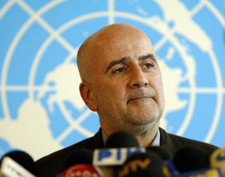
Meet IPSI's Faculty:
Álvaro de Soto, who successfully mediated the Central American Peace Process and served as Special Coordinator for the Middle East Peace Process, will lend his extensive experience to a three-day negotiation training at the 2011 Bologna Symposium >>
See the full list of invited faculty >>
___________________
|
|
IPSI Symposiums

Read about a typical day at the 2011 Bologna Symposium >>
___________________
|
IPSI Leadership
Cameron M. Chisholm Dr. I. William Zartman
Dr. P. Terrence Hopmann
Alexander Little
Nadim Salti
Pamela Aall
Ahmedou Ould-Abdallah
Betty Bigombe
Jan Eliasson
Gareth Evans
Dr. Ted Robert Gurr
Amb. Jacques Paul Klein
Peter Kyle
Dr. Jean Paul Lederach
Jeffrey Mapendere
John Marks
Susan Collin Marks
Dr. Joyce Neu Dr. Valerie Rosoux
William Stuebner
Dr. Ruth Wedgwood Dr. Craig Zelizer About Us >> ___________________ |
|