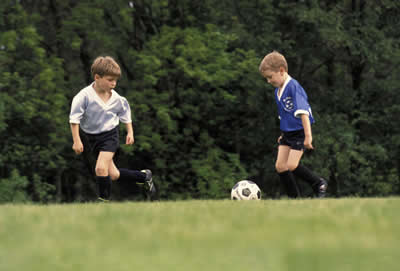
Because soccer is a very inclusive game, youth soccer teams differ
greatly in terms of ability and experience. Uneven match-ups will
result on occasion (especially in tournaments), so you are likely to be
involved in at least a few games each season where one team is far
better than the other. At more advanced levels of the game, an
occasional blowout will certainly be an unwelcome affront, but players
generally have the maturity to learn a few lessons from the outcome and
move on. When this happens in youth soccer, though, it is in the
interest of all participants to level the competition in some way so
that each player continues to experience a game that better matches the
challenges of the game with each player's ability level.
To understand why this is the case, consider the premise that every
game represents an opportunity for players to learn something. However,
uneven matches may teach our players lessons we would prefer they
avoid! For example, we want our players to approach each game with
respect toward their opponent, and to never assume that a win is
assured simply by "showing up". We also want our players to perform at
their best in every practice and every game, so that we reinforce
proper habits and work rate.
Unfortunately, when players discover they can give less than their
best effort and still win, most will do just that. Conversely, when
players perceive that even their best effort will have no positive
bearing on the outcome of the match, they also tend to give
half-hearted performances. Either way, every player involved in a match
like this will have reinforced the wrong attitudes and habits required
to develop as a player, and few will take any joy away from the
experience.
How should teams and leagues deal with situations like these? One
common approach, often called the "mercy rule" or "knock-out rule",
dictates that a game will end if one team obtains a certain margin of
victory (7 goals, 10 goals, etc.) at any point in the game. On paper,
this policy appears to minimize the embarrassment suffered by the
losing team, but the reality is that the players involved are
effectively told "you aren't even worth playing for a full match"!
Further, this rule does nothing to create a more appropriate playing
environment during the minutes that were played, and it reduces playing
time for all players (especially for substitutes, who may not play any
minutes if the last few goals are scored in quick succession).
Another common suggestion is to simply tell your players to reduce
their efforts at scoring more goals. Though this line of thought may be
well-intentioned, instructions like "don't score any more" or "don't
try so hard" send the wrong message and don't aid the development of
any player. Telling your players to ignore obvious goal-scoring
opportunities is arguably more disrespectful of the opponent than
"running up the score", and will only lead to disillusioned players on
both sides of the scoreline.
Instead, it is better to increase the difficulty for a dominant
player or team to score additional goals by making a few modifications
to the playing environment. If the win has been ensured, then the
following adjustments can allow you to actually increase your demands
on your players while also granting a more realistic challenge to the
opposing team...
Reduce numbers. The first, and easiest,
adjustment you can make is to take a player off the field, and then
play down a player (or two, if necessary). This change will require
your players who remain on the field to work harder to compensate for
the missing teammate, and it also increases the time and space
available to the trailing team. In addition, this is a great way for
your players to practice playing in a numbers-down situation, which
often occurs at older age groups (due to injuries, absences, or player
ejections).
Impose touch restrictions. In youth soccer, we often see
goals scored simply as a result of the "bigger, faster athlete"
dribbling the length of the field and scoring on his or her own. If the
other team isn't able to present a suitable defense against such a
player, you can impose a two- or three-touch limit on this player (or
all your players) so that they have to rely on passing and movement off
the ball (instead of solo dribbling efforts) to score more goals.
Focus on possession. You can also require your players to
complete a minimum number of consecutive passes (without losing
possession) before they are permitted to score. Again, this will force
your players to do more passing and off-ball movement to succeed, and
will make scoring more difficult since your opponent will now have more
time for players to recover defensively. From the viewpoint of tactical
development, a possession-based restriction also teaches your players
how to score using a "build-up" attack, as opposed to simply relying on
quick counterattacks to score.
Emphasize defensive responsibilities. Once you have the
outcome of the match essentially secured, you should re-assert your
expectations regarding your team's defensive effort. For example, you
can set a goal to "preserve the shutout" or to "not allow any more
goals" by your opponent. Since players tend to relax (or become
outright lazy) on defense when they have a comfortable lead, these
types of goals can be timely reminders of the habits you desire from
your team.
Limit your scoring methods. Finally, you might consider
specifying a particular (and challenging) method of scoring for
additional goals. If you require players to score from either a volley
or a header, then you also force players to practice attacking from the
wings and delivering crosses in the air. You can require players to
score shots from outside the penalty area, which encourages them to
practice their long-range finishing. Since you don't have to play to
your strengths to ensure victory in this match, this is an ideal time
to work on any areas of weakness that affect your team.
The key to success in these situations will always be found by
looking at the problem from the perspective of player development.
There is no single "right" answer to this problem, but applying
guidelines like the ones above can help you turn a disappointing
match-up into a valuable learning opportunity for everyone involved.