Asia Business Center Newsletter
|
|
Haas School of Business, U.C. Berkeley
Tel: 510.643.6883
Fax: 510.643.6880
|
January 2010
|
|
|
|
Greetings!,
The Spring semester has started here at U.C. Berkeley and there is a lot to look forward to in 2010!
We're planning the 2010 Asia Business Center Conference in Shanghai for October 19, 2010. Please save the date! The topic will be "Leading Through Innovation in Asia" and will feature Prof. Michael Katz, and 2009 Nobel Prize Winner in Economics and Haas Professor Emeritus, Dr. Oliver Williamson, among others. We are all looking forward to this wonderful event and are working on the logistics and sponsorships.
In other news, we're proud to announce that we signed an MOU (memorandum of understanding) with the Chinese University of Hong Kong. The Chinese University students will study at Haas-Berkeley from June 21-25, 2010.
Fifty students from Nanyang Technical University in Singapore will be on the Haas campus from March 1-March 12. This is the largest group of managers in the history of the Haas-NTU program! Also, Prof. Andy Rose just returned from Shanghai where he taught a class to EMBA students at SUFE about international finance and economics in December '09.
Lastly, I urge all of you to join our ABC page on Facebook - we will make sure to keep it current, so you'll be up-to-date with all the Center's news. It is our way to reach out and interact with all of you!
Please check out all the great content in this rich newsletter below.
Sincerely,
Teck Ho
Director, Asia Business Center
|
|
Save the Date!
 The 2010 Asia Business Center Conference is scheduled for Tuesday, October 19, 2010 at the Peninsula Hotel Shanghai on the Bund in Shaghai, China. The topic will be "Leading Through Innovation in Asia" and confirmed participants thus far from Haas include: Dean Lyons and Professors Teck-Hua Ho, Michael Katz, and Oliver Williamson, 2009 Nobel Prize Winner in Economics. More information will be forthcoming - please keep checking back to our conference page.
|
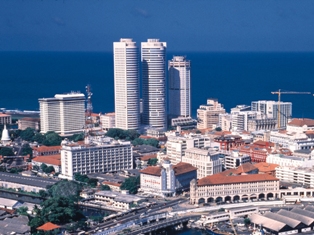 Sri Lanka's Resurgent Economy* Sri Lanka's Resurgent Economy*
By Anosha Subasinghe, BS '91
Sri Lanka
is usually in the news for its ethnic conflict and the
tsunami of 2004. But today Sri Lanka is
making news in the financial sector for a different reason, the expected
resurgence of a battered economy. Sri Lanka
is located at the tip of the Indian Ocean, an
island home to about 20 million people living in an area of 65,000 square kilometers. Its
main industries are garments (the main buyer being U.S.A), tea, coconut,
rubber, tourism, etc. But today, foreign investors are mainly watching the
country's stock exchange which seems to be doing exceptionally well amidst the
global downturn.
Just to give you the latest update, the Sri Lankan stock
market capitalization climbed to a record on September 17, 2009,
making Sri Lanka's benchmark
index the best performer in Asia for 2009. The
Colombo All Share Index gained 96 percent this year as the army declared
victory after 30 years over the rebel outfit, the Liberation Tamil Tigers of
Eelam (LTTE), the most ruthless rebel army in the world, who perfected the art
of suicide bombing.
At this juncture, the jubilant mood of
the true patriots who lived here through thick and thin while suicide bombers were
on a continuous rampage assassinating innocent civilians and top politicians for
over 30 years, can be felt. At last peace dawned on this island in June 2009. So now,
the country can concentrate on developing its economy rather than spending money on a
war which has severely affected its coffers in the last decades. It is no small
miracle that Sri Lanka
has weathered a ruthless war, a catastrophic tsunami, and a devastating global
recession. Now Sri Lanka
is quite optimistic of recovering its lost pride in the near future.
The stock market index I mentioned earlier is only one of
the indicators of a country going forward. The IMF recently granted an approval
for a loan of USD 2.6 billion to the Central Bank further boosting Sri Lankan
morale at its time of need. The Board of Investment in Sri Lanka has stated
that foreign investments are flowing into the country boosting the optimism of
the recent victorious mood. On July 31st, the Governor of Central
bank stated that the Central Bank plans to raise another $500 million from
overseas investors to help rebuild the nation.
However, the turnaround will not happen overnight. The country,
especially after a war, has side effects to mitigate. Some economic
indicators that hamper progress are high interest rates, volatile inflation
rates and the never-ending red tape of bureaucracy. Moreover, the enormous budget
deficits and the drastic decrease in foreign reserves are still
sore points among analysts. If enhanced economic growth is the vision, then these encumberances must be dealt with proper planning and
implementation.
Government spending into key areas
such as infrastructure and agriculture has been promised to flow, further enhancing the economy. The government
is also starting to revive its tourism sector which had suffered immensely during
the last three decades. Sri
Lanka is home to sandy beaches, lush tea
plantations, magnificent ancient cities, lush forests and diverse safari
parks. International travel magazines rate some of the luxury boutique hotels
as some of the best in the world. The government
declared September 27, 2009 - October 3, 2009 as 'Tourism Week' in order to further enhance the tourism sector. It recently allocated 700 million Sri
Lankan Rupees on worldwide advertising to boost the Sri Lankan
image abroad. A captivating global advertising clip adeptly named, "Small
Miracle," is being aired all over the world. The Sri Lanka Tourism Promotion Bureau
hopes to increase the number of tourists by at least 20% as a result of all
these efforts.
These positive indicators only show a promising future for
the whole country. Traditionally economic progress has been most evident in the western province, Colombo,
where the commercial capital is located. Fortunately, the latest statistics show that
disparity among the provinces is reducing - currently the North and East provinces
which were ravaged by war are gaining vast amounts of foreign funding to
spearhead rural economic growth. Once these focused economic drives
trickle down to the rural provinces, the whole of Sri Lanka should reap the benefits. So
watch out for this island with its small economy bouncing back soon and making
an indelible mark in the South Asian economic foray in the future.
* written September 2009. In December '09, news reports stated that the Sri Lankan stock exchange was one of the
2009 best performing stock markets in the world.
|
 ABC in the News ABC in the News
Dean Lyons is the feature story on the Dec. 25, 2009 issue of iMoney Magazine, a member of Hong Kong Economic Times Limited. Dean Lyons discusses his thoughts on high-risk
investments and is described as a former advisor to Goldman Sachs and
Dean of the UC Berkeley Haas School of Business, an academic expert in global
economics ( article PDF). Dean Lyons is also interviewed for a Business Week article
on what business schools are doing in Asia, 11/2/2009. The story link is here.
|
 The Asia Business Center on Facebook! The Asia Business Center on Facebook!
The Asia Business Center is now on Facebook. To keep abreast of all of our current happenings, please become a fan here.
|
Upcoming Events
Wednesday,
January 27,
2010 - Campo
Santo Open Process Performative Lectures: Playwriting in process with a
theater company and their community, with playwright Naomi Iizuka
Wednesday,
January 27,
2010 - Spectacle and Sacrifice: The Ritual Foundations of Village Life in North China
Thursday,
January 28,
2010 - Slumdogs vs. Millionaires with Hernando DeSoto
Thursday,
January 28,
2010 - Berkeley Entrepreneurs Forum: Angel Investors: Alternative Financing?
Friday,
January 29,
2010 - China's First Panda Reserve: A Person, a People, and a National Cause Tuesday,
February 9,
2010 - 1903: Racism, Revenge, and Ressentiment
Wednesday,
February 10,
2010 - The Cleanest Race
Thursday,
February 11,
2010 - The Gupta Connection: The Buddha Image in India, Sri Lanka, Southeast Asia, and China
Friday,
February 19,
2010 - Relocating Ozu: The Question of an Asian Cinematic Vernacular
Saturday,
February 20,
2010 - Relocating Ozu: The Question of an Asian Cinematic Vernacular
Monday,
February 22,
2010 - UC Berkeley Cleantech Institute: Haas School of Business
Wednesday,
February 24,
2010 - 'Hell in a Very Small Place': Cold War and Decolonization in the Assault on the Vietnamese Body at Dien Bien Phu (1950-54)
Friday,
February 26,
2010 - Popular Accountability and Regime Resilience in Reform-Era China
see ABC calendar for more info.
|
|
|
|
|


