Join us on
|

|
Join us on
|
|
|
|
In honor of our return to Standard Time we are offering an extra hour of sailing to this Saturday's full or half day charters, for FREE!  You won't want to miss out on this opportunity. Don't forget to set your clocks back an hour on Saturday night. You won't want to miss out on this opportunity. Don't forget to set your clocks back an hour on Saturday night.
Happy Halloween! We hope that you get to scare up some frightfully good sailing stories! Your learning experiences, trips, and adventures act as inspiration for other sailors. Remember to send in your stories and photos to share.
|
Winter Rates Begin on Sunday!
|
|

There are even more reasons to charter this weekend - the dollars you'll save when winter rates go into effect on Sunday, November 1st! Enjoy the savings!
Sailboats:
|
Today's Tip
|
|
 Now that the days are getting shorter and the clocks are being set back to Standard Time, remember that you need to have Bareboat or higher certification to sail after dark. If you only have Basic Cruising certification or you just don't feel like being a nighttime navigator, you can still have an enjoyable evening aboard by dining at the docks or overnighting on the hook or on a mooring. This is a great chance to snuggle up with someone special or to just enjoy a good book! Now that the days are getting shorter and the clocks are being set back to Standard Time, remember that you need to have Bareboat or higher certification to sail after dark. If you only have Basic Cruising certification or you just don't feel like being a nighttime navigator, you can still have an enjoyable evening aboard by dining at the docks or overnighting on the hook or on a mooring. This is a great chance to snuggle up with someone special or to just enjoy a good book!

|
Nautical Noggin-Boggler WINNER!
|
|
We selected our winner randomly from the correct answers submitted. Don't miss your chance to dazzle us with your knowledge and win a prize!
Congratulations to last week's winner: MIKE JOHNSON
 
Winner of: Maritime Institute "Mariner's Guide to Rules of the Road" Navigational Study Aid
You are a sailing
vessel under sail in a narrow channel and you are approaching a fishing
vessel in operation. Who is the "stand-on" vessel in this situation?
ANSWER:
The stand-on vessel is the sailing vessel.
The key words in the question are NARROW CHANNEL. This tells you that the situation is governed by RULE 9: Narrow Channels.
USCG RULE 9
Narrow Channels
(a) A vessel proceeding
along the course of a narrow channel or fairway shall keep as near
to the outer limit of the channel or fairway which lies on her starboard
side as is safe and practicable.
(b) A vessel of less than 20 meters
in length
or a sailing
vessel shall not impede the passage of a vessel which can safely
navigate only within a narrow channel or fairway.
(c) A vessel engaged
in fishing shall not impede the passage of any other vessel
navigating within a narrow channel or fairway.
|
Nautical Noggin-Boggler Further Discussion
Explaining Meteorological Visibility
|
|
Based on some of the responses that we received to our October 13, 2009 Noggin-Boggler, we feel that a more thorough discussion of Meteorological Visibility is in order. Several people thought that since the Meteorological Visibility was given as 10 Nautical Miles, that was as far as any object could be seen. In fact, it is possible to see an object at a greater distance than the Meteorological Visibility if the object is illuminated! Here is why...
Meteorological Visibility is defined as:
a) the greatest distance at which a black object of suitable dimensions, situated near the ground, can be seen and recognized when observed against a bright background;
b) the greatest distance at which lights of 1,000 candelas can be seen and identified against an unlit background.
In the Noggin-Boggler the Meteorological Visibility was given as 10 Nautical Miles. But since the light was 10 Million Candlepower (candelas), it was 10,000 times brighter than the light used to establish the visibility in definition (b) above. A 10,000,000 Candlepower light has a 32 Nautical Mile Luminous Range in 10 Nautical Miles of Meteorological Visibility (see figure below), so in this case, the Geographic Visibility of 15.4 nm is the limiting factor.
To explain this by example, imagine fog that is so thick that you can just discern a car when it is one block away. The visibility is one block. But now the driver turns on the car's headlights and you can see the lights (but not the car) when the car is two blocks from you. This is an example of how a light's Luminous Range can exceed the Meteorological Visibility, and is the reason why we turn on our headlights and our navigation lights in the fog. Estimating a light's Luminous Range and Geographic Range is useful in navigation when working with lighthouses and lighted beacons.

|
Last Hump Night Sail!
|
|
 Wednesday, October 28th Wednesday, October 28th
5pm - 10pm
Alameda
Last Hump Night of the season. Don't miss out!
Members, come on down, jump on a boat, and go for an enjoyable
evening sail. When you get back to the dock the BBQ will be hot
and the drinks will be cold!
We look forward to getting you out on the water.
Members & their Guests ONLY: $30
|
Beer Can Races - Last Race of the Year!
|
|
 Every Other Friday Every Other Friday
April 3rd - October 30th
5pm - 9pm
Alameda
Ballena Bay YC Spring Sunset Series
(aka Beer Can Races)
Open to non-members!
Last Race: Friday, October 30th
Join us for fun, competitive sailing aboard a Colgate 26 as we take part in the Ballena Bay YC beer can races. Afterwards slide up to the yacht club bar to relive each exciting minute and critique yourselves (and the other racers!) in a tack-by-tack race analysis from our onboard Club Nautique Tactician-du-jour.
Meet at CN Alameda at 5 pm to prep the boat, review sailing instructions and conditions, then get out to the starting line for the race.
No prior race experience required.
Must be Basic Cruising certified.
Reservations required. Call to confirm dates.
NOTE: David Hayward has thrown down the gauntlet. He's challenging any other Colgate to try and beat him and his team. Get ready for some good match racing!
Members: $35/Non-Members: $47
|
Winter Wednesday Seminar Series
|
|
Every Other Wednesday
November - March
6pm - 8pm
Alameda
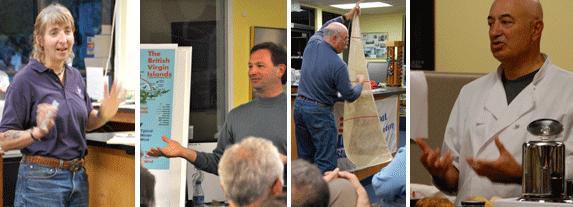
November 4 - Cruising Central America
Presented by Joe Brandt, Club Nautique instructor. Joe, his wife, Jacque, and their two cats, spent seven years cruising aboard their Wauquiez 47, Marna Lynn. Four of those years were spent in Central America. Don't miss this information-packed presentation composed of photos, charts, marinas and places of interest, both on the water and further inland.
November 18 - Cooking On Board
Presented by Lynn Orloff Jones, cooking teacher and author of Can-to-Pan Cookery. Lynn's book is geared towards boaters and outdoorsmen who need to provide yummy, healthy, warm meals with limited storage and cooking space.
Menu fee of $15/person
Please call to book your seat today.
Everyone Welcome: FREE*!
* Some seminars may have a small fee for materials or to pay outside speakers.
|
Bareboat Prep Charter Share
|
|
 Have you finished Basic Cruising? Get ready for your Bareboat class and build your skills. Join other Basic Cruising certified students and follow the guidelines that we set for you to practice specific maneuvers to prepare you for your Bareboat certification. Have you finished Basic Cruising? Get ready for your Bareboat class and build your skills. Join other Basic Cruising certified students and follow the guidelines that we set for you to practice specific maneuvers to prepare you for your Bareboat certification.
Session topics: Sailing, Motoring, Crew Overboard & Anchoring. Attend all four sessions and skipper one of the sessions and you'll receive four credits towards your experience requirement for Bareboat class.
 Upcoming Sessions: Upcoming Sessions:
Saturday, October 31st
9am - 1pm - Motoring - Sausalito
2pm - 6pm - Sailing - Sausalito
Saturday, November 7th
9am - 1pm - Anchoring - Sausalito
2pm - 6pm - Crew Overboard - Sausalito
Members: $75*/Non-Members: $115*
*Take both morning and afternoon sessions and get an additional $10 off!
|
Radar Clinic
|
|
 Saturday, November 15th Saturday, November 15th
9am - 5pm
Alameda
2 Seats Open!
Learn about the different types of Radars, their settings, and how to use this powerful tool for navigation and collision avoidance. This course will also introduce you to the use of GPS. Together you will learn to use these tools to steer yourself safely out of the fog.
Ultimate Members: FREE
Members: $282/Non-Members: $375
|
Big Boat Motoring Clinic
|
|
 Saturday, November 15th Saturday, November 15th
9am - 5pm
Alameda
2 Seats Open
For Bareboat certified skippers and above (or equivalent qualifications). Taught onboard one of our larger sailboats. Learn to use all the factors such as prop walk, current and wind, that can make or break a successful docking. Take this clinic to get the skills you need to feel confident motoring in any situation.
Ultimate Members: FREE
Members: $244/Non-Members: $325 |
Coast Guard Licensing Course
|
|
GET YOUR COAST GUARD LICENSE!
GET PAID TO GO SAILING!


December 7th -18th
Alameda
Club Nautique will be hosting a Coast Guard License Course, presented by Maritime Institute at our Alameda facility. Maritime Institute is one of the top licensing schools in the country.
The course will be taught by Club Nautique instructor, Arnstein Mustad. Captain Mustad holds a 100-ton Near Coastal USCG Masters license, Yachtmaster
Ocean certificate, STCW-95 endorsement and is a US SAILING certified
instructor through Coastal Passage Making.
Club Nautique Members who enroll in this course will receive $100 in Club Nautique "Boating Bucks" usable towards a future charter.
|
Nautical Noggin-Boggler
|
|
Reply to this email with your answer to the following nautical Noggin-Boggler. There is no need to change the subject line. Club Nautique will randomly select a winner from all correct responses received by end of business on Monday, November 2nd.
QUESTION:
From the Daily Updates of Solstice, October 20, 2002
Folks thinking about going cruising might be interested in how time is kept during a longer ocean passage. Onboard Solstice we have two official clocks. One keeps the ship's time, which we leave set to the time zone of our last port of departure - regardless of any time zones we might cross. This simplifies our watch-keeping schedule and maintains continuity in our log entries. Our ship's time is currently set to Tahiti time. The other clock is set to UTC, which is an abbreviation for Coordinated Universal Time - also known as Greenwich Mean Time or Zulu Time. We use this clock primarily for keeping radio schedules, which are at fixed times regardless of our current time zone.
As we sail west, we cross into a new time zone for every 15° of longitude. The time zone that we are currently using for our ship's time is UTC minus 10 hours. When we get to Niue, which is at almost 170° W, we will change that to UTC minus 11 hours. The International Date Line is nominally at 180°, but makes some jogs to the east to incorporate Kiribati, Tonga and parts of New Zealand. While it's Thursday here, it's already Friday on the other side of that line.
Russell Radio is a good source of weather information for the trip to New Zealand. Russell Radio comes up every day at 0800 New Zealand time. In New Zealand they have Daylight Saving Time just like the United States. Like us, they 'spring forward' and 'fall back', except that they are 'springing' while we are 'falling'. That happens on Sunday, which is really Saturday, with their time at UTC plus 12 hours - which then becomes UTC plus 13 hours. So what time do I tune up my radio on Saturday to get Russell Radio?
Answer to be given in Niue local time
This week's prize:
an MFJ 12/24 Dual Time Digital Clock
|
Coastal Passage Making Corner
|
|
Coastal Cruising Adventure
Onboard Anne's Turn
The crew was treated right. Gourmet cook, Chuck prepared all the meals.

Christine enjoying spinnaker sailing.

Anne's Turn off of Yellow Bluff, Santa Cruz Island.

The crew enjoying a scrumptious feast at Steve's Steakhouse.

Spotted - three very large whales - possibly blue whales!

Avalon in the sunshine.

Avalon at dusk.

Jim's secret weapon.

Pulling in to San Diego.

Jim and his cruising buddy, Todd Eversole.

|
Caught on Camera
|
|
The Great Pumpkin Regatta - Richmond Yacht Club
The Richmond Yacht Club puts on one of the best parties of the year. With races on Saturday and Sunday and a costume party on Saturday night. This year the theme was Gilligan's Island.
Pip raced with his friend and they took three bullets in the U20 fleet! Congratulations Pip!

Paul channels his inner Thurston, which as we came to find out, isn't very far from the surface.

Gilligan, the Skipper and the Professor were there.

Mr. and Mrs. Howell of the San Francisco Howells made an appearance.

Sunday, the start committee boat gets swamped with people looking to get their trivia questions.

Starters were serenaded by a calypso band.

It was a beautiful day!

|
|
|


